
AI-CRM scalability is about handling growth: more data, users, and automation without losing performance. Scalable systems ensure faster response times, higher win rates, and smoother workflows, making them critical for growing businesses. Key features include real-time data integration, advanced automation, and flexible tools to manage costs and improve efficiency. Challenges like fragmented data, tool integration, and rising costs can be tackled with dynamic scaling, unified data hubs, and bi-directional synchronization. To scale effectively:
Scaling AI-CRM isn’t just about technology - it’s about creating systems that grow with your business while delivering faster, smarter, and more efficient results.
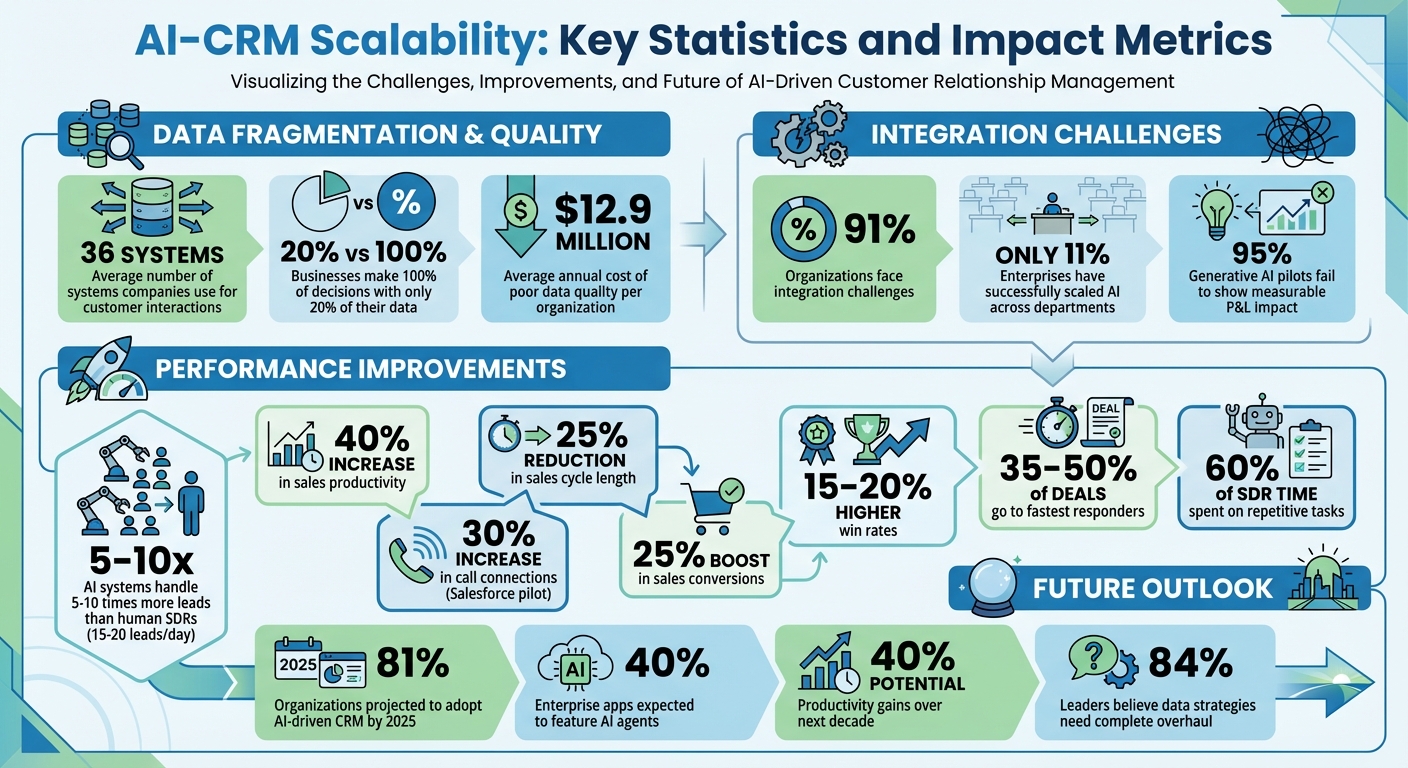
AI-CRM Scalability: Key Statistics and Impact Metrics
Scaling an AI-CRM system often magnifies the problem of fragmented data. On average, companies juggle 36 different systems to handle customer interactions. This setup can leave your AI working with an incomplete picture, creating data silos that limit its effectiveness.
"Most businesses are making 100% of their decisions with only 20% of the data - the rest is scattered across systems, trapped in conversations, or just plain bad."
– Vadim Volnitskyi, CRM Expert
The financial impact of poor data quality is staggering, costing organizations an average of $12.9 million annually. As your database grows to include millions of records, the technical demands increase. Proper indexing and asynchronous processing become critical to avoid delays during bulk imports or while generating reports. Without these measures, your AI may falter under heavy workloads.
And that’s just the data issue - integrating various tools brings its own set of hurdles.
Getting your AI-CRM to work seamlessly with other systems is no small feat. A whopping 91% of organizations report facing integration challenges. To scale effectively, you need bi-directional, real-time data integration. Static integrations that sync only once a day can result in missed opportunities, especially with high-intent leads.
| Challenge | Technical Impact | Recommended Solution |
|---|---|---|
| Data Silos | Fragmented customer view; AI inaccuracies | Unified Data Hubs / Data Cloud |
| Sync Latency | Missed leads | Real-time Bi-directional Sync |
| Shadow IT | Security risks; inconsistent data | Centralized AI Governance |
As integration issues pile up, ensuring smooth operations becomes increasingly expensive.
Scaling AI-CRM systems without a clear resource management strategy can burn through your budget quickly. Only 11% of enterprises have managed to scale AI across departments, and 95% of generative AI pilots fail to show any measurable impact on profit and loss statements.
One common pitfall is over-provisioning infrastructure, which leads to wasted resources during off-peak hours. A smarter approach is dynamic scaling, where automated resource management adjusts infrastructure to match real-time demand. This method can save companies significant costs compared to building in-house solutions, which can cost upwards of $2 million over just 6–12 months. Additionally, implementing tagging systems to monitor project expenses can help control budgets without sacrificing performance.
Tackling these challenges head-on with tailored solutions is crucial for building scalable AI-CRM systems that deliver real results.
Scalable AI-CRM systems are built with features designed to tackle the challenges of growth head-on.
One key difference between a scalable AI-CRM and one that struggles under growth pressure is its ability to handle capacity. While human sales development representatives (SDRs) typically manage 15–20 lead qualifications daily due to time spent on research and administrative tasks, AI systems can handle 5–10 times more leads without requiring additional resources.
Unlimited parallel calls eliminate interaction bottlenecks, ensuring every lead gets immediate attention. This capability allows businesses to handle thousands of personalized calls and manage multi-channel responses simultaneously - ideal for scaling operations during periods of rapid growth.
Multi-channel support ensures prospects receive 24/7 responses, keeping deals from going cold. Intelligent follow-up texts during calls can also save agency operators 8–12 hours per week by automating manual data entry.
"It's like having a dedicated agent who never misses a beat... drastically improving our sales conversion"
– Ava Thompson, Dealership Manager
Platforms like My AI Front Desk (https://myaifrontdesk.com) demonstrate these capabilities, ensuring no lead is left unattended.
This level of capacity paves the way for seamless automation and deeper workflow integration.
Automation takes over repetitive tasks that often consume up to 60% of an SDR's time, such as lead qualification, data entry, and follow-ups. But true scalability requires more than just automating tasks - it hinges on real-time data synchronization at the data layer. This ensures the AI has access to complete customer histories across all interactions.
The industry is moving toward "agentic AI" - systems that not only suggest actions but also execute them independently. These systems can handle tasks like reading emails, updating records, and scheduling meetings without human intervention. For demanding operations, such as bulk data imports or generating large reports, scalable systems use asynchronous processing with background job queues to keep user interfaces running smoothly.
Integration tools like Zapier, which connects with over 9,000 apps, and API workflows enable seamless action chaining across platforms. For example, when an opportunity is marked as "Closed-Won", the system can automatically create a project in a management tool and send a Slack notification. Companies that achieve this level of integration often see a 40% boost in sales productivity and a 25% reduction in sales cycle length.
While automation is a cornerstone, flexible features are equally critical for addressing diverse business needs.
To support sustainable growth, an AI-CRM must be flexible enough to meet the unique requirements of various businesses. It should cater to different customer segments, time zones, and communication preferences. Features like adjustable call durations, multi-language support, and customizable pronunciation guides ensure businesses can meet these needs without investing in separate solutions.
Other advanced features, such as a voice library with over 100 premium options to match a brand's tone, active times control for setting business hours across regions, and intake form workflows to collect tailored caller information, further enhance scalability.
Feature gating allows businesses to control access on a per-client or department basis. This makes it easy to create service tiers with simple toggles, avoiding the need to rebuild the entire tech stack.
"AI agents are not add-ons. They represent the next layer of intelligence in CRMs"
– Ali Farhat, Founder of Scalevise
Scaling an AI-CRM system takes careful planning and a structured approach to ensure smooth growth.
Start by auditing your existing system. Take stock of your tech stack and data flows to pinpoint any weak spots that could slow down growth.
Focus on data quality and consistency - clean and standardized data is essential for scaling successfully. Analyze response times and lead qualification capacity to uncover bottlenecks that might be costing you anywhere from 35% to 50% of potential deals.
It’s also important to map out user workflows for different roles. For example, enterprise account executives likely have different needs compared to SMB support reps. By understanding these workflows, you can ensure that scaling won’t result in a system that feels overly complicated or counterintuitive.
Finally, set clear growth targets to guide your scaling efforts.
Once you’ve assessed your system, establish measurable goals that align with your business objectives. For example, if your current system handles 15–20 leads per day, aim to significantly increase that capacity - perhaps to 100+ leads daily. You could also focus on shortening your sales cycle by 25% or boosting productivity by up to 40% through automation.
Prioritize features that directly impact revenue, efficiency, or user satisfaction. For instance, if faster response times are critical, you might focus on adding capabilities like unlimited parallel calls or post-call webhooks. Features like advanced analytics might take a backseat if they’re less urgent.
Consider this: Salesforce once implemented an AI-powered sales dialer in a six-month pilot program, which resulted in a 30% increase in call connections and a 25% boost in sales conversions. Use similar benchmarks to set actionable targets for your team.
With your goals in place, focus on adding scalable features to meet your needs. Start by integrating at the data layer to eliminate silos and ensure every customer’s history is fully accessible. An API-first approach can be particularly helpful - platforms like My AI Front Desk (https://myaifrontdesk.com) offer Zapier integrations with over 9,000 apps, along with post-call webhooks that keep data flowing smoothly across your entire system.
Bidirectional synchronization is another must-have. This ensures that updates in one system are instantly reflected across all others. For example, when a deal closes, your AI-CRM should automatically create a project in your management tool and send a Slack notification - removing the need for manual updates.
When rolling out new features, take it step by step. Use a phased approach: pilot the feature, refine it based on feedback, and then expand its use. This Discovery → MVP → Pilot → Full Launch process helps you manage changes effectively while catching integration issues early. For tasks that demand heavy resources - like bulk data imports or large report generation - use asynchronous processing with background job queues to keep your system responsive as your data volume grows.
Scaling your AI-CRM is just the first step - keeping it efficient and aligned with your growing business requires ongoing effort and smart strategies.
Once your AI-CRM system is up and running, monitoring its performance is essential to ensure it stays on track. Regular reviews - monthly for system health, quarterly for optimizations, and annually for strategic adjustments - can help you stay ahead of potential issues and refine workflows where needed.
Focus on tracking key technical metrics through your analytics dashboard, such as sync success rate, average sync latency, and API error rates. These metrics can alert you to problems early. For example, if you notice sync latency creeping above your baseline, it might signal an issue that could disrupt your team's ability to respond promptly to leads. Addressing these signs early prevents minor glitches from snowballing into larger problems.
Don't overlook data quality. Conduct weekly audits to ensure your data remains accurate and actionable. Poor data quality can cost businesses an average of $12.9 million annually, making this a critical step in maintaining system reliability.
AI-CRM systems do more than just store data - they actively enhance performance. Explainable AI provides clarity behind system recommendations, such as why a deal should move to a specific stage or why one lead is prioritized over another. This transparency not only builds trust but also uncovers patterns that might otherwise go unnoticed.
Incorporate human-in-the-loop workflows to balance automation with oversight. Here, AI suggests actions that require a simple human approval click. This setup helps you avoid costly errors while still reaping the efficiency of automation.
Companies that integrate agentic AI into their operations could see productivity gains of up to 40% over the next decade. To achieve this, establish continuous learning feedback loops, where AI refines its processes based on past successes. Over time, this enables smarter messaging, better lead qualification, and more streamlined workflows.
Armed with these insights, your business can position itself for scalable growth.
Once your AI-CRM system is delivering results, it’s time to think ahead. The transition from "assistive" to "agentic" AI is reshaping how businesses scale. In fact, 40% of enterprise apps are expected to feature task-specific AI agents. Ensuring your system can evolve with these advancements is crucial.
Choose platforms with no-code or low-code capabilities and unified data architecture. These features allow you to adapt quickly and avoid the pitfalls of data silos. For instance, platforms like My AI Front Desk (https://myaifrontdesk.com) provide the flexibility to adjust system responses as your needs evolve.
A unified data architecture is particularly important. Systems that integrate both structured and unstructured data - spanning phone calls, emails, chat, and social media - give your AI the comprehensive context it needs to scale effectively. By eliminating data silos, you ensure your AI operates seamlessly, even as interaction volumes grow. This foundation is essential for long-term scalability and success.
Scaling your AI-CRM system isn’t just a technical upgrade - it’s a long-term commitment that can define your business's success. Companies that thrive are those that create scalable systems, moving from basic assistive tools to advanced, autonomous AI capabilities. This shift is becoming increasingly critical, with 81% of organizations projected to adopt AI-driven CRM systems by 2025. The question is: how quickly can your business adapt?
The foundation of scalability lies in unified, high-quality data. To ensure this, you should audit your data regularly, implement role-based access controls, and establish strong governance frameworks to minimize security risks. It's worth noting that 84% of leaders believe their current data strategies need a complete overhaul to support AI implementation.
"A CRM built around a static deployment struggles to keep up, creating systems that fail to reflect how teams actually work." – Phil Spurgeon, CRM Strategist
This insight underscores the need for a more dynamic approach to CRM systems. Businesses that see measurable gains - like 15–20% higher win rates or 30% faster ramp-up times for sales reps - share some common practices. They design their systems to handle peak loads from the start, integrate human-in-the-loop workflows for critical decisions, and opt for flexible platforms that avoid restrictive pricing models. Speed is also a game-changer: companies that respond quickly secure 35–50% of deals.
To keep your AI-CRM aligned with your growth, focus on these priorities: build a strong data architecture, automate repetitive tasks, maintain human oversight for critical decisions, and track performance metrics consistently. With agentic AI projected to boost productivity by up to 40% over the next decade, now is the time to lay the groundwork for a scalable, future-proof system.
To keep data quality in check while scaling AI-CRM systems, businesses need to prioritize accuracy, consistency, and completeness. One way to do this is by setting clear data entry standards and using automation tools to cut down on human errors. Regular audits and validating data right at the entry point can also stop small issues from snowballing as the system grows.
AI-powered tools can play a big role here. They can handle tasks like deduplication, data enrichment, and real-time validation, which helps maintain clean and useful datasets. It's also important to assign specific people or teams to oversee data management, ensuring accountability. On top of that, a solid data governance framework - with measurable goals like achieving 95% accuracy - can keep everything on track. These steps help businesses ensure their AI-CRM systems stay dependable and efficient, even as they scale up.
A scalable AI-CRM should make it easy to connect with your current tools. Think CRMs, marketing platforms, and communication systems. Features like APIs, webhooks, and automation workflows play a big role here, ensuring data flows smoothly while cutting down on manual tasks.
Another must-have is AI-driven automation. This includes handling tasks like lead qualification, follow-ups, appointment scheduling, and managing communication across channels like phone, email, and messaging. With customizable workflows and advanced AI models (like GPT-4), interactions become faster and more accurate.
On top of that, prioritize features like advanced analytics, multi-language support, and flexible billing options. These tools allow businesses to track performance, explore new markets, and scale operations without overhauling their infrastructure. Add in customizable settings - such as business hours and user management - and the system can grow alongside your business while keeping things efficient and your customers happy.
Dynamic scaling in AI-CRM systems gives businesses the ability to adjust resource usage in real time, ensuring they only pay for the resources they actually need. This approach eliminates the waste caused by over-provisioning or maintaining unused capacity.
Take features like active times control and adjustable AI usage limits - these tools allow companies to handle peak and off-peak periods with precision. By automating tasks and scaling resources as demand fluctuates, businesses can keep costs in check without sacrificing efficiency or service quality. It’s a smart way to balance operational savings with the potential for growth.
Start your free trial for My AI Front Desk today, it takes minutes to setup!


