
Real-time AI call monitoring is transforming how businesses handle customer interactions. By analyzing 100% of calls as they happen, this technology helps businesses address issues immediately, improve service quality, and boost customer satisfaction. Here's what you need to know:
This technology not only improves customer experiences but also reduces operational costs and enhances agent training. Businesses adopting AI call monitoring often see a return on investment within months.
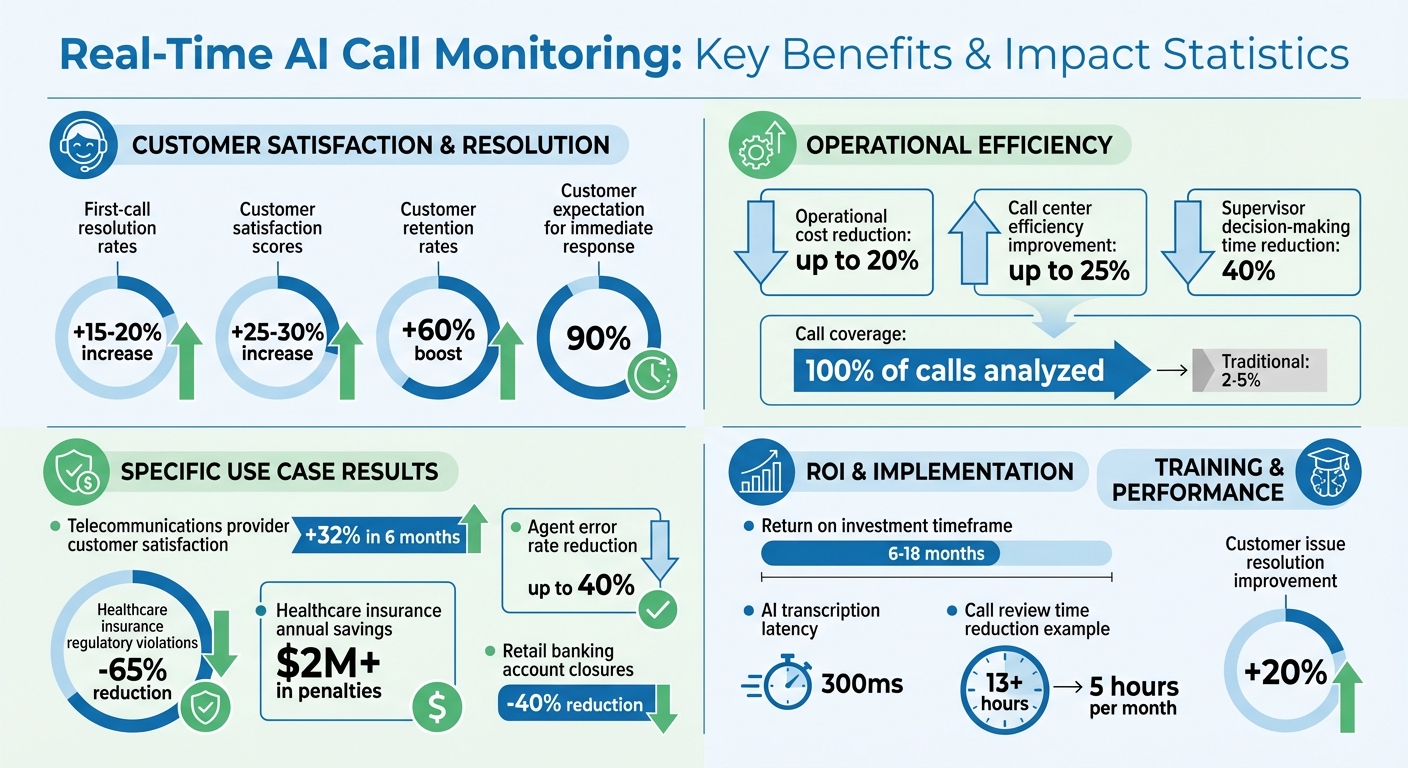
Real-Time AI Call Monitoring Benefits and Impact Statistics
Modern AI can transcribe live audio with just 300ms latency, providing stable and accurate transcripts for analysis. These transcripts form the backbone of real-time insights during calls.
Sentiment analysis takes things further by evaluating the emotional tone of conversations. It identifies emotions like stress, frustration, or satisfaction, helping supervisors spot calls that need immediate intervention. For example, a telecommunications provider that implemented this technology in 2025 saw a 32% boost in customer satisfaction scores within six months. The system flagged negative sentiments in real time, allowing managers to step in and resolve issues quickly.
"If there's one thing we heard loud and clear, it's that real-time capabilities are the next requirement. Whether live transcription, in-the-moment coaching, or agentic workflows, the shift is already underway." - Jason Tatum, VP of Product, CallRail
Dual-channel recording is another key feature, separating agent and customer audio streams. This improves both coaching efforts and compliance monitoring.
Building on transcription and sentiment analysis, keyword detection takes agent support to the next level.
Keyword detection flags critical phrases as they’re spoken. If a customer mentions something like "cancel my account" or "refund", the AI instantly pulls up the right scripts or resources for the agent. These systems don’t just rely on exact matches - they use machine learning to understand context, which makes the process much more accurate.
In 2025, a healthcare insurance company combined keyword detection with compliance tracking, cutting regulatory violations by 65% and saving over $2 million annually in penalties. The AI monitored for specific legal phrases and disclosures, alerting supervisors if something was missed.
"AI-powered speech recognition detects phrases like 'cancel my account' or 'I want a refund' and flags them instantly - so you can step in before the situation escalates." - Enreach
In sales, this technology can identify mentions of products, competitors, or promotions and prompt agents with the right talking points at the perfect moment. Companies using these systems have seen agent error rates drop by up to 40%.
These automated triggers also lay the foundation for predictive analytics, which takes call monitoring to a whole new level.
Predictive analytics shifts the focus from reacting to anticipating outcomes. Instead of just analyzing what’s being said, AI models can predict whether a call is likely to lead to a sale, resolution, or escalation - sometimes before the conversation even ends.
For example, AI can spot churn risks by evaluating sentiment changes and specific phrase patterns, flagging accounts that may need extra attention. A retail banking institution used this approach in 2025, reducing account closures by 40% through real-time identification of dissatisfied customers.
Predictive technology is also great at spotting trends. If there’s a sudden increase in calls about a service outage or product issue, the AI can immediately bring this to the team’s attention. Supervisors can then brief agents and ensure consistent messaging across all calls. In healthcare, predictive AI can detect urgent patient symptoms or behaviors, triggering workflows like notifying care teams or scheduling follow-ups.
By combining predictive analytics with speech-to-text, sentiment analysis, and keyword detection, businesses can create a seamless and proactive call monitoring system.
| Technology | Primary Function | Business Impact |
|---|---|---|
| Streaming Speech-to-Text | Real-time transcription (300ms latency) | Enables live coaching and immediate insights |
| Sentiment Analysis | Measures emotional tone and satisfaction | Detects escalations; improves customer experience |
| Keyword Detection | Identifies critical phrases and triggers workflows | Reduces agent errors by up to 40% |
| Predictive Analytics | Forecasts call outcomes and customer needs | Increases retention rates by 60% |
With advancements in speech-to-text, sentiment analysis, and predictive insights, small businesses are seeing real improvements in agent performance, customer satisfaction, and operational costs.
Real-time AI monitoring has transformed how agents are trained and supported. Instead of waiting days or weeks for feedback on recorded calls, agents now receive instant guidance while interacting with customers.
Supervisors can use whisper coaching - a feature that allows them to guide agents discreetly during calls without the customer noticing. For example, Joe Phelps from The Husband and Wife Law Firm reported a drastic reduction in call review time. AI monitoring cut the process from over 13 hours a month to just 5 hours by identifying key moments in calls within 1–2 minutes. This allowed managers to spend more time coaching rather than sifting through recordings:
"Before, we spent 13+ hours a month reviewing over 100 calls. Now, AI identifies key moments in 1-2 minutes, reducing review times to 5 hours so managers can coach more effectively." - Joe Phelps, Intake Director, The Husband and Wife Law Firm
At MedCare Equipment Company, IT Manager Zac Shannon noted a 20% improvement in resolving customer issues and closing deals after adopting AI-powered call monitoring.
This kind of support not only boosts agent confidence but also enhances customer interactions.
When agents are equipped with real-time support, they resolve problems faster and more effectively. First-call resolution rates improve by 15–20%, while customer satisfaction scores increase by 25–30% when issues are resolved during the first interaction.
AI-powered sentiment analysis is another game-changer. It flags frustrated callers as soon as their tone shifts, enabling supervisors to step in and de-escalate situations before they spiral. This proactive approach reduces the need for customers to repeat themselves or wait for callbacks. Companies with strong real-time monitoring programs report 60% higher customer retention rates compared to their competitors.
Speed is critical, too. 90% of customers say they expect immediate responses to their service inquiries. Real-time AI ensures agents have the information they need - whether it’s account history, suggested solutions, or connecting customers to the right team - without delay.
The result? Happier customers and fewer escalations, all while streamlining operations.
AI-driven quality assurance evaluates 100% of calls, replacing the traditional spot-checking method, which typically reviews only 2–5% of interactions. This ensures consistent, objective scoring across all conversations and eliminates the need for manual call reviews.
Real-time monitoring also slashes costs. It reduces operational expenses by up to 20% and boosts call center efficiency by as much as 25%, while cutting supervisor decision-making time by 40%. By addressing issues immediately, it minimizes repeat calls and improves overall efficiency.
These savings add up quickly. Many businesses recoup their investment in AI technology within 6 to 18 months thanks to reduced churn and streamlined operations.
AI can transform operations, but it comes with its fair share of hurdles. To make the most of it, businesses need to address legal, technical, and cultural challenges head-on. From ensuring compliance with data privacy laws to integrating tools with older systems and securing employee buy-in, a thoughtful approach is key.
Data privacy isn't just about ticking boxes; it's about meeting strict legal requirements. For instance, states like California, Florida, and Illinois demand explicit consent when third-party AI tools analyze calls. Generic disclosures won't cut it. Failing to notify participants can lead to hefty penalties, including $5,000 per call in statutory damages. For businesses handling large call volumes, this can quickly snowball into massive liabilities.
To navigate these risks, businesses need to:
As Protecto.ai highlights:
"Regulators have moved on from 'annual checklist' compliance. Today's standard is continuous assurance: show - at any moment - what data your AI used, where it came from, how it was protected, and why the model acted as it did."
The message is clear: compliance is no longer a one-time task. It’s an ongoing responsibility.
Integrating AI tools with older, on-premise systems can feel like trying to fit a square peg into a round hole. Many legacy systems lack modern APIs or webhooks, making real-time data synchronization a challenge. To overcome this, businesses should:
Starting small can ease the transition. Focus on high-impact areas like compliance monitoring or sales performance before scaling to all calls. Incorporating a human-in-the-loop process ensures that AI-flagged anomalies are double-checked, especially in sensitive situations. These steps help ensure AI tools work smoothly alongside existing systems.
Even the best technology can fall flat without frontline support. Agents need to see AI as a partner, not a watchdog. Position AI monitoring as a developmental tool that offers real-time guidance, like intelligent call whisper systems, rather than as a means of surveillance.
Here’s how to foster trust and collaboration:
When agents feel included and see AI as a tool for growth, adoption becomes much smoother. It’s not just about technology - it’s about building trust and showing how AI can make their jobs easier and more rewarding.
AI-powered call monitoring is evolving rapidly, promising systems that go beyond transcription and predictions. Picture tools that can interpret emotions, track customers across all communication channels, and even manage entire interactions without human involvement.
Next-gen algorithms aim to do more than just detect basic sentiments - they’ll identify subtle emotions like frustration or confusion by analyzing vocal cues. This advancement in affective computing allows AI to step in when conversations take a negative turn, alerting agents in real time.
For example, if a customer shows signs of stress during a billing dispute, the AI might immediately provide the agent with a "battle card" outlining steps to de-escalate the situation or even suggest bringing in a supervisor. Companies using real-time monitoring have seen a 60% boost in customer retention rates, and enhanced emotion recognition could push these numbers even higher.
"The answer lies in building emotional intelligence into your AI contact center strategy. This isn't about replacing human empathy with algorithms, but rather creating AI systems that can recognize, understand, and appropriately respond to customer emotions." - Jim Iyoob, Chief Revenue Officer, Etech Global Services
Modern customers engage through a mix of channels - text messages, WhatsApp, phone calls, and more. Multimodal monitoring integrates data from these diverse channels, offering a unified view of the customer journey.
This approach gives agents the full story before they even pick up the phone. Instead of asking customers to repeat themselves, agents can review the entire interaction history - whether it’s from a text conversation or a call - and pick up where things left off. Businesses using this strategy report a 15–20% improvement in first-call resolution rates and a 25–30% increase in customer satisfaction.
Some advanced systems are even testing augmented reality (AR) interfaces for visual overlays of customer data. These innovations pave the way for fully autonomous interactions, which are closer than you might think.
Autonomous AI agents are no longer just for answering FAQs - they’re scheduling appointments, closing deals, and solving complex, multi-step problems without human intervention. These agents leverage sophisticated AI models to understand natural language and respond in ways that feel personal and intuitive.
A standout feature is voice cloning, which allows businesses to train AI agents to speak in a specific brand voice - or even mimic the tone of a business owner. This ensures a consistent and familiar experience for customers while maintaining 24/7 availability.
Predictive analytics takes things a step further. Instead of waiting for customers to explain their issues, AI agents can anticipate needs by analyzing past interactions and the current context. This proactive approach allows agents to offer solutions before a problem is even mentioned. Real-time analytics ensure that these systems stay compliant and maintain high-quality interactions.
"AI isn't just transcribing calls - it's prioritizing the most important moments, allowing you to focus on what truly needs attention." - Enreach
For businesses eager to embrace these capabilities, platforms like My AI Front Desk already provide autonomous AI receptionists. These systems handle unlimited parallel calls, manage real-time text workflows, and deliver in-depth analytics - all designed to help small businesses capture leads and deliver around-the-clock personalized service.
Moving from post-call analysis to real-time intervention is no longer just an option - it's a game-changer. Traditional quality assurance methods rely on reviewing only a small percentage of calls after they’ve ended. In contrast, AI monitors 100% of conversations in real time, addressing issues before they escalate and customers become frustrated. Companies using real-time monitoring often see better resolution rates, increased customer satisfaction, and improved retention.
For small businesses, AI call monitoring is like having an extra set of hands. A single supervisor can oversee multiple calls at once using live transcripts, stepping in with whisper coaching only when necessary. This reduces repeat calls and lowers operational costs. In today’s fast-paced world, where customers demand quick answers, real-time monitoring ensures you’re always a step ahead in delivering exceptional service. These practical benefits highlight why adopting AI-driven solutions isn’t just smart - it’s essential.
Adopting AI solutions is simpler than it might seem, and the benefits start showing up quickly. Many businesses see a return on investment within months through reduced churn and improved efficiency. To get started, define clear goals - whether that's improving compliance, boosting sales, or cutting down training time.
Integration plays a crucial role. The best AI platforms work seamlessly with tools like your CRM or calendar, turning every call into a trackable opportunity. For example, My AI Front Desk offers a robust system starting at $79 per month (billed annually). It includes AI receptionists capable of handling unlimited simultaneous calls, managing real-time text workflows, and syncing appointments automatically. Features like over 100 premium voice options, GPT-4 and Claude integration, and detailed analytics dashboards make it easy to gain insights without overwhelming your team.
The key to success lies in presenting AI monitoring as a tool for growth, not surveillance. When agents see real-time feedback as a way to improve their skills rather than as a way to micromanage them, adoption rates soar - and so do the results.
AI-driven real-time call monitoring takes data privacy seriously by blending cutting-edge technology with strict legal compliance. Here’s how it works:
To comply with regulations like GDPR or CCPA, businesses can adopt features that enhance transparency and control. For example:
By combining these safeguards with advanced technical solutions, organizations can protect privacy while still benefiting from AI’s ability to enhance operations.
Bringing AI call monitoring into your existing systems isn’t always straightforward. One of the biggest obstacles is making it work seamlessly with tools you already use, like CRMs, telephony platforms, and established workflows. This often means handling technical tweaks, configuring APIs, or even building custom solutions. These steps can take time and usually require skilled professionals to get it right.
Another significant concern is data security and privacy. AI call monitoring involves capturing sensitive customer details, which makes it crucial to comply with privacy laws and adopt secure data management practices. For industries with strict regulations, like healthcare or finance, meeting these standards is non-negotiable.
Then there’s the human element. Resistance to change can slow down adoption, especially when employees need to learn new processes or adapt to updated workflows. On top of that, the AI system must provide accurate insights without disrupting daily operations. To ease the transition, businesses need to focus on thorough planning, effective training, and regular system fine-tuning.
AI call monitoring helps boost customer satisfaction and loyalty by offering real-time insights into what customers want and how agents are performing. This means businesses can quickly address problems, customize interactions to meet individual needs, and keep improving the quality of their service.
By analyzing live conversations, AI can spot issues, uncover upselling opportunities, and make sure customer concerns are handled quickly. This approach builds trust and strengthens long-term relationships.
Start your free trial for My AI Front Desk today, it takes minutes to setup!


