
Picking a phone number might feel like a small task on your massive to-do list, but it's one of the cornerstones of your brand identity. It's often the very first way a potential customer will reach out and connect with you directly. The right number can build immediate trust in your local community or give you the polish of a national brand. The wrong one? It just creates static.
Don't just think of your business phone number as a string of digits—it's a powerful branding tool. In a world where customers make snap judgments, the number you display can heavily influence their decision to pick up the phone. It's working for you 24/7, shaping perceptions before a single "hello."
A thoughtful choice can quickly become a lead-generation machine. The real goal is to find a number that clicks perfectly with your brand's personality and how you position yourself in the market. Every little detail, from the area code to how easy it is to remember, contributes to that critical first interaction.
Your number needs to feel like it belongs to your business. Are you the go-to local plumber who knows every street in the neighborhood? A familiar local area code creates an instant connection. Or maybe you're an e-commerce store shipping nationwide? A toll-free number projects a professional, accessible image to customers everywhere.
Think through these key points:
A phone number isn't just a utility; it's the front door to your business. Making it easy to find, remember, and dial is fundamental to creating a positive customer experience from the very first touchpoint.
Of course, the number itself is only half the battle. How the call gets answered is what seals that first impression. To make sure every call starts off perfectly, it helps to know how to answer the phone professionally, setting the tone for a great conversation. By pairing your new number with smart tools like an AI receptionist, you can guarantee every caller gets a prompt, helpful, and professional response—capturing every single opportunity from the very first ring.
When it's time to pick a phone number, the decision really boils down to one simple question: what do you want this number to do for your business? Each option—local, toll-free, and vanity—is a strategic tool. Your choice should be a direct reflection of what you're trying to achieve right now.
To help you see the differences at a glance, here’s a quick breakdown of how local, toll-free, and vanity numbers stack up against each other based on their strengths and ideal use cases.
This table should make it clear that there's no single "best" option—only the best option for your specific goals. A local handyman and a national software company have very different needs, and their phone numbers should reflect that.
For most small businesses, a local number is the quickest way to build credibility in your community. Think about it: when a potential customer sees a familiar area code, it creates an immediate sense of connection. It sends the message, "we're right here in your neighborhood."
This small detail can dramatically boost answer rates on your outbound calls and give new customers the confidence to dial you up. It’s all about removing friction.
On the flip side, if your ambitions stretch beyond city limits, a toll-free number (like an 800, 888, or 877) is your best bet. It immediately signals that you're a larger, more established operation.
More importantly, it removes any cost barrier for customers calling from different states, making your business feel professional and accessible to a national audience. This is the go-to choice for e-commerce brands or service providers with a coast-to-coast client base.
Then you have vanity numbers. These are the marketing powerhouses like 1-800-FLOWERS that get stuck in a customer's head.
While they almost always cost more, the marketing payoff can be massive, especially if you’re running campaigns on radio, TV, or billboards where instant recall is everything. A great vanity number isn't just a contact method; it becomes a branding asset all on its own.
The right number builds a bridge to your customers, while the wrong one can create a dead end. This flowchart shows it perfectly.
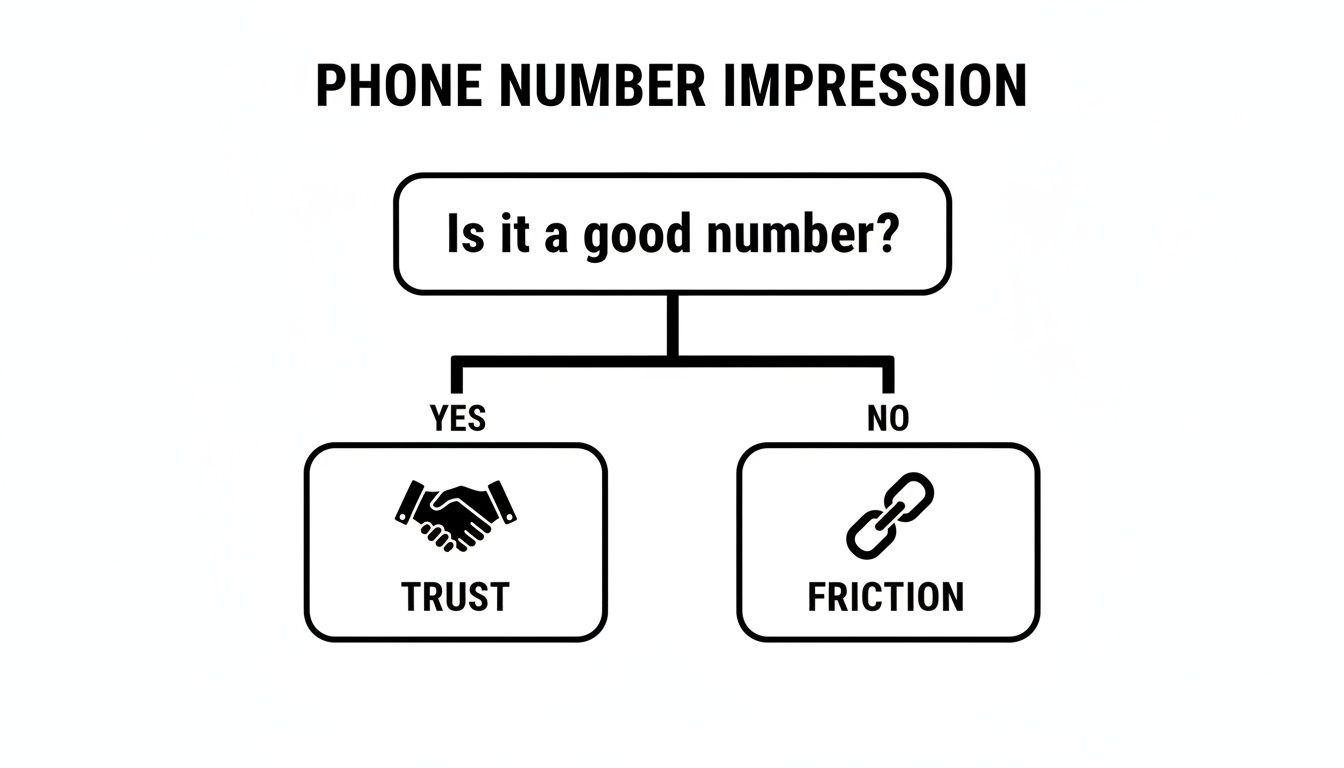
As you can see, a number that feels familiar and professional makes it easy for a lead to become a conversation. One that feels out of place or confusing can stop them before they even dial.
Ultimately, the best strategy might even be a hybrid one. You could use a local number on your Google Business Profile to attract nearby customers and put a toll-free number on your website for your national audience. This lets you get the best of both worlds.
For a deeper look into all the nuances, check out our complete guide on choosing a phone number for your business. Whatever you choose, the mission is always the same: make it incredibly simple for people to reach you.
For any business that relies on a strong community connection, the right area code is a secret weapon. It’s a simple, almost subconscious trigger. When a potential customer sees a familiar three-digit prefix, your business instantly feels more trustworthy and relevant.
This small detail can dramatically increase the odds someone will answer your call or dial your number. Think about it from their shoes: a call from an unknown, out-of-state number screams "spam," but one with a local prefix feels like a neighbor reaching out. When you're picking a phone number, tapping into this local familiarity is one of the easiest ways to build rapport before you even say hello.
One of the smartest moves a service-based business can make is creating a "virtual" presence in multiple cities. You don't need pricey physical offices to feel like a local favorite in surrounding towns. Instead, you can simply get phone numbers with the area codes for each key territory you want to target.
For example, a contractor based in a suburb could get numbers for:
Each of these numbers can forward directly to your main line or be handled by an AI receptionist, so you never miss a beat. This simple strategy makes your marketing in those areas far more effective, since every ad, flyer, and online listing features a number that instantly connects with the local community.
Your area code does more than just route calls—it tells a story about your business. A local number says, "We're part of your community," which is a powerful message that a toll-free or out-of-state number simply can't convey.
To really drive this home, make sure you're consistently optimizing your Google Business Profile. Listing your local number there reinforces your connection to the area and helps you pop up in all those valuable "near me" searches.
Beyond just appearances, using multiple local numbers gives you incredibly valuable data. By assigning a unique number to different service areas or marketing campaigns, you can track exactly which regions are sending you the best leads. This insight is gold, allowing you to focus your advertising spend where it actually delivers a return.
My AI Front Desk makes this strategy dead simple to execute. You can easily add multiple numbers with specific area codes and let the AI receptionist handle all the incoming calls. It can even ask callers for their zip code to route them properly or log their location in your CRM, giving you a crystal-clear picture of your customer geography without any extra work on your part.
A phone number just sitting on your website is a huge missed opportunity. Its real power comes alive when you weave it into the very fabric of your daily operations. That's how you turn it from a simple contact method into an intelligent, automated hub for your business. After you've spent the time picking a phone number that fits your brand, the next move is to make it work for you.
Think about this: an incoming call doesn't just ring—it triggers a whole sequence of perfectly timed actions. The caller's info is logged, a new lead pops up in your CRM, and a follow-up task gets scheduled, all without you lifting a finger. This isn't some futuristic tech for massive corporations anymore; it’s accessible and frankly, essential for any small business looking to squeeze the most out of every single lead.
The main goal here is to get information flowing seamlessly between your phone system and the software you already rely on. The absolute first and most critical step is connecting your new number to your Customer Relationship Management (CRM) system. This is non-negotiable if you want to make sure every single interaction is captured, logged, and organized.
Here's what that integration actually looks like in practice:
This kind of integration flips your phone from a reactive tool into a proactive one. With My AI Front Desk, setting up these connections is a breeze. Our platform, for example, can push call details, recordings, and even transcripts directly into your CRM right after a call ends, giving you a rich, detailed record of every lead.
Beyond basic CRM hookups, you can build out some seriously sophisticated workflows that automate entire processes. This is where you truly start to reclaim your time and focus on what you actually do best—running your business. Just think about your most repetitive, manual tasks and imagine how a phone call could kick them off automatically.
For instance, a caller who says something like "I need to schedule an appointment" to your AI receptionist could instantly get a text message with your Google Calendar booking link. It's a simple workflow, but it saves both you and the customer a ton of time and creates a fantastic, frictionless experience.
By 2025, an estimated 4.69 billion people will own smartphones, a number projected to hit 5.12 billion by 2026. That explosive growth means your business number can't just exist; it needs to be an active player in an automated ecosystem to stand out. Integrating your system with tools like Zapier, which connects to over 9,000 apps, can put your workflows on autopilot and drive more revenue. You can find more details in these global smartphone usage statistics.
With an intelligent system like My AI Front Desk, you can configure post-call webhooks and notifications that trigger actions in all your other applications. This capability lets you build custom automations that are perfectly tailored to your business needs, making sure no lead is ever left behind and your operations are running at peak efficiency.
You’ve done the hard work of picking the perfect phone number. It’s tempting to immediately blast it across all your marketing, but hold on for just a moment. A thoughtful rollout is the final, critical piece of the puzzle to ensure a professional and seamless transition for your customers.
Before you go live, a few internal checks can save you from the nightmare of dropped calls and confused clients. Trust me, it’s worth the extra few minutes.
First things first: conduct some thorough testing. This isn’t just about making one call to see if it rings. You need to simulate real-world scenarios. Have different people on your team call the new number from both their cell phones and a landline to make sure every connection is crystal clear.
Your testing needs to go deeper than just a simple ring-through. You have to verify every possible path a caller might take.
Here’s a quick list of what to check:
A smooth launch is all about anticipating problems before your customers find them. Spending just 30 minutes testing your setup now can prevent hours of headaches and lost leads down the road.
Once you've triple-checked everything and confirmed it's all working perfectly, it’s time for the big update. Consistency here is non-negotiable. A customer finding an old number on a forgotten social media profile can lead to frustration and a lost sale. You need a plan.
I recommend creating a master list of every single place your phone number is displayed. Go through it line by line and update each one systematically.
Common places business numbers tend to hide include:
This process ensures a clean break from your old number and funnels all communication through your new, optimized system. For more guidance on the technical side of things, our complete guide to business phone number setup can walk you through the nitty-gritty details.
With your new number live and working perfectly, you’re ready to capture every single opportunity that comes your way.
You’ve done the hard work of picking the perfect phone number. Now what? The final piece of the puzzle is transforming that simple string of digits from a contact point into a genuine competitive advantage.
This is where you layer on intelligent automation. Think of it as giving your business phone number a brain.
Imagine a potential customer calling your business late at night. Instead of hitting a cold, generic voicemail, they’re greeted by a sharp, helpful AI receptionist. This isn't just a recording; it's an interactive system that can answer their common questions, capture their details, and even book an appointment right on your calendar. That’s the difference between a missed call and a new client.
The goal here is simple: create a system that catches every single lead, no matter when they call. A well-tuned AI ensures you never miss out because you were on another line, with a client, or just grabbing a well-deserved coffee.
This technology lets your number do so much more than just ring. It can:
This is about more than just answering the phone. It's about delivering a consistently great experience that converts curious callers into loyal customers. By automating that first touchpoint, you make sure every single person feels heard and valued from the get-go.
As you think about modernizing your communications, it’s interesting to see how other fields are using similar tech. For example, look at the applications of AI in newsrooms. The core idea is the same: using smart automation to manage information and interact more efficiently.
Ultimately, this strategy turns your phone number into one of your most valuable assets. You’ve already selected the number that represents your brand; now it's time to give it the power to actually grow your business. For a full walkthrough on getting this set up, check out our complete AI-powered phone numbers setup guide.
Jumping into the world of business phone numbers always stirs up a few questions. It's totally normal. Let's tackle some of the most common ones so you can move forward with confidence and sidestep any last-minute snags.
Yes, you absolutely can. The process is called porting, and it’s how you move your existing number from your old provider to a new one.
The one golden rule? Do not cancel your old service before the port is complete. Your account has to be active for the transfer to go through. You'll just need your account number and a Number Transfer PIN from your current carrier to give the new provider the green light.
If you're starting fresh, getting a new number is practically instant.
With a service like My AI Front Desk, you can browse, select, and activate a new local or toll-free number in just a couple of minutes. The whole thing is automated, so you can lock in your number and start designing how your calls get handled right away.
Whether you're bringing an old number with you or grabbing a new one, the most important thing is that it fits your long-term business goals. Think of it as the foundation for all your customer conversations—it needs to be solid.
Ready to turn that new number into a 24/7 client-booking, lead-capturing powerhouse? My AI Front Desk can hook you up with an AI receptionist that answers calls, schedules appointments, and makes sure you never miss a beat. Get started at myaifrontdesk.com.
Start your free trial for My AI Front Desk today, it takes minutes to setup!


