
Predictive analytics is transforming customer experience (CX) by anticipating needs and delivering tailored solutions. From airlines reducing churn by 59% to telecoms increasing revenue, businesses are seeing measurable results. Here's how:
Predictive analytics shifts CX from reactive to proactive, helping businesses deliver what customers expect: personalized, seamless, and efficient service.
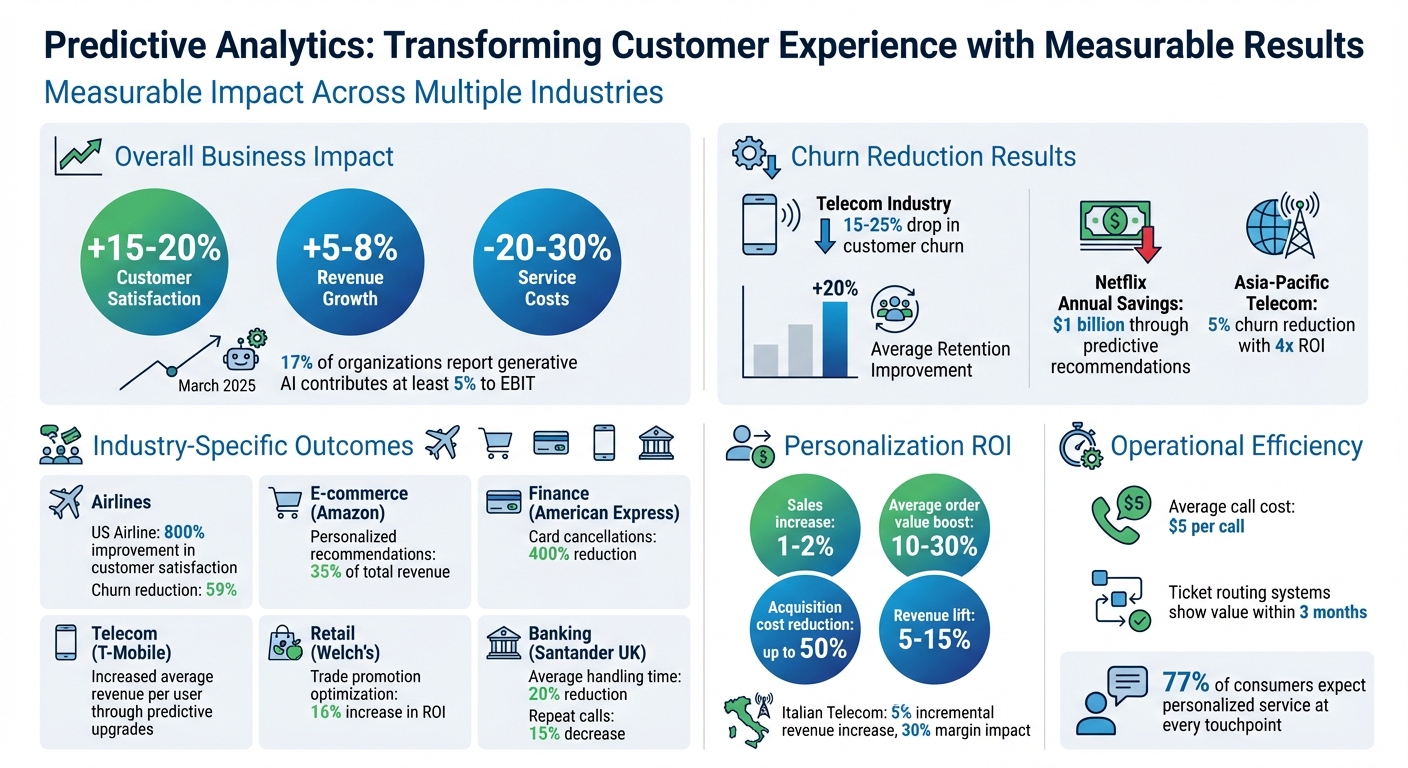
Predictive Analytics Impact on Customer Experience: Key Statistics and ROI Across Industries
Automated Call Reason Prediction (ACRP) uses call metadata and past interactions - like chat, email, and social media activity - to anticipate why someone is calling, even before an agent or AI receptionist answers. By applying Natural Language Processing (NLP), the system scans previous conversations for patterns, keywords, and recurring phrases, creating a clear picture of the caller's likely needs.
When paired with a CRM, this system instantly pulls up relevant customer information, such as purchase history, communication preferences, and recent activity. For instance, if a customer recently explored your pricing page, opened multiple billing-related emails, and then places a call, the system can predict they're likely inquiring about payment issues rather than scheduling. This insight ensures the caller is connected to the resource best suited to address their concern.
Once the caller's intent is identified, the system routes the call to the most appropriate destination. For example, high-value customers flagged as at-risk might be sent directly to a retention specialist, while technical questions are directed to support agents with the necessary expertise. Meanwhile, routine inquiries - like asking about business hours or rescheduling an appointment - are handled by an AI receptionist.
A great example of this in action comes from the Royal Bank of Scotland. They use real-time analytics to monitor complaints and predict spikes in call volumes, allowing them to allocate resources dynamically and prepare for surges. This level of precision ensures that customers receive tailored support, improving both efficiency and satisfaction. It also helps businesses save on costs while delivering a more personalized experience.
At an average cost of $5 per call, predictive routing helps cut expenses by reducing the time spent on calls and minimizing unnecessary transfers. Companies like Brittania Airways have used ACRP to shorten call-handling times, while healthcare providers have reduced patient wait times, and insurance companies have lowered callback rates.
The financial impact goes beyond just cutting costs. As of March 2025, 17% of organizations report that generative AI contributes at least 5% to their EBIT. In the telecom industry, predictive retention programs have led to a 15% to 25% drop in customer churn. Ticket routing systems deliver results quickly, often showing value within three months through faster resolution times and improved customer satisfaction scores. These outcomes highlight how predictive analytics shifts customer service from being reactive to offering proactive, personalized solutions.
Predictive analytics doesn't just stop at routing calls effectively - it also plays a key role in delivering personalized offers during live customer interactions.
Predictive models rely on data like purchase history, call intent, and sentiment analysis to create tailored offers during calls. By analyzing both historical and real-time signals, machine learning identifies the next best action for each customer based on their unique behavior patterns.
Take Amazon, for example. Its recommendation engine is a prime example of predictive analytics at scale - personalized recommendations contribute up to 35% of Amazon's total revenue. Similarly, T-Mobile uses this technology to pinpoint customers likely to upgrade their phone plans by analyzing usage patterns and service interactions, boosting their average revenue per user. American Express has also leveraged predictive models to reduce card cancellations by 400%, offering targeted solutions to customers identified as at-risk.
These systems work by breaking down offers into modular components - like copy, images, and discounts - that can be dynamically assembled based on the customer's profile. This modular approach also allows call scripts to be adjusted on the fly, enhancing the personalization of every interaction.
Predictive analytics doesn't just personalize offers - it also fine-tunes call scripts in real time. Using Natural Language Processing (NLP), these systems detect key phrases that help agents respond more effectively. Sentiment and empathy detection further enhances interactions by analyzing vocal tone and word choice, identifying emotions like frustration or anger. Based on this analysis, agents can adjust their tone, offer concessions, or take other steps to improve the customer experience.
"Empathy detection is one of the most innovative use cases... it can gauge the emotional needs of customers in real-time... suggesting the agent use calming language or offer an apology early." - Viva Technology
Santander UK offers a great example of how this works in practice. By using AI to analyze trends and customer sentiment, they revamped their call center operations, achieving a 20% reduction in average handling time and a 15% decrease in repeat calls. The system dynamically adapted conversation flows, making each interaction feel personalized rather than robotic.
Personalized recommendations don't just improve customer satisfaction - they also deliver measurable business outcomes. Studies show they can increase sales by 1%–2% and boost average order value by 10%–30%.
An Italian telecommunications company implemented an AI-driven "next best experience" engine in late 2025, which flagged data usage spikes and triggered proactive outreach by human advisors. The result? A 5% increase in incremental revenue and a 30% margin impact within a year. Sprint employed a similar strategy, using AI to identify at-risk customers and equipping agents with tailored retention offers, significantly reducing churn.
Here are some standout examples of how predictive analytics drives results across industries:
| Industry | Predictive Application | Business Outcome |
|---|---|---|
| E-commerce (Amazon) | Recommendation Engine | 35% of total revenue |
| Finance (American Express) | Targeted Retention Offers | 400% reduction in cancellations |
| Retail (Welch's) | Trade Promotion Optimization | 16% increase in ROI |
| Banking (Santander UK) | AI Call Operations | 20% reduction in handling time |
Even small businesses can harness these capabilities. Platforms like My AI Front Desk offer tools like texting workflows to send personalized messages during calls and post-call webhooks to trigger follow-ups based on customer needs identified during conversations. With CRM integration, these systems automatically organize customer data, allowing AI assistants to reference past interactions and preferences when recommending services or scheduling appointments.
These strategies highlight how personalization not only improves customer experiences but also drives tangible business growth. This naturally leads us to the next critical application: stopping customer churn before it starts.
It's no secret that keeping your current customers is far more cost-effective than constantly chasing new ones. This is where predictive analytics steps in, helping businesses identify early warning signs of churn and take action before it's too late.
Predictive models rely on advanced techniques like feature engineering, machine learning, and natural language processing (NLP) to analyze customer data. By evaluating factors such as login frequency, support ticket volume, and usage patterns, these models generate risk scores. When a customer's risk score crosses a set threshold, the system triggers workflows to address the issue before the customer decides to leave.
| Data Category | Common Churn Indicators |
|---|---|
| Behavioral | Reduced login frequency, shorter session durations, abandoned features, long inactivity gaps |
| Transactional | Payment failures, changes in subscription lifecycle, declining purchase frequency |
| Customer Support | High ticket volume, unresolved issues, negative sentiment in call transcripts, repeat calls |
| Feedback/Sentiment | Dropping Net Promoter Scores (NPS), low Customer Satisfaction (CSAT), negative social media feedback |
By identifying at-risk customers early, businesses can go beyond traditional retention strategies, such as optimized call routing or generic offers, to deliver highly personalized solutions.
"Many traditional business functions like operations, demand planning, and corporate finance wind up doing some kind of predictive tasks that rely heavily on assumptions and rules of thumb. Letting the data drive and temper our own assumptions [made us] dramatically more accurate on average with our predictions."
– Neeti Singhal Mahajan, Vice President of Strategy and Insights, Daily Harvest
Once at-risk customers are flagged, automated outreach tools like SMS, email, and push notifications can be used to re-engage them. For example, an Asia-Pacific telecommunications company managed to cut churn by 5% while achieving an ROI nearly four times higher than its previous methods by using predictive models to identify customers dissatisfied with billing.
Smaller businesses can also take advantage of these tools. Platforms like My AI Front Desk provide AI-powered phone and text campaigns that target disengaged customers. By integrating with CRMs, these campaigns ensure outreach is informed by each customer’s history. Features like post-call webhooks enable timely follow-ups, ensuring no at-risk customer slips through the cracks.
These proactive efforts set the stage for measurable improvements in retention.
Companies that use predictive models for retention often see impressive results. On average, businesses report a 20% boost in customer retention rates. Telecom providers using predictive retention programs have achieved churn reductions of 15%–25%. Netflix saves an estimated $1 billion annually by using predictive recommendations to keep subscribers engaged. Sprint, meanwhile, reduced churn by identifying at-risk customers with AI and offering tailored incentives to keep them loyal. A global payments processor estimated that predictive models could cut attrition by up to 20% annually by flagging merchants likely to reduce business within a week.
These success stories highlight the power of predictive analytics in customer retention, offering businesses a clear path to keeping their customers engaged and loyal.
Taking advantage of predictive insights to improve call routing, enhance personalization, and reduce churn is easier than ever with My AI Front Desk. This platform lets you deliver tailored customer experiences without requiring a major IT overhaul or a team of data scientists. Instead, it offers simple workflows and seamless integrations.
Good data is the backbone of any predictive system. To get started, connect My AI Front Desk to your existing CRM to sync customer interactions, preferences, and call history. This integration equips the AI receptionist with the context it needs to anticipate caller needs effortlessly.
With features like CRM Integration and Zapier Integration (which connects to over 9,000 apps), the platform creates a centralized system that organizes leads and contacts automatically. Over time, it builds more accurate customer profiles. Regular CRM maintenance - like removing duplicates or outdated records - helps keep predictions accurate.
Start small to make personalization manageable. For instance, you could focus on customizing responses for repeat callers or addressing frequent support inquiries from customers who’ve reached out multiple times in the past month. This pilot approach allows you to refine your strategy before scaling it across all customer interactions.
Once your data is ready, you can create predictive workflows using the "Edit Receptionist" panel. The interface allows you to define complex scenarios in plain English, eliminating the need for technical know-how. For example: "If a caller mentions pricing concerns, send a text with our latest promotion", or "Transfer calls about refunds directly to the billing department".
| Workflow Type | Mechanism | Predictive Application |
|---|---|---|
| Texting Workflows | Sends automated SMS during calls | Proactively shares resources based on caller intent |
| Call Transfer | Routes calls to specific departments | Matches callers with the best resource for their needs |
| Intake Forms | Asks predefined questions | Gathers key details by predicting relevant data points |
| Post-Call Webhooks | Sends call data to external systems | Triggers follow-ups based on conversation outcomes |
The Analytics Dashboard tracks every interaction, offering insights into call trends, common requests, and conversion rates. Meanwhile, Post-Call Webhooks ensure that conversation data flows seamlessly into your CRM, so no customer is overlooked. Features like Unlimited Parallel Calls ensure predictive personalization works for every caller, even during peak times.
"Integration isn't just about connecting systems; it's about transforming how you work." - My AI Front Desk
Once your workflows are live, tracking their performance is key. Metrics like conversion rates, customer satisfaction scores, and churn reduction can help you measure the effectiveness of your predictive workflows. The analytics dashboard provides actionable insights, showing which personalization efforts are driving real results.
To measure ROI, set up a control group of customers who receive standard interactions and compare their behavior to those who experience AI-driven personalization. For example, if at-risk customers receive proactive outreach through AI-powered phone and text campaigns, monitor whether they remain engaged compared to those who didn’t receive personalized attention.
Customer feedback is another crucial input. The AI learns from every interaction, improving its accuracy over time. If certain workflows aren’t delivering the desired results, you can tweak triggers or messaging without needing to write any code. Research shows that personalization can cut acquisition costs by up to 50% and boost revenues by 5-15% - but only if you continuously refine your approach using real data.
With 24/7 availability, My AI Front Desk ensures that predictive workflows and personalized service run smoothly, regardless of time zones or holidays. This constant operation helps you build richer customer profiles with every interaction, creating a snowball effect that makes your personalization efforts even more effective over time.
Predictive analytics is no longer just a buzzword - it’s delivering real, measurable outcomes. Businesses are seeing customer satisfaction climb by 15%–20%, revenue grow by 5%–8%, and service costs drop by 20%–30%.
Platforms like My AI Front Desk are bringing these capabilities to small businesses. With features like Automated Call Reason Prediction and seamless CRM integration, the platform anticipates customer needs before they’re fully voiced. This proactive approach aligns with what 77% of consumers now expect: personalized service at every touchpoint.
The results speak for themselves. Predicting customer needs, routing calls intelligently, and engaging early have proven to increase retention and satisfaction. Examples include an airline achieving an 800% boost in customer satisfaction and a payments processor cutting merchant attrition by 20%. The key is clear - leveraging data to anticipate needs and act with precision drives success.
What’s more, predictive personalization gets smarter with every interaction. Each call enriches the system, making future predictions sharper and more accurate. With advanced features and seamless integration, My AI Front Desk ensures that your personalization efforts scale as your business grows.
In today’s market, predictive customer service isn’t optional - it’s expected. Companies that embrace these tools will strengthen customer relationships, minimize churn, and capture revenue that might otherwise slip away. And with consumers willing to pay a premium for personalized experiences, predictive analytics has become more than a tool - it’s a necessity.
Predictive analytics takes customer satisfaction in call centers to the next level by tapping into historical data - like previous interactions, purchase history, and sentiment analysis. By analyzing this information, systems can anticipate a caller’s needs even before they connect with an agent. This means calls get routed to the most suitable representative, relevant details are readily available, and the best next steps can be suggested in real time. The result? Shorter call handling times and a smoother experience that makes customers feel understood from the very beginning.
When agents receive predictive insights - like potential issues or personalized recommendations - they can adapt their responses to match each caller’s needs. This creates a more efficient and engaging interaction. My AI Front Desk applies these principles through its AI receptionist, which predicts caller intent, auto-populates CRM details, and uses tailored scripts to make every conversation feel personal. For small businesses, this translates into quicker issue resolution, reduced wait times, and a seamless, top-tier customer experience.
Identifying customer churn often requires paying attention to critical signs like a drop in purchase or usage frequency, lower engagement levels, and negative feedback or survey responses. On top of that, shifts in demographic or behavioral trends, such as altered spending patterns or decreased interactions with your brand, can also hint at churn risks.
By keeping a close watch on these signals, businesses can take timely actions to reconnect with customers and boost retention.
Predictive analytics empowers small businesses to anticipate what their customers might need by examining past interactions to predict future behaviors. This approach allows businesses to tailor every interaction - whether it’s recommending products or offering services - without resorting to one-size-fits-all messaging.
AI-powered SaaS platforms make implementing predictive personalization accessible, even for businesses without large IT budgets. These tools are designed to integrate seamlessly with existing systems like CRMs or marketing platforms, often using low-code solutions. By inputting data such as call logs, purchase history, or website activity, these platforms can deliver real-time insights. For example, they can predict why a customer is calling or highlight leads that are most likely to convert.
To get started, focus on a specific goal, such as refining lead qualification or delivering personalized product recommendations. Many of these platforms use a pay-as-you-go pricing model, so you’re only charged for what you actually use. Plus, with features like built-in analytics dashboards, small businesses can easily monitor metrics like improved conversion rates or reduced customer churn - no need for a dedicated IT team.
Start your free trial for My AI Front Desk today, it takes minutes to setup!


