
At its core, the difference between outbound and inbound calls is pretty simple: inbound is reactive, and outbound is proactive. Inbound calls are all about handling incoming requests from customers needing support or looking to buy. Outbound calls are the ones your business makes to generate leads, run surveys, or follow up with potential clients.
For a small business owner, deciding between an inbound or outbound calling strategy can feel like choosing between a magnet and a megaphone. One pulls in customers who are already looking for you, while the other blasts your message out to a wider audience. The right call isn't about which is "better" in a vacuum, but which fits your immediate goals.
Inbound calls are really the foundation of great customer service and a way to capture existing interest. Think of them as the digital welcome mat for your business. When a customer calls you, it's because your marketing already did the heavy lifting to get them there. This approach is fantastic for converting warm leads and building real, long-term loyalty.
Outbound calls, on the other hand, are your tool for proactive growth. They empower you to go after specific high-value clients, test the waters in new markets, or get direct, unfiltered feedback from people you want to reach. It’s about creating opportunities instead of just waiting for them to knock. This dynamic mirrors a wider strategic choice, which you can explore further in our guide to inbound vs outbound marketing.
Whether you lean into inbound, outbound, or a mix of both, modern businesses often rely on solid infrastructure like cloud-based contact centre solutions to keep things running smoothly and stay flexible.
Here's a quick breakdown of how these two approaches stack up:
Inbound calls have always been a cornerstone of customer relations, and their importance is only growing. The global call center outsourcing market is expected to hit nearly $102.89 billion by 2025, with inbound services leading the charge. A big reason for this is that 59% of consumers still prefer picking up the phone to build a connection and get their issues sorted out efficiently.
To really get a handle on the difference between inbound and outbound calls, you have to look past the surface-level definitions. We need to see how they actually play out in a business, because each approach leaves a totally different footprint on everything from daily operations to your long-term bottom line.
This visual gives a great high-level summary of how the two strategies stack up, covering everything from their core goals to the tech they lean on.
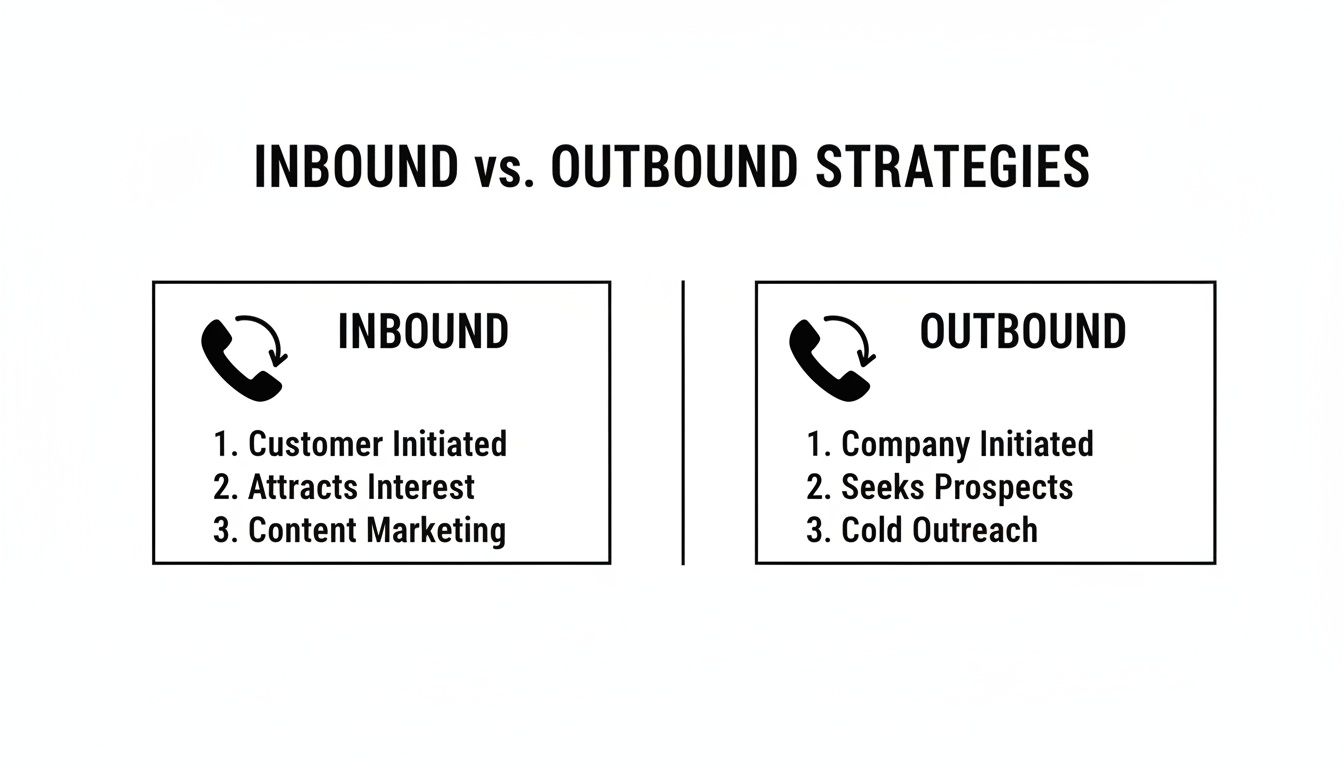
As you can see, while both use the phone, what they're trying to accomplish couldn't be more different. That means you need entirely unique tools and ways of measuring success for each one.
The main point of an inbound call strategy is to deliver top-notch customer service and support. It's about turning existing interest into concrete action, like booking an appointment or making a sale. This is a reactive game, perfect for a local HVAC company getting calls for emergency repairs or a dental office scheduling patients who found them online. The key is that the customer is the one reaching out, showing they already have a need.
On the flip side, an outbound call strategy is all about proactively drumming up business and generating new leads. Think of a B2B software company targeting a specific list of enterprise clients or a real estate agent hunting for new listings. Here, the business makes the first move to create demand that wasn't there before.
The real difference isn't just about who makes the call; it's about the entire mindset. Inbound is about capturing and nurturing demand that's already there. Outbound is about creating brand new opportunities from the ground up.
When you're trying to figure out if your strategy is working, you'll be looking at completely different numbers for each approach. Inbound success is all about efficiency and making customers happy.
Looking at the financials, you run into a classic business trade-off. Inbound leads can cost up to 60% less than outbound ones, which is great for businesses that already have a solid marketing engine bringing people in. This approach depends on tools like CRM systems and helpdesk software to keep up with all the incoming requests. You can see how various tools stack up by checking out our AI receptionist feature comparison.
Outbound calling, on the other hand, means spending money on things like dialers and prospect lists. But the potential payoff is huge, with larger deal sizes and the ability to target your ideal customer directly. It's unmatched for building personal rapport and getting instant feedback in a way that digital marketing just can't. For any small business serious about aggressive growth, this direct, hands-on approach is still an absolute must.
When customers are already out there looking for what you offer, an inbound strategy isn't just a good idea—it's the most direct way to capitalize on existing demand. Think about service-based businesses like dental offices, law firms, or home service contractors. Their success often comes down to one simple thing: being there the moment a potential client decides to pick up the phone.
Every single inbound call is a hot lead. It's someone your marketing dollars already worked hard to attract.
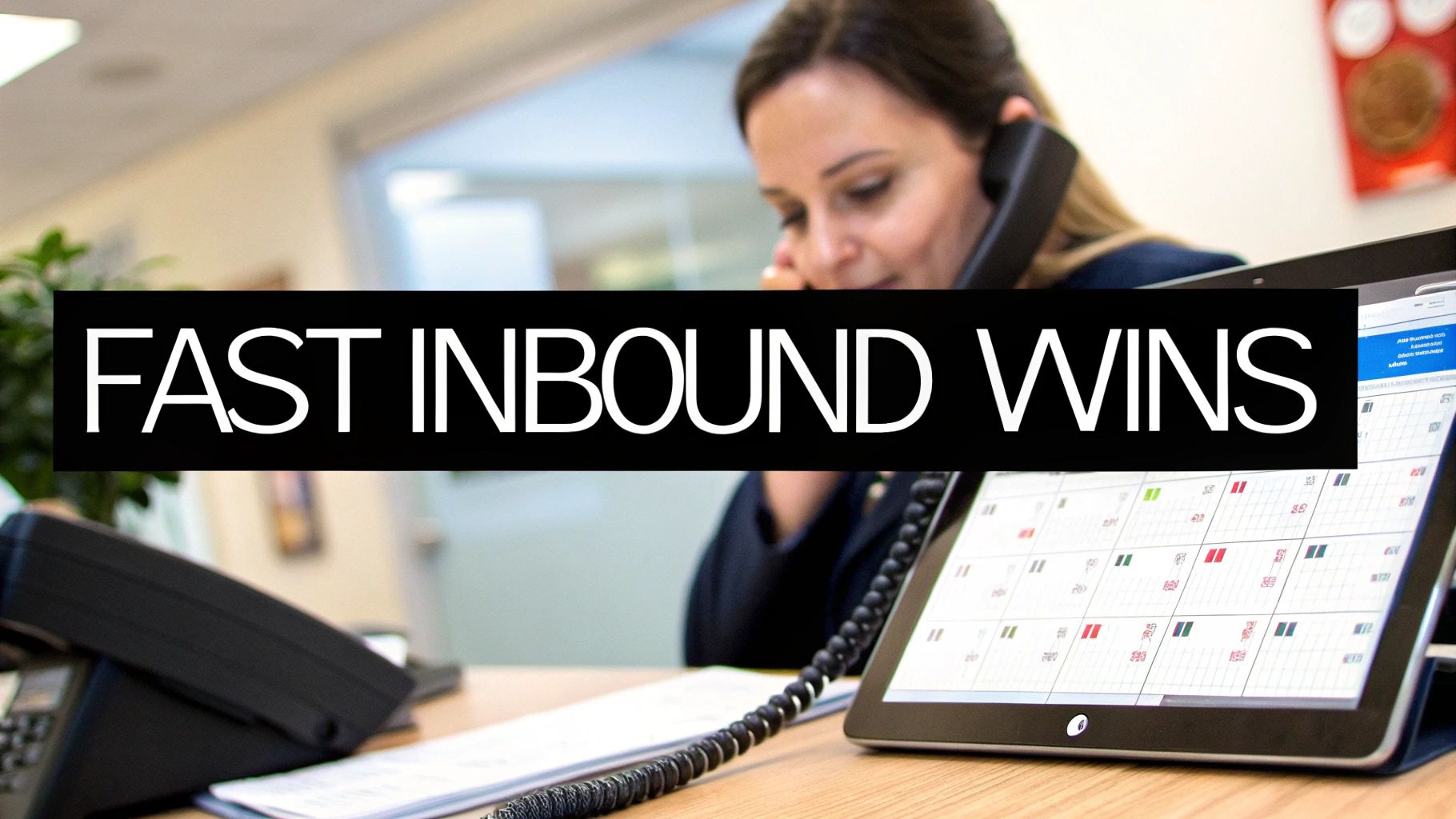
Missing that call is like locking your front door just as a customer with cash in hand is walking up. This is where a sharp inbound system, like an AI receptionist, goes from being a simple answering service to a powerful revenue machine. It guarantees no lead ever gets lost to a busy signal or voicemail, turning every ring into a real business opportunity.
You should lean heavily on an inbound focus when your main goals are immediate response times and getting appointments on the books without any friction. The customer already has the motivation; your job is to make saying "yes" as easy as possible.
Here are a few classic scenarios where inbound is king:
When you compare outbound calls vs inbound calls, the game is won or lost on speed. For inbound leads, responding within the first five minutes can boost conversion rates exponentially. If you fail, you're practically handing that customer over to a competitor who was faster on the draw.
To really nail an inbound strategy, you need tools that automate and accelerate the whole process from "hello" to "booked." An AI receptionist, for example, can use specific features to turn a simple phone call into a confirmed client on the spot. With seamless calendar integration, the AI can book appointments during the call, completely wiping out the frustrating back-and-forth of finding a time that works.
On top of that, an AI texting bot can fire off instant follow-ups with appointment details or links to intake forms, keeping the customer engaged and moving forward. This level of automation means your business is capturing leads and filling its pipeline even after you've all gone home for the day, making your inbound channel a truly reliable engine for growth.
While inbound strategies are fantastic for capturing people already looking for you, an outbound approach is all about creating new opportunities from scratch. Think of it as the engine for proactive growth. It’s essential when you're launching a new service, breaking into a different geographic market, or going after those high-value accounts that are unlikely to just stumble upon your website.
An outbound strategy puts you squarely in the driver's seat of your own pipeline. You aren’t just waiting for the phone to ring; you're actively identifying and chasing the exact clients you want to work with.
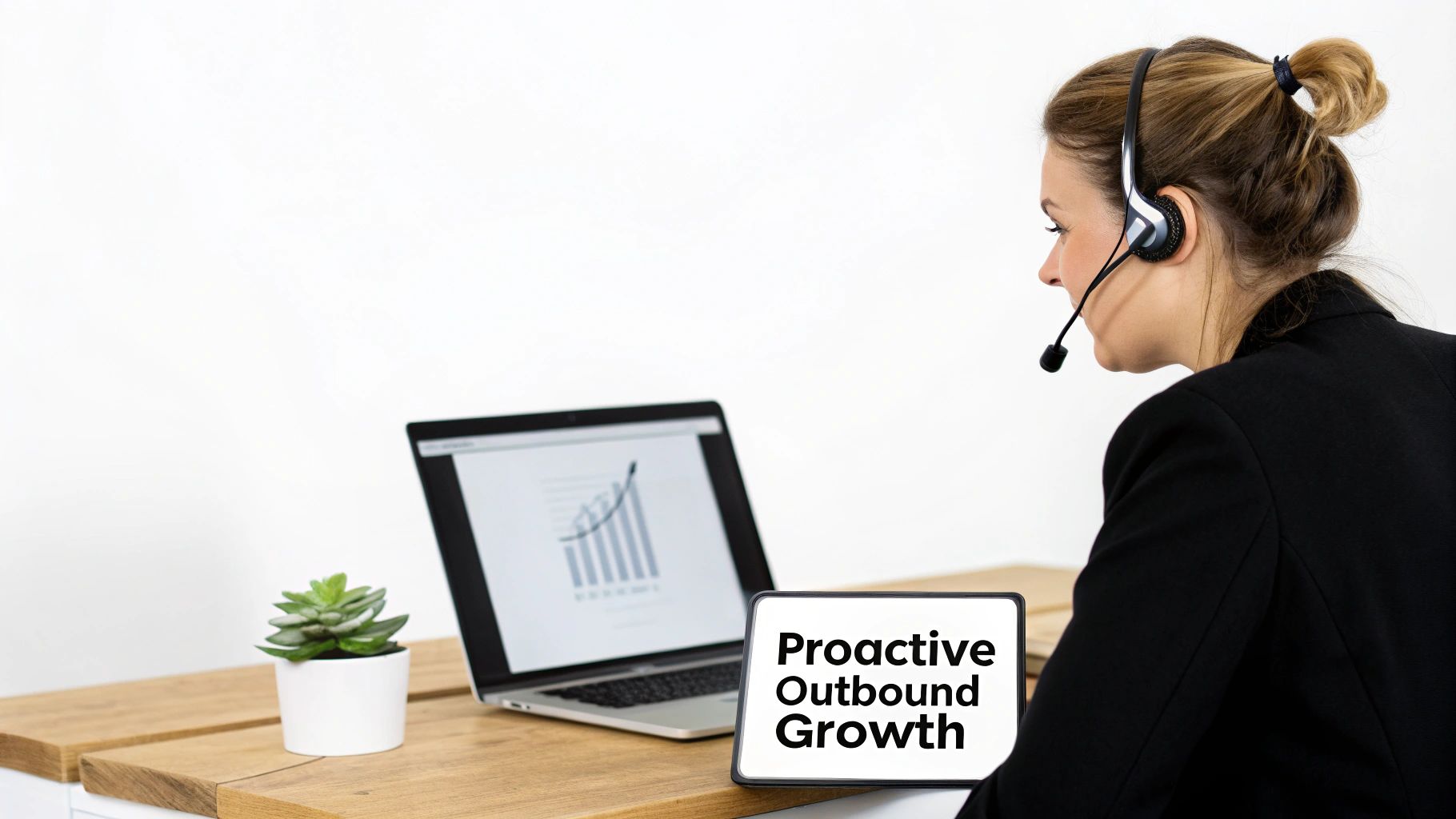
This kind of direct outreach can be incredibly effective in certain industries, especially where a personalized touch cuts through the noise and helps land major contracts. If you're curious about which businesses benefit most, we've put together a detailed guide on AI-powered outbound strategies.
Let's be honest: the biggest historical knock on outbound calling has been efficiency. Traditional cold calling is a brutal numbers game, often leading to low connection rates and serious agent burnout. But modern AI tools have completely flipped the script, turning outbound from a brute-force tactic into a precision-guided strategy.
New technologies make outbound campaigns far more effective and scalable by automating the most grueling parts of the process. This frees up your team to do what they do best: have valuable conversations with qualified leads.
Here's how AI is making a difference:
Outbound calling has made a serious comeback, and it's all thanks to AI. While old-school cold calls scrape by with a 2% response rate, AI-driven campaigns can push conversions up to 21% and deliver 60% in cost savings. You can find more insights on how AI is blending sales strategies over at superagi.com.
By adopting these tools, any business can make its outbound efforts dramatically more efficient and successful, turning what was once a grind into a consistent source of high-quality leads.
The whole outbound calls vs inbound calls debate misses the point. You don't have to choose. The smartest growth strategies combine both into a single, cohesive model that feeds itself, turning separate tasks into one powerful communication engine.
Think about it. An outbound campaign might pique someone's interest in a new service, prompting them to call you back later with questions. Just like that, a cold lead becomes a warm inbound inquiry, dramatically boosting your chances of closing the deal. It works the other way, too. The data you gather from inbound support calls—like common questions or pain points—is pure gold for building hyper-relevant outbound prospecting lists.
This synergy elevates your business from a one-track approach to a dynamic cycle of outreach and response.
For a hybrid strategy to actually work, you need a central hub that can handle leads and data from both channels without missing a beat. A unified system, ideally with a built-in CRM, is non-negotiable for tracking every single interaction, whether it started with your team dialing out or a customer dialing in. This is how you stop valuable leads from slipping through the cracks.
When your inbound and outbound systems talk to each other, you can set up intelligent, automated workflows that trigger based on the call's origin.
The real magic of a hybrid model isn't just doing two things at once. It's using the insights from one strategy to make the other exponentially smarter. Your inbound calls tell you what customers want, and your outbound calls let you proactively offer it to them.
To truly bring this blended strategy to life, you'll need seamless integration and smart automation. Here’s a step-by-step look at how you can build a unified workflow using a platform like My AI Front Desk.
By following these steps, you create a self-perpetuating cycle where each interaction makes the next one more effective, driving continuous growth.
A successful blended communication engine really comes down to seamless integration and smart automation. For businesses looking to build a more efficient model, exploring the role of AI in sales and marketing offers great insights into connecting these advanced tools. An AI-powered platform makes this integration far more achievable by managing leads from both channels in one place.
If you're curious how an AI receptionist stacks up against traditional methods, check out our detailed breakdown on AI vs human operators. By using analytics to measure the combined results of your efforts, you can constantly fine-tune your approach and make sure your inbound and outbound strategies are working together to drive maximum growth.
Got questions about the whole outbound vs. inbound calls debate? You're not alone. Let's clear up some of the common sticking points business owners run into when trying to pick the right play for their situation.
The core difference is simple: who's making the first move? Inbound calls are reactive. A customer finds you and calls in looking for help, info, or to buy something. Outbound calls are proactive. Your team picks up the phone to reach out to a prospect for a sale, a marketing pitch, or a follow-up.
This one distinction splits your operations into two completely different models. One is all about catching and converting demand that's already out there. The other is about getting out there and creating demand from scratch.
If you're just starting out or watching the budget, an inbound strategy is usually the lighter lift financially. These leads are already warm—they came looking for you—so your cost to acquire them is often much lower. Your marketing dollars create the buzz, and an efficient inbound system, like an AI receptionist, makes sure none of that investment slips through the cracks as a missed call.
A lot of small business owners think they have to pick a side. The reality is, modern tools make it totally possible to run both playbooks at once, even with a tiny crew. The secret is automation.
An AI-powered platform lets you handle both incoming and outgoing calls without having to hire a small army. For instance, an AI can field all your customer service calls while another part of the system runs a targeted outbound campaign to a curated lead list. This creates a scalable, hybrid model that builds relationships and drives new business without burning out your team.
An AI receptionist is a total game-changer for your inbound call strategy. Its main job is to guarantee 100% of calls get answered 24/7, which puts an immediate stop to lead leakage. But it does way more than just pick up the phone. It can:
By automating these critical first interactions, an AI receptionist basically turns your business phone line into a tireless, highly efficient conversion machine that's always on the clock.
Ready to see how AI can sharpen your calling strategy? My AI Front Desk gives you both an AI receptionist for inbound and an AI outbound dialer, helping you capture every lead and create new opportunities. Discover our solutions today!
Start your free trial for My AI Front Desk today, it takes minutes to setup!


