
A voicemail used to feel like a safety net. For many small businesses, it is now a leak in the bucket.
When a call goes unanswered, most owners assume the caller will leave a message and wait. That assumption breaks fast under real behavior. Only 20% of callers leave a voicemail, which means 80% hang up immediately when they reach one, according to Ringeden’s analysis of voicemail behavior. If your phone process depends on voicemail alone, most missed calls are not being delayed. They are disappearing.
That does not mean leaving a voicemail no longer matters. It means the old way of using voicemail no longer works. A good message still has value. A bad one wastes attention. And a smart voicemail strategy today blends concise scripts, timing, and immediate follow-up across text, email, and scheduling tools.
Four out of five callers do not leave a voicemail. That single behavior breaks the old assumption that voicemail is a reliable backup for missed calls.
The core problem is operational. Many small businesses still treat voicemail as the full safety net instead of one part of a response system. Callers do not experience it that way. To them, voicemail often signals delay, uncertainty, and more effort.
That is the paradox. Businesses keep offering voicemail as the fallback, while callers treat it like a stopping point.
Speed shapes caller behavior. Someone calling a dental office, law firm, home service company, or salon usually wants one of a few things: book, confirm, ask a quick question, or solve an immediate problem. A generic greeting asks them to slow down, explain themselves, and trust that someone will return the call soon.
For a prospect who is already comparing options, that is a weak trade.
Small business owners usually lose callers for three practical reasons:
The risk of missed calls is therefore higher than many teams admit. The caller is not judging your voicemail by itself. They are deciding whether to call the next provider, send a text, submit a form, or abandon the task. For a closer look at that revenue risk, see this article on the danger of missed calls.
Voicemail still has a job. It just cannot do the whole job alone.
In practice, voicemail works best as a connector. It should either move the caller toward a clear next action or trigger a fast follow-up behind the scenes. That is the gap many articles miss. Classic voicemail advice focuses on what to say. Modern phone coverage also requires what happens immediately after the beep, especially for small businesses that cannot staff the phones every minute of the day.
A manual voicemail can still work if it is short, specific, and easy to answer. An incoming voicemail can still produce revenue if the business routes it into text follow-up, scheduling, notifications, or an AI receptionist workflow such as My AI Front Desk.
Passive voicemail loses leads. Active voicemail supports conversion.
Most voicemail advice is too soft. Speak clearly. Smile while talking. Be polite. None of that is wrong, but it is incomplete.
A better approach is structural. The message needs a job, a sequence, and a clean finish. That matters even more now, because many service businesses still struggle with handling and following up on voicemails. A 2025 CallRail survey found that 42% of service industry owners struggle with efficient voicemail handling and follow-up, a gap discussed in this overview of professional voicemail messages and modern handling challenges.
Here is the framework I recommend.
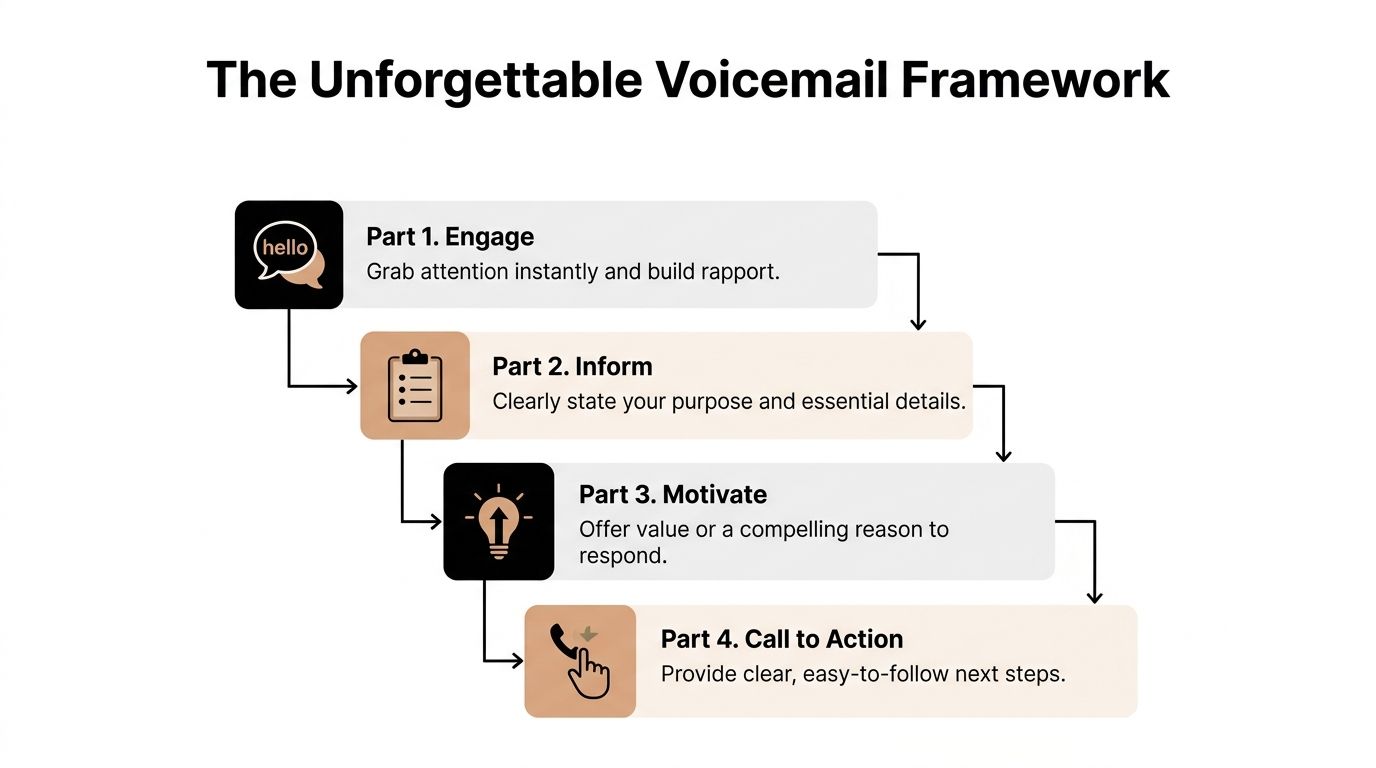
The first line decides whether the listener keeps processing the message or mentally checks out.
Say your name first. Then your company. Then a simple reason for the call. Do not make people wait to decode who you are.
Good opening:
Bad opening:
The weak version creates mystery where none is helpful. The strong version creates context.
Once you have attention, explain why this message matters now.
Do not tell your whole story. Give the listener just enough information to place the call. A prior inquiry, a scheduled appointment, a referral, a proposal, a missed connection. That is enough.
Examples:
Here, many people lose the thread. They stack too much detail into voicemail because they are trying to avoid another call. That usually backfires. Voicemail is not the place for your full case.
Now answer the silent question in the listener’s head. Why should they respond?
This does not need hype. It needs relevance. Think in terms of benefit, clarity, or convenience.
A useful value line might sound like this:
Notice what these do not do. They do not overpitch. They do not sound rehearsed. They make a response feel worthwhile.
If your voicemail does not contain a reason to respond, the listener hears it as admin, not opportunity.
End with a single next step. One.
Do not offer five paths. Do not ask the listener to remember a long list. Keep the ask simple and low-friction.
Examples:
That final option matters because voicemail today works better when it is paired with immediate follow-up. If you want a practical look at automated voicemail handling, this guide to automated voicemail messages for small businesses outlines how businesses connect messages to faster workflows.
Use this simple formula:
A finished message often sounds like this:
“Hi Jenna, this is Chris from Oak Street Fitness. I’m following up on the membership inquiry you sent in. I have a couple of options that may fit the schedule you mentioned. Call me back at this number, or reply to the text I’m sending over in a minute.”
That message is short, concrete, and easy to act on. That is the standard.
A framework helps. Scripts make it usable.
The right script depends on the relationship, the urgency, and the action you want next. Cold outreach needs curiosity. Appointment reminders need clarity. Follow-ups need continuity. Networking messages need warmth without sounding vague.
One important boundary matters in sales. In cold calling, leaving one or two strategic voicemails can raise email reply rates from 2.73% to 5.87%, but leaving three or more drops reply rates to 2.2%, according to Gong’s voicemail analysis. So the script matters, but so does restraint.
| Scenario | Primary Goal | Key Phrase Example |
|---|---|---|
| Cold outreach | Earn attention for the next touch | “I’ll send a quick email with context.” |
| Appointment confirmation | Reduce confusion and missed handoffs | “Please call us back if you need to reschedule.” |
| Post-meeting follow-up | Reinforce momentum | “I’m sending the summary right after this.” |
| Networking follow-up | Reopen a warm conversation | “Good talking with you at the event.” |
| Customer check-in | Make the next step easy | “Reply to the text if that’s easier.” |
This one should not try to close. Its job is to support the next email or touchpoint.
“Hi Taylor, this is Melissa from BrightPath IT. I’m reaching out because we work with local service teams that want a cleaner way to handle incoming leads. I’ll send you a quick email so you have context. If it’s relevant, feel free to reply there or call me back at this number.”
Why it works:
What to avoid:
This script is about certainty. The listener should know who called, what the appointment is, and what to do if anything changed.
“Hi Jordan, this is Emily from Riverstone Dental. I’m calling to confirm your appointment for tomorrow. If everything still works on your end, no need to call back. If you need to change the time, please call us at this number and we’ll help you reschedule.”
Why it works:
A lot of appointment voicemails fail because they pack in too much policy language. Save the fine print for text or email. The voicemail should do the simple job cleanly.
After a meeting, voicemail should reinforce memory and make the next move obvious.
“Hi Rebecca, this is Sam from Clearview HR. Good speaking with you earlier today. I’m sending over the summary we discussed, including the onboarding notes and next steps. If you want to talk through any part of it after you review, call me back and I’ll walk through it with you.”
Why it works:
This is useful when inboxes are crowded. A quick voicemail can keep your email from feeling disconnected.
Networking voicemails should sound human. The goal is not to impress. It is to make reconnecting easy.
“Hi Alex, this is Nina. Good talking with you at the chamber breakfast this morning. I enjoyed our conversation about referral partnerships. I’ll send a short note so you have my contact information, and if you want to continue the conversation next week, just reply there or call me back.”
Why it works:
This type of voicemail is often overlooked. It can strengthen retention and reopen stalled conversations.
“Hi Chris, this is Dana from Summit Home Services. I’m checking in on the estimate we sent over. If you have any questions, or if you want to review the options together, call me back at this number. If text is easier, you can reply there and we’ll take it from there.”
Why it works:
The best voicemail scripts sound like a competent person leaving a useful message, not a script trying to sound natural.
If you are leaving a voicemail as part of an outreach sequence, cap it at one or two messages. After that, the script is no longer the main problem. The sequence is.
Two people can read the same script and get very different results. Delivery changes how the message lands.
A strong voicemail sounds composed, specific, and easy to follow. A weak one sounds rushed, flat, or over-explained. The fix is usually simple. Slow down slightly, shorten sentences, and speak like you are talking to one person, not broadcasting to a room.
Focus on three things.
Many people think “sounding professional” means sounding formal. It usually means sounding easy to understand.
When you leave the message affects whether the listener is receptive. In an analysis of 7.8 million calls, the best callback windows were 10:00 to 11:30 AM and 4:00 to 5:30 PM local time, which performed 18% and 15% above average, and the same data found that leaving a voicemail boosts subsequent pickup rates by nearly 26%, according to Orum’s analysis of voicemail influence on engagement.
That does not mean every industry behaves identically. It does mean random timing is a weak strategy.
Use local time and work from likely attention windows.
If your team is refining first impressions more broadly, this guide on phone greetings is useful because voicemail quality often reflects the same habits as live call handling.
Good delivery does not mean sounding polished. It means making the message effortless to understand at the moment the listener hears it.
A clear script, left at a better time, by a caller who sounds grounded, will beat a clever script delivered poorly.
Manual skill still matters. But manual voicemail processes break as soon as volume rises.
That happens in two places. First, inbound calls go unanswered and the business hopes someone leaves a useful message. Second, outbound teams spend too much time leaving voicemails by hand, then fail to follow up fast enough. In both cases, the voicemail itself is only one part of the system. The primary issue is what happens next.
For inbound calls, an AI-powered voicemail system can achieve high transcription accuracy, and when paired with automated workflows like an instant SMS follow-up, it can significantly improve response rates. One reason is behavioral. 91% of people under 30 reply to a text in under a minute, according to SellCell’s voicemail statistics overview.
That is the opening for automation. Not because voicemail becomes magical, but because the business stops treating voicemail as an isolated audio file.
A modern setup can do several things immediately after a missed call or voicemail:
This matters for service businesses especially. A caller who reaches voicemail may be looking for availability, pricing, directions, or confirmation. If they get a text with the next step right away, the business has a second chance to keep the conversation alive.
Owners usually see the same failure points:
| Problem | What happens manually | What automation changes |
|---|---|---|
| Missed call after hours | Caller hits voicemail and disappears | System responds with a message and follow-up workflow |
| Team checks voicemail late | Lead goes cold before anyone replies | Notifications arrive immediately |
| Audio is hard to parse | Details get missed or misheard | Transcription makes the message searchable |
| Staff forget follow-up | No text, no email, no appointment link | Workflow sends the next step automatically |
None of those failures are unusual. They are operational.
The best voicemail systems now act more like call-routing and conversation systems than old message boxes.
Useful features include:
This is also where scripting intersects with interface design. If you are working on message phrasing for texts or follow-up prompts, resources on writing into text apps are useful because follow-up quality depends on how natural the written message feels after the voicemail event.
Take a small home services business. A prospect calls after hours for a quote. No one answers.
In an older workflow, the caller hears a generic greeting, maybe leaves a message, and waits. The office listens the next morning. If the details are incomplete, someone calls back. If the caller already booked elsewhere, the trail ends.
In an automated workflow, the missed call triggers a customized message and immediate follow-up. The message is transcribed. A text goes out with a short acknowledgment and a booking or intake option. The lead enters the CRM. The team sees the notification when business hours resume and can continue from the transcript instead of starting blind.
That is a very different process even though it still starts with leaving a voicemail.
For businesses that want this workflow in one place, My AI Front Desk’s AI-powered voicemail and message taking handles voicemail transcription, notifications, texting workflows, CRM connections, Google Calendar integration, pronunciation guides, premium voice options, and post-call actions through tools like webhooks and Zapier. The practical value is not the voicemail alone. It is the move from missed call to organized follow-up without manual handoffs.
Automation also helps with outbound campaigns, but only when it is controlled.
The point is not to blast identical voicemail drops across every contact. The point is to support a sequence with concise, relevant messages, then let text and email carry the rest of the load. Good outbound voicemail automation should preserve the rules from earlier:
Automation improves voicemail when it removes delays and busywork. It hurts voicemail when it scales bad scripts and weak timing.
The businesses that get value from voicemail now do not rely on callbacks alone. They use voicemail as a trigger. That is a significant shift.
Leaving a voicemail still matters. Hoping voicemail will do all the work does not.
The old model was passive. Miss a call, send it to voicemail, check messages later, return the important ones, and assume the process is good enough. That model leaks opportunity because callers have more options and less patience.
The better model is active. Use a clear script when you leave a voicemail. Time it well. Keep the action simple. Then connect that message to text, email, scheduling, and CRM follow-up so the conversation keeps moving even if nobody answers live.
A practical voicemail strategy has a few consistent traits:
That is not just phone etiquette. It is operations.
A lot of voicemail habits survive because they feel professional, not because they perform well.
Avoid:
This is also why broader marketing discipline matters. Voicemail is one touchpoint in a conversion path, not a standalone tactic. If you want to sharpen the rest of that path, these conversion rate optimization best practices are a useful companion because the same principle applies across channels. Reduce friction, clarify the next step, and respond while intent is still high.
The point of leaving a voicemail is no longer to “check in.” The point is to move the conversation forward with the least possible friction.
Businesses that treat voicemail this way stop measuring success only by callbacks. They build systems that recover missed calls, support outbound touchpoints, and turn brief moments of attention into booked appointments, qualified leads, and cleaner follow-up.
If your business is still using voicemail as a passive inbox, it is worth updating the process. My AI Front Desk helps small businesses handle missed calls with AI voicemail transcription, instant notifications, texting workflows, scheduling, and CRM follow-up so more callers turn into real conversations instead of lost leads.
Start your free trial for My AI Front Desk today, it takes minutes to setup!


