
Your website form is working. Your ads are bringing people in. Calls come from people who already know your business name. On paper, that sounds like the easy part.
In practice, small business owners lose revenue right here.
A lead fills out a form at lunch. Someone calls after hours. A prospect texts while your team is busy. Another person wants pricing, but nobody replies until the next morning. By then, the buyer has moved on, or booked with the competitor who answered first.
That is the problem the inbound sales rep is meant to solve. Not a cold caller. Not a generic “salesperson.” A specialist whose job is to convert existing interest into booked appointments, qualified opportunities, and closed revenue.
Most small businesses do not have a lead generation problem. They have a lead handling problem.
Marketing creates attention. Search, ads, referrals, social posts, and your website bring in people who are already looking. Then the operational mess starts. Calls go unanswered. Forms sit in an inbox. Staff reply when they can. Good leads get treated like interruptions.
An inbound sales rep exists to fix that gap.
This role matters because inbound leads are usually warmer than outbound contacts. 59% of marketing professionals believe inbound strategies generate the highest-quality leads, compared to 16% for outbound methods, according to Zendesk’s sales statistics. That lines up with what many owners already feel. The people coming to you are usually easier to help than the people you are chasing.
Buyers do their homework before they talk to anyone. They read reviews, compare options, look at your site, and often decide whether you are worth a conversation before your team says a word.
That changes the sales job.
The old model rewarded volume. Make more dials. Push harder. Interrupt more strangers. The inbound model rewards response, relevance, and follow-through. A good inbound sales rep knows how to pick up a warm conversation, ask the right questions, and move the buyer to a next step without sounding scripted.
Warm leads still go cold when nobody owns the handoff between marketing activity and sales action.
Owners often assume a front desk person, office manager, or general sales rep can “just handle inbound.” Sometimes they can. Often they cannot, because inbound work has its own rhythm:
If you are deciding whether this should stay human-led, become AI-assisted, or some mix of both, this comparison of AI vs human receptionist workflows for modern businesses is useful because the bottleneck is rarely “getting leads.” It is handling them well, every time.
The easiest way to understand an inbound sales rep is this. They are not a sales hunter. They are a sales concierge.
A hunter goes out and creates contact. A concierge receives a customer who already arrived, figures out what they need, and guides them to the right outcome.

That distinction changes everything about the job.
A strong inbound sales rep does not jump straight into pitching. They do three things first:
Confirm intent
They figure out why the prospect reached out now, not just what product or service they mentioned.
Diagnose fit
They look for urgency, budget reality, decision-making authority, and whether the business can solve the problem.
Map the next step
Sometimes that is a quote. Sometimes it is a demo. Sometimes it is a site visit. Sometimes it is disqualifying politely and quickly.
That is why this role works best when the rep thinks like an advisor. The buyer has already taken the first step. The rep’s job is to reduce friction, create clarity, and earn trust.
An inbound sales rep is not there to recite a script or dump features.
When owners hire the wrong person, the warning signs show up fast:
The better mindset is consultative. The rep should sound like someone solving a problem with the customer, not someone trying to win an argument.
A lot of businesses blur inbound and outbound into one generic role. That can work in a tiny team, but the mindset is different. This breakdown of inbound vs outbound marketing for agencies is useful because it highlights why buyer-initiated interest needs a different response style.
Inbound sales works when the rep accepts one hard truth. Interest is not commitment.
A person who filled out a form is not yet sold. A caller asking for pricing is not necessarily qualified. A lead who sounds enthusiastic may still disappear if the process feels clumsy.
The best inbound reps build momentum by making the process easy:
The inbound sales rep wins by reducing buyer effort.
A good inbound sales day is not random. It is a sequence.
The rep starts by checking new inquiries from forms, calls, chat requests, emails, and referral submissions. Some leads want service today. Some are comparing options. Some are tirekickers. The first job is triage.
The rep scans new leads and asks basic fit questions quickly. What service do they need? How urgent is the issue? Are they in the service area? Are they asking for information, or are they trying to buy?
Then follow-up begins.
Some teams use a strict internal rule for first contact. Others just say “fast as possible.” The exact internal policy matters less than whether somebody owns it and executes it.
A simple standard works better than a vague one. New lead comes in. First touch happens immediately or it gets assigned without delay.
A rep may call first, then text if there is no answer, then email with a clear next step. The point is not to spam. The point is to keep momentum while the buyer still remembers why they reached out.
Once contact is made, the rep shifts from response mode into discovery mode.
This is the part many owners underestimate. The conversation should not sound like, “Here’s what we offer.” It should sound like, “Tell me what’s going on.”
Inbound reps using consultative selling skills achieve 60% higher conversion rates because their process is built on discovery, needs assessment, and personalized solution mapping rather than generic pitching, according to Apollo.io’s analysis of inbound sales representatives.
A useful discovery framework usually covers:
Discovery calls should produce one thing above all else. A clear next action that both sides understand.
After the first wave of qualification, the rep spends the middle of the day moving active opportunities forward.
That can include:
Weaker reps often drift into “checking in” messages that create no movement. Strong reps always attach a reason to reply. They answer a question, narrow a choice, confirm logistics, or offer a specific time.
By late afternoon, the rep should be updating statuses, notes, objections, and next steps in the CRM.
Many small businesses skip this because it feels administrative. Then the owner cannot tell which leads are good, which rep is converting, or why deals stall. If the information lives only in one person’s memory, the process breaks the moment volume rises.
A clean inbound workflow turns every inquiry into a visible pipeline. That is what makes coaching possible.
A small business owner usually asks two questions about an inbound sales rep. “What should they be good at?” and “How do I know they’re working?”
Those are separate issues. Skill explains how they operate. KPIs show what the operation produces.

Inbound is not won by aggression. It is won by control, curiosity, and judgment.
The strongest reps usually share these traits:
A rep can know your script perfectly and still lose deals if they cannot listen.
This role also needs operational discipline.
A modern inbound sales rep should be comfortable with:
If you want a practical benchmark for what to monitor in a sales environment, these tips to improve sales performance align well with inbound management because they focus on execution, not motivational fluff.
Do not start with raw call count. Start with movement through the funnel.
| KPI | Why it matters |
|---|---|
| Lead response time | Shows whether interest is being acted on while it is still fresh |
| Lead-to-opportunity conversion | Reveals whether the rep qualifies and advances the right leads |
| Close ratio | Shows how well opportunities become customers |
| Sales cycle length | Helps you see where friction or indecision is building |
| Average deal size | Keeps focus on revenue quality, not just activity |
| Customer lifetime value | Useful when reps influence fit and retention, not just initial close |
One metric I always watch closely is persistence. 80% of sales require at least five follow-ups, yet 44% of sales reps give up after one attempt, according to The Brevet Group’s sales statistics roundup. If your rep is polite but inconsistent, the pipeline will look weaker than it should.
A busy rep is not always a productive rep.
Be careful with vanity metrics such as:
The right KPI set should tell you whether the rep is turning attention into revenue efficiently.
Hiring for inbound is where many small businesses sabotage themselves.
They write a generic sales job post, interview for charisma, and onboard the new rep with product brochures plus a login. Then they wonder why good leads stall.
A strong inbound sales rep job post should emphasize consultative work, speed, and process ownership.
A simple outline works:
Avoid writing a posting that sounds like a boiler-room closer role if what you really need is someone who can guide buyers.
The best interview questions make candidates explain how they think.
Useful prompts include:
Listen for structure. Good inbound reps usually have one.
Your inbound team does not need fantasy training. They need training for the mess: duplicate inquiries, vague form submissions, poor-fit leads, and marketing-generated contacts who are curious but not ready.
One issue worth training early is the tirekicker.
Handling tirekicker leads is a key challenge because they create friction between sales and marketing. Tools like automated intake forms and post-call webhooks can qualify intent 51% faster, based on the verified guidance tied to this discussion on inbound qualification workflows.
That should shape onboarding.
Teach reps how to separate:
A rep who cannot disqualify will clog your pipeline and make your marketing look worse than it is.
Early onboarding should include three things:
The owner or manager should also define handoffs clearly. If the rep books estimates for a technician, or passes SQLs to an account executive, everybody should know what “qualified” means before leads start moving.
The classic inbound sales rep workflow has a built-in problem. Too much of the day gets consumed by work that matters, but does not require a human seller.
Answer the phone. Gather details. Chase missed calls. Send a scheduling link. Update the CRM. Confirm tomorrow’s appointment. Text the no-show. Log notes. Repeat.
That is useful work. It is also expensive human time.
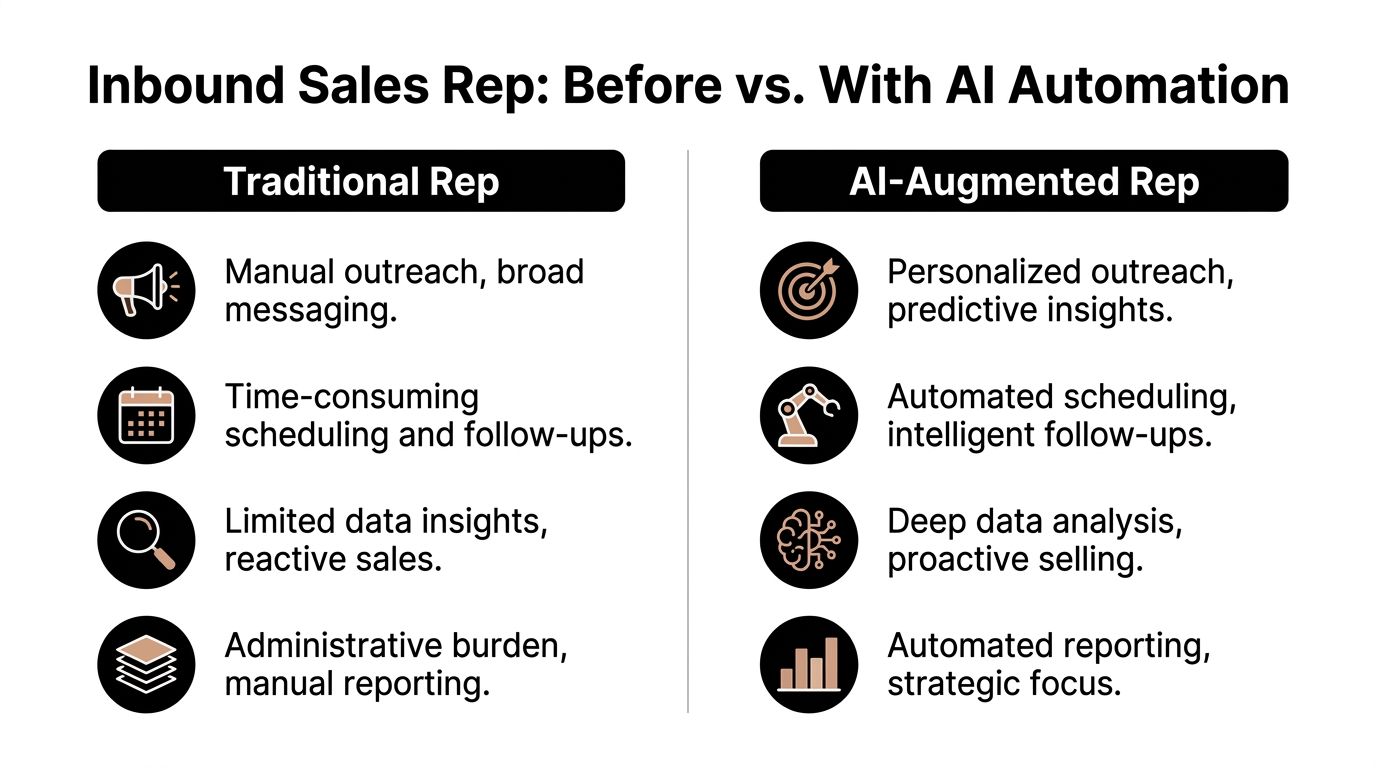
In a manual setup, the rep acts as responder, qualifier, scheduler, note-taker, and closer.
That creates predictable bottlenecks:
The result is uneven execution. Some leads get a great experience. Others slip.
Now compare that with an AI-supported system.
An AI receptionist can answer calls immediately, collect intake information, respond by text, route or book appointments into Google Calendar, and push conversation data into the CRM through integrations or post-call webhooks. That changes the inbound sales rep’s job from handling everything to handling the moments where human judgment matters most.
A tool like My AI Front Desk’s workflow automation approach fits naturally. It supports inbound operations with features such as Google Calendar integration, CRM integration, texting workflows, unlimited parallel calls, post-call webhooks, multi-language support, and call recordings. For a small business, those features remove a lot of repetitive front-end work before a human rep steps in.
The strongest argument for AI in inbound is not hype. It is response time.
Responding to an inbound lead within 25 seconds can increase conversion rates by up to 9x, according to Harte Hanks on speed-to-lead benchmarks. Humans can hit that sometimes. They cannot do it consistently across lunch breaks, evenings, call spikes, or simultaneous conversations.
AI can.
That matters most in small businesses because the owner often assumes missed speed is a staffing problem. Sometimes it is. Often it is a workflow problem.
AI should not replace the parts of selling that require nuance.
Keep these with the human rep:
The best setup is division of labor, not blind automation.
AI handles first response, intake, routing, reminders, and logging. The inbound sales rep handles diagnosis, persuasion, and commitment.
If a human rep spends the day booking and chasing, you hired a seller and turned them into an admin.
A traditional rep starts the morning with voicemail cleanup.
An AI-augmented rep starts with a queue of already-captured conversations, organized notes, booked meetings, and clearer priority signals. That rep can spend more time in real sales conversations and less time recreating them from memory.
That is the upgrade small businesses should care about. Not “AI replacing sales.” Better use of scarce human selling time.
The inbound sales rep role is not shrinking. It is getting sharper.
Businesses still need people who can listen well, qualify, ask better questions, and move buyers toward a confident decision. That human part does not go away.
What changes is the workflow around that person.
The companies with an edge are not the ones forcing humans to do every repetitive step by hand. They are the ones combining human judgment with systems that answer faster, capture more context, and keep the pipeline organized without constant babysitting.
For a small business owner, that means the right question is no longer, “Do I need an inbound sales rep?” The better question is, “Which parts of inbound should a skilled rep own, and which parts should technology handle automatically?”
Get that split right, and the role becomes far more valuable.
You stop paying human talent to chase missed calls and type notes. You let them do the work that closes business.
If your business is missing calls, replying slowly to web leads, or wasting staff time on scheduling and qualification, My AI Front Desk is worth evaluating. It gives small businesses an AI receptionist layer for inbound lead capture, texting, calendar booking, and CRM-connected workflows so human reps can focus on qualified conversations instead of front-desk repetition.
Start your free trial for My AI Front Desk today, it takes minutes to setup!


