
At its heart, an inbound call center solution is a system built to handle all your incoming customer communication. It takes everything—phone calls, text messages, even website inquiries—and organizes it into something you can actually use to grow your business. Think of it as a super-smart digital receptionist who’s on the clock 24/7, making sure you never miss a lead and that every customer gets a professional response.

For most growing businesses, a missed call isn’t just a minor slip-up. It's lost money. It's a missed opportunity. When a potential customer can't get ahold of you, they don’t wait around—they just call your competitor. An inbound call center solution fixes this problem head-on by creating a reliable, professional front door for your business.
It’s like the central nervous system for all your customer interactions. Instead of calls ringing endlessly at an empty desk or going to a generic voicemail box that never gets checked, the system intelligently manages every single contact. It organizes, routes, and captures critical information, turning what was once a chaotic mess into a smooth, efficient process.
Let's break down exactly what these solutions do on a day-to-day basis. The table below outlines the core functions you should expect and how they directly benefit a small business like yours.
Ultimately, these systems are designed to turn every customer touchpoint into a positive, productive interaction, helping you build a reputation for great service.
This technology is specifically built to crush the problems that hold businesses back. It’s all about systematically getting rid of the daily frustrations that keep you from scaling up. A solid inbound solution helps you:
The demand for these systems is exploding for a reason. The global call center market is on track to hit $500.1 billion by 2030, fueled by rising customer expectations and the relentless growth of e-commerce. In fact, since 2020, a whopping 61% of business leaders have seen their call volumes spike, which puts a huge strain on businesses that aren't prepared. You can dig into more call center statistics on CMSWire.com.
At its core, an inbound call center solution is about two things: control and opportunity. It gives you control over your customer experience and creates the opportunity to convert every single inquiry into a tangible business result.
The best part? Modern solutions, especially those using AI, have made this technology accessible to everyone. You no longer need a massive budget or a physical office full of agents to provide world-class service. Today's tools offer sophisticated features that were once only available to huge corporations, completely leveling the playing field for small businesses ready to grow.
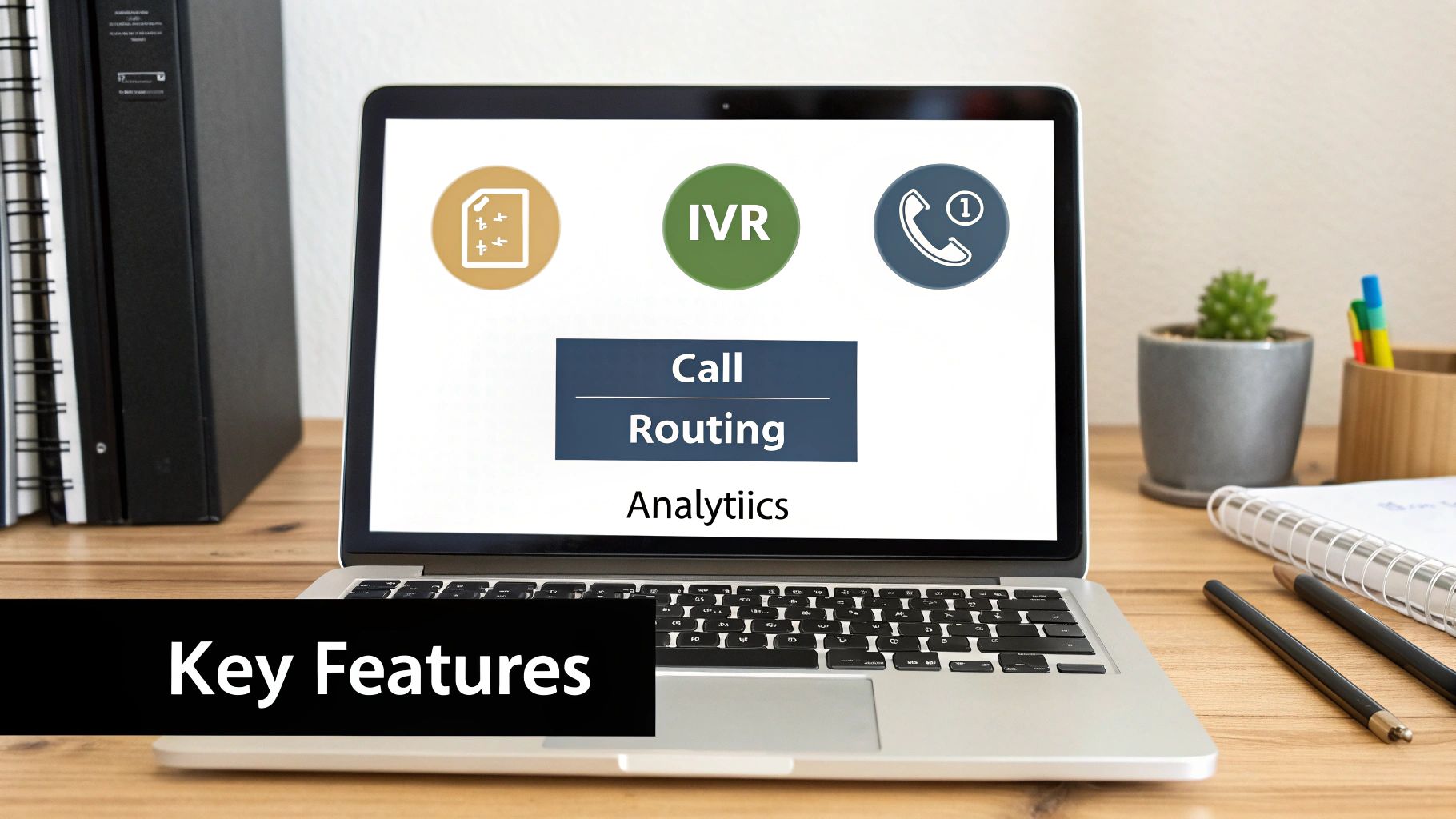
Alright, you get what an inbound call center solution is. Now, let’s dig into the specific features that take it from a simple phone line to a powerhouse for your business. These aren't just flashy add-ons; they are the gears that make the whole system hum, turning every ring into a smooth, productive interaction.
Think of these features like a highly-trained team. Each tool has its job, but they all work together to make sure no opportunity gets dropped and every customer feels taken care of. Any truly great inbound call center solution is built on a foundation of smart call management, effortless automation, and sharp analytics.
These aren't just technical bells and whistles. They are practical solutions to the real-world headaches small businesses face every day. Let's break down what you should really be looking for.
This is the absolute heart of any inbound system. It's all about getting your callers where they need to go, quickly and without any fuss. Good call management creates a smooth journey for the customer from the second they dial your number.
Bad call management? That just leads to long hold times, frustrated callers, and a reputation you don't want. Let's get it right.
Key features here include:
These tools work together to create a polished, professional first impression. Instead of chaos, you get precision. That translates directly into a better customer experience.
The real magic happens when your inbound solution connects with the other tools you already rely on. This is what turns it from a siloed phone system into the command center for all your customer interactions. When your systems talk to each other, your team suddenly gets a whole lot more efficient.
For example, when you connect your call center solution to your Customer Relationship Management (CRM) software, every call can automatically log a new lead or update a customer's record. No more tedious manual data entry, and your customer history is always spot-on.
A truly effective inbound solution doesn’t just answer calls—it acts on them. By integrating with tools like Google Calendar or Zapier, it can schedule appointments, send follow-up texts, and trigger workflows across thousands of other applications.
Other must-have automation features include:
These features slash manual work and make sure important information gets where it needs to go, instantly. To see just how far this can go, you can check out some of the most advanced AI receptionist features that are changing how businesses communicate.
You can't fix what you can't see. Any top-tier inbound call center solution has to give you a clear, detailed analytics dashboard. This is your command center for understanding call volume, agent performance, and how well the whole system is working.
With solid analytics, you stop guessing and start making decisions based on actual data. You can spot your busiest call times and adjust staffing, see which marketing campaigns are actually making the phone ring, and track key metrics to prove the system is paying for itself. You'll want to keep an eye on things like call volume, average wait time, and how many issues get resolved on the first call.
Artificial intelligence isn't some far-off concept from a sci-fi movie anymore. It’s here, right now, solving very real, very practical problems for businesses every day. When we talk about an inbound call center solution, AI is like adding a superstar player to your team—a force multiplier that handles all the repetitive, time-consuming tasks. This frees up your human staff to focus on the conversations that actually grow your business.
Think of it less like a phone system and more like an intelligent gatekeeper. One that instantly understands what each caller needs. That's the heart of what AI does. It’s not just about answering the phone faster; it's about handling calls smarter, with a level of speed and precision a human team just can't match on its own.
The most visible and immediate way AI is changing the game is with the AI receptionist. Forget those clunky, robotic phone menus that everyone hates. Modern AI, powered by sophisticated models like GPT-4, can hold natural, fluid conversations that actually build a connection with your customers.
A top-notch AI receptionist can:
This kind of smart automation creates a buttery-smooth experience for your customers while making your internal operations dramatically more efficient. You can see how a modern AI receptionist can be tailored to become the perfect front-line ambassador for your specific business.
AI doesn't just manage calls; it elevates them. It turns a standard inquiry into a perfectly qualified lead, a routine question into a satisfying customer experience, and a missed call into a booked appointment.
This shift is making serious economic waves. The market for AI in call centers is expected to jump from $1.6 billion to $4.1 billion. Businesses already on board are seeing 14% more issues resolved per hour. And by 2025, it's predicted that chatbots will handle 80% of routine interactions. The trend is clear. You can find more stats about the future of contact centers on Plivo.com.
Beyond just answering the phone, AI brings a much deeper level of understanding to the table. It uses something called Natural Language Processing (NLP) to listen to what a caller is saying and figure out their intent on the spot.
Here’s a simple example: a caller might say, "I need to talk to someone about a bill," while another might say, "My recent payment looks wrong." An old-school phone tree would get stuck. But an AI-powered system knows both callers want the billing department and routes them there instantly.
This completely does away with those frustrating phone menus that make customers press "1" for this and "2" for that. The AI just asks, "How can I help you today?" and gets the person to the right place on the first try. While this guide on AI for SEO focuses on search optimization, it highlights the broader power of AI to make digital operations, like call centers, far more streamlined and effective. This kind of smart routing doesn't just make customers happier; it cuts down call times, freeing up your team to help even more people.
Picking the right way to handle your inbound calls isn't just a tech decision—it's a strategic move that hits your budget, your brand, and your ability to grow. You’re essentially deciding who becomes the voice of your business. The three main paths are building a team in-house, outsourcing to a pro, or adopting a modern AI-powered solution.
Each approach comes with its own set of trade-offs. The best choice really boils down to your specific business goals, and it’s a balancing act between cost, the ability to scale, and how much control you want over the customer experience. Let's break down how they stack up.
Hiring your own team gives you the ultimate level of control. These employees live and breathe your company culture, develop deep product knowledge, and are 100% dedicated to your brand. This model is perfect for businesses with really complex products or those handling sensitive customer data where direct oversight is a must.
But that control comes with a hefty price tag. You're on the hook for everything: salaries, benefits, training, equipment, and office space. Need to scale up? Get ready for a lengthy hiring process. And offering 24/7 coverage can be almost impossible for a small business budget.
Handing off your calls to a third-party service can slash your direct costs. It gets rid of all the overhead tied to hiring and managing a team, and many services offer round-the-clock availability right out of the box. It’s a fast track to expanding your support capacity without a massive upfront investment.
The flip side is a potential loss of control over your brand’s voice and the quality of service. Outsourced agents are juggling calls for multiple companies, so they might not have the same passion or in-depth knowledge as someone on your own payroll. You run the risk of delivering a generic, impersonal experience that just doesn't feel like you.
This simple decision tree can help you see if your needs lean more toward a human touch or an AI-driven approach.
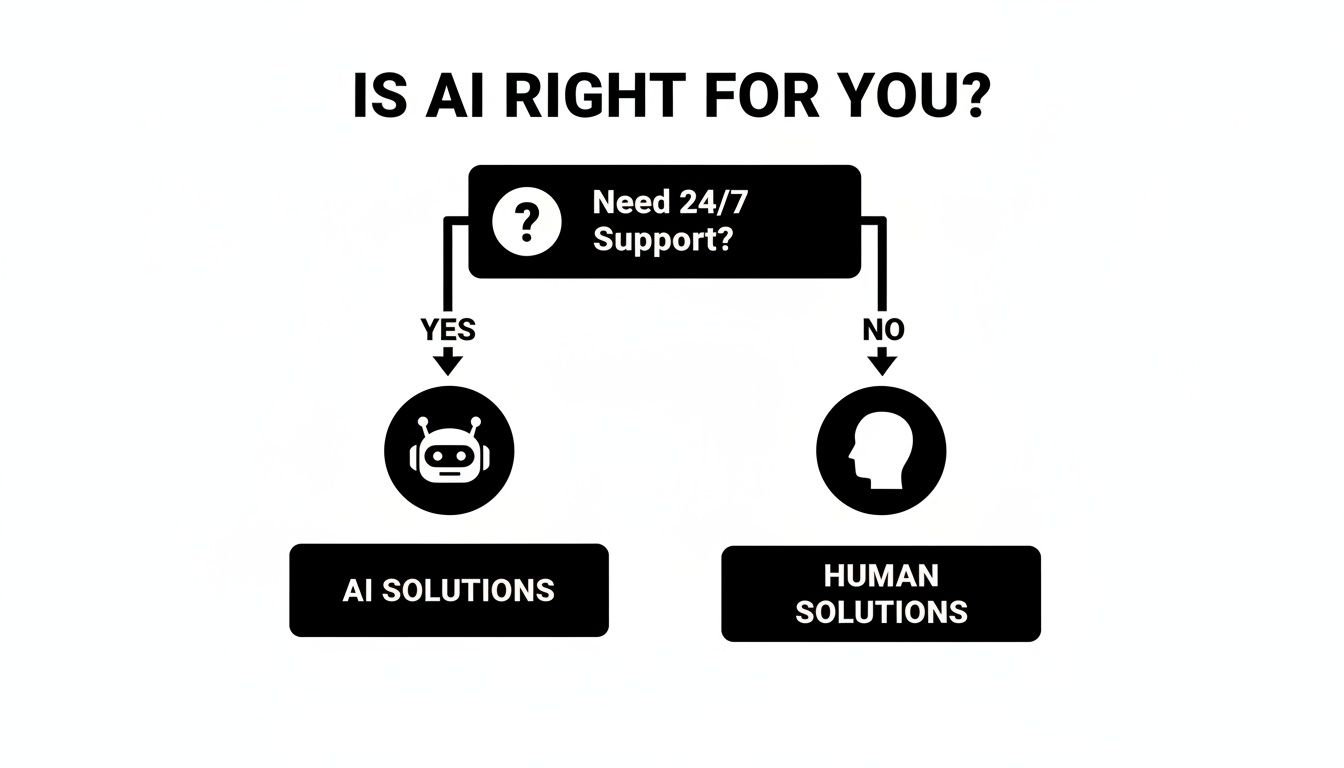
As you can see, the need for constant availability is often the tipping point for bringing in an automated solution.
The AI-powered inbound call center solution steps in as a powerful hybrid, giving you the best of both worlds. It delivers the perfect brand consistency and scalability of an automated system while keeping costs low and predictable. An AI receptionist can handle an unlimited number of calls at once—so you never miss a lead—and it operates 24/7 without any extra staffing costs.
An AI solution offers infinite scalability with perfect consistency. It’s like having your best agent on every single call, every single time, at a fraction of the cost of a traditional team.
This model lets you keep total control over the entire conversation. You customize the scripts, you set the tone, and you define the workflows, making sure every single interaction is a perfect match for your brand. For a more detailed look, you can explore a direct in-house vs outsourced vs AI solution comparison and see the numbers for yourself.
To make things even clearer, the table below gives you an at-a-glance look at how these three models compare across the metrics that matter most to a growing business.
When you line them up, the choice becomes clearer. While an in-house team offers deep brand immersion and outsourcing provides a quick fix for staffing, the AI-powered solution stands out as the modern, cost-effective, and massively scalable alternative that gives small businesses the power to compete.
Picking the right inbound call center solution is a lot like hiring a key employee. Get it right, and your business transforms. Get it wrong, and you’re stuck with daily headaches. To make a smart choice, you need to look past the flashy marketing and focus on what actually matters for your day-to-day operations.
The whole process starts with a simple, honest look at what your business really needs. Before you even glance at a single vendor, map out your absolute must-haves. Do you need a system that can book appointments straight into your calendar? Is multi-language support a deal-breaker for your customer base? Answering these questions first acts as a filter, immediately weeding out solutions that don’t fit your core goals.
This initial self-check keeps you from getting distracted by features you’ll never touch. Instead, you can build a focused shortlist of vendors that are actually equipped to solve your specific problems.
Once you know what you need, use these core criteria to size up each potential partner. A truly solid inbound call center solution has to deliver on all these fronts, not just one or two. Think of these as the non-negotiables for any modern system.
These three pillars—usability, connectivity, and scalability—are the foundation of a good investment.
With your criteria ready, it’s time to talk to vendors. Don't be shy about asking tough, specific questions that cut through the sales pitch. Your mission is to find out what it's really like to use their platform every day.
A vendor’s transparency about pricing and support says everything about their commitment to customers. Vague answers or hidden fees are massive red flags that point to a difficult partnership down the road.
Here’s a checklist of essential questions to ask any provider you’re considering:
By arming yourself with this structured evaluation process, you shift from being a passive buyer to an informed decision-maker. You’ll be ready to choose an inbound solution that becomes a genuine asset for your business's growth.
Choosing the right inbound call center solution is just the start. The real magic happens when you get it running and start seeing the results. A smooth setup is key to capturing leads and boosting your service right out of the gate, setting you up for real, measurable growth.
Getting your new solution up and running shouldn't be a headache. Most modern platforms are built for a quick launch, letting you go live without needing a degree in computer science. The idea is to weave the new system into your daily routine with as little fuss as possible.
Kicking things off comes down to a few simple but vital steps. Following a plan ensures you've covered all your bases and tailored the solution to fit your business. Nailing this initial setup is everything for long-term success.
Here’s a practical checklist to get you through it:
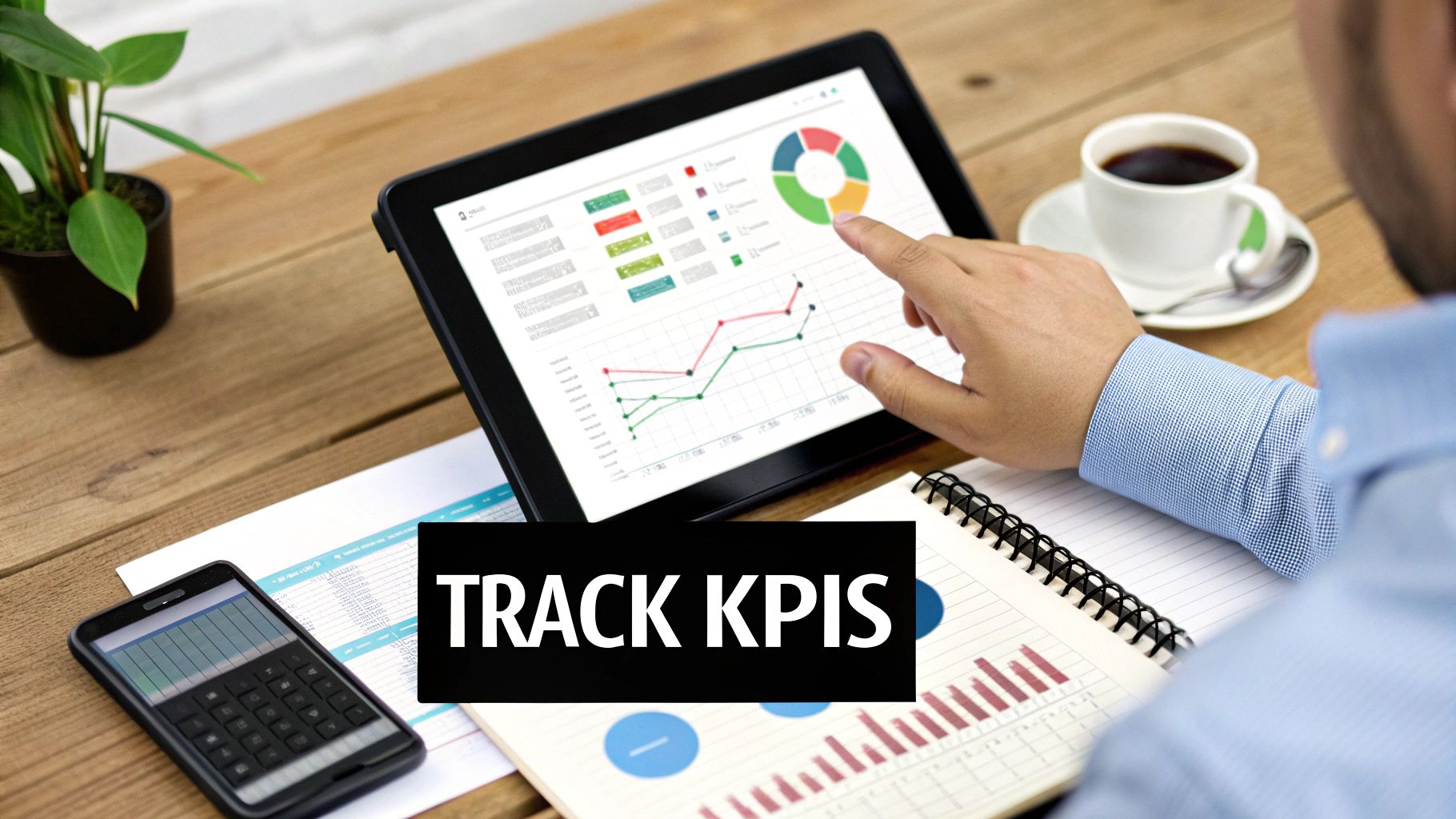
Once you're live, it's all about performance. It’s easy to drown in data, but success isn't about tracking every single metric under the sun. Instead, you need to zero in on the Key Performance Indicators (KPIs) that actually show your business is getting healthier and that your investment is paying off.
Forget vanity metrics like total call volume. The real insights come from KPIs that tie directly to your bottom line, proving how your inbound call center solution is fueling tangible business growth.
Your solution's analytics dashboard is your mission control. Use it to keep an eye on the numbers that really count and make smart, data-backed decisions to sharpen your strategy.
Focus your attention on these high-impact KPIs:
By keeping a close watch on these core metrics, you stop guessing. You get a clear, factual picture of how your inbound solution is performing, which lets you fine-tune your approach and confidently justify the investment. This is how you scale your business sustainably.
Stepping into the world of inbound call center solutions can feel a bit overwhelming. That's perfectly normal. Let's tackle some of the most common questions business owners have, breaking them down into clear, straightforward answers to show you the real-world value of this tech.
You’d be surprised. Modern AI, especially those powered by advanced models like GPT-4, are built for natural, flowing conversations. Forget the robotic voices of the past. They understand context, know when to ask for clarification, and can be customized with over 100 premium voices to perfectly match your brand's personality.
They’re brilliant at handling routine tasks like booking appointments or qualifying new leads. But the really smart part? They can be programmed to instantly transfer a call to a human team member for more complex issues, so your customer experience never misses a beat.
The cost can be all over the map, depending on the route you take. Hiring a traditional in-house agent means shelling out thousands every month for salary, benefits, and overhead. Outsourcing can be just as tricky, often locking you into long-term contracts with billing structures that are anything but simple.
An AI-powered inbound call center solution, on the other hand, is a whole different ballgame. Most operate on a simple monthly subscription with a generous number of calls or minutes included. It’s a scalable, budget-friendly approach that lets you sidestep the costs of hiring, training, and managing more staff.
The real magic of an AI solution is its cost-effectiveness. You get the power of a full-time agent for a tiny fraction of the price, putting professional call management within reach for any business.
Nope, you shouldn't have to. Any reputable provider will make this part easy through simple call forwarding. You get to keep the business number your customers already know and trust. All incoming calls just get routed to the new system behind the scenes.
It’s a completely seamless transition for your customers—they won't notice a thing. Of course, if you want a new number for a specific marketing campaign or a new department, you can usually get one through the service, giving you total flexibility.
If you’re picturing a complicated IT project, think again. Today's solutions are built for business owners, not tech wizards. The setup is usually a guided, step-by-step process you can knock out in less than an hour, no technical expertise required.
When it comes to integrations, look for platforms that play nicely with the tools you already rely on, like Google Calendar for bookings or a direct connection to your CRM. A solid Zapier integration is also a huge plus, as it unlocks the ability to connect with thousands of other apps for automated workflows, all without writing a single line of code. This is what makes a solution fit into your business like it was always meant to be there.
Ready to see how an AI-powered receptionist can completely change your lead conversion and customer service game? Explore what My AI Front Desk can do for your business and start your journey to never missing a lead again. Learn more about our AI solutions.
Start your free trial for My AI Front Desk today, it takes minutes to setup!


