
Thinking about opening your own call center? It’s a lot more than just getting some phones and a list of numbers. You need a smart plan that blends the right business model, the best modern tech, and a team that’s trained to win.
This guide is your blueprint. We'll walk through everything from carving out your niche and getting the legal and financial ducks in a row, to picking the perfect tech stack (think AI receptionists and powerful dialers), and finally, hiring and training a killer team.
Welcome to the definitive guide on how to open a call center. This isn't about building an old-school phone bank; it's about creating a modern, efficient communication hub that actually drives business growth. The path from a simple idea to a humming, fully operational center can feel daunting, but with the right strategy, it's completely achievable.
Let’s be real, a solid launch plan is non-negotiable. To give you a clear picture of what's involved, we've broken down the core components you'll need to focus on.
This table summarizes the essential pillars you need to build on. Getting these right from the start will save you countless headaches and set you up for success.
Each element builds on the last, so following a methodical approach is key. Don't try to jump ahead—nail down one area before moving to the next.
This roadmap breaks down the entire journey into three clear phases: Plan, Build, and Launch.
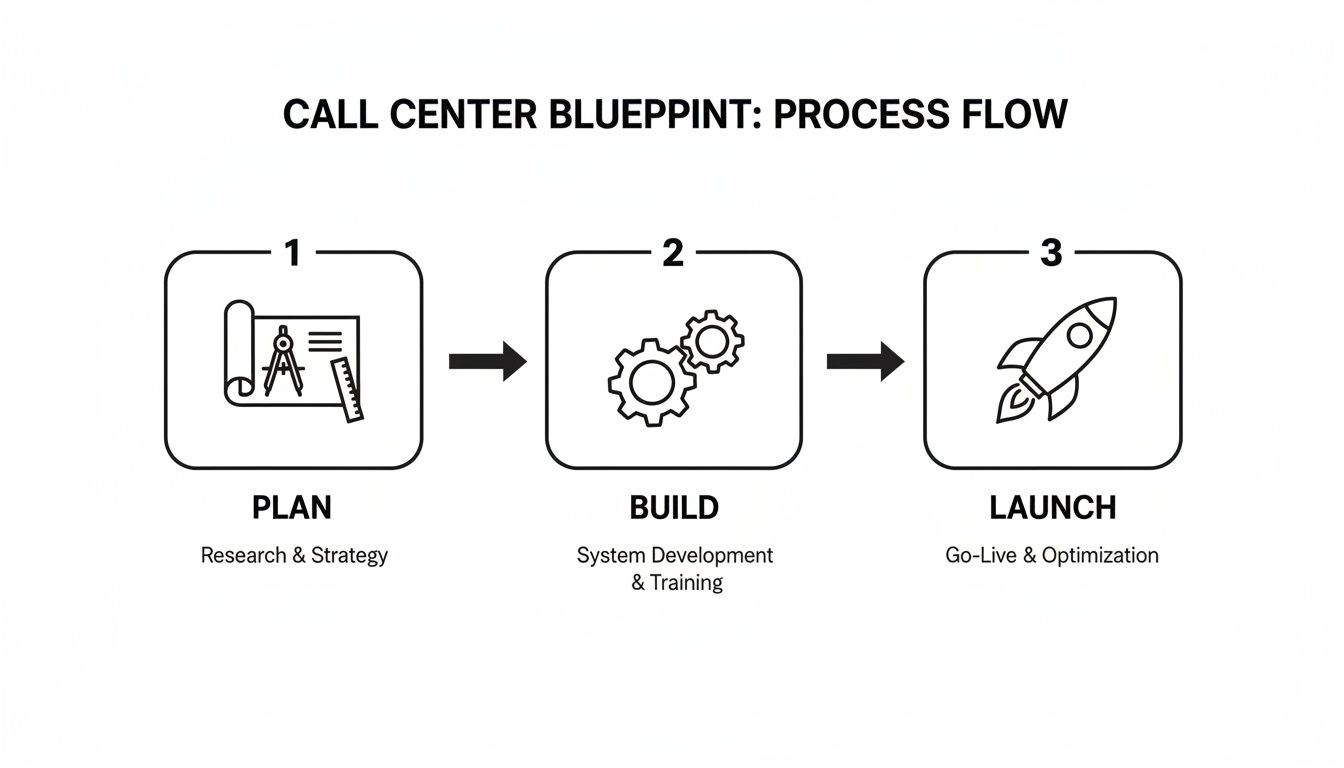
As you can see, each phase builds on the one before it, which is why a step-by-step approach is so critical. From your initial idea all the way to opening your doors, a structured plan is your best friend.
The opportunity here is massive. The global call center market hit $352.4 billion in 2024 and is expected to rocket to over $500.1 billion by 2030. What's driving it? A relentless demand for top-notch customer service.
As you put together your blueprint, always keep an eye on continuous business process optimization. Getting your workflows right from day one makes everything smoother and helps you scale without breaking a sweat.
At the end of the day, success comes down to the right mix of people, processes, and technology. For a deeper dive, check out our guide on the essential steps for a successful call center set up.
Before you even think about taking your first call, you need to lay a rock-solid legal and financial groundwork. I know, this part isn't the most exciting—it's mostly paperwork and planning. But getting it right from day one is what protects you from nasty surprises, keeps you compliant, and builds the stable base you need to actually grow.
Think of it like building a house. You wouldn't dream of putting up walls without pouring a solid concrete foundation first. The exact same principle applies here. This means picking the right business structure, getting registered with the proper authorities, and mapping out a realistic financial plan.

Your choice of business entity will affect everything from how you’re taxed to your personal liability if something goes wrong. For most people starting a new call center, the choice usually boils down to two solid options.
Limited Liability Company (LLC): This is the go-to for most small businesses, and for good reason. An LLC creates a legal wall between your personal assets and your business debts. If the business ever faces legal trouble, your house, car, and personal savings are shielded. It also offers a good amount of tax flexibility.
C Corporation (C-Corp): A C-Corp offers the highest level of liability protection because it creates a completely separate legal entity. The administrative side is more complex, but this structure can be far more appealing to investors if you plan on raising venture capital down the line.
For most entrepreneurs launching their first call center, an LLC is the simplest and most direct path. That said, it never hurts to chat with a legal or financial pro to make sure your choice lines up with your long-term vision.
Once you've picked a structure, it’s time to make it official. This involves a few key administrative hurdles that legitimize your business. Don't be tempted to skip these—failing to comply can lead to hefty fines and legal headaches you really don't want.
As soon as you start thinking about hiring, it's crucial to understand your obligations. Following key HR compliance best practices to avoid legal risks isn't just a good idea; it's non-negotiable for protecting your new venture.
A detailed financial plan is your roadmap to actually making money. This starts with an honest, clear-eyed budget that accounts for all your initial and ongoing expenses.
Pro Tip: Don't just guess at your costs—get actual quotes. Call software vendors, look up commercial real estate listings in your area, and research what the average agent salary is. A budget grounded in reality is your best defense against unexpected cash flow problems later on.
Your startup budget needs to realistically cover several key areas:
Finally, you need to decide how you'll fund all of this. Are you going to bootstrap it with your own savings? Apply for a small business loan? Or will you try to attract investors? Each path has its own set of pros and cons, so weigh your options carefully based on your personal financial situation and how fast you want to grow.
Think of your call center's technology as its central nervous system. It's what dictates how efficiently your agents work, how you connect with callers, and ultimately, how fast your business can grow. Getting this right isn't just about picking some software; it’s about building an operational engine that gives you a competitive edge from day one.
The first big decision you'll face is whether to go with an on-premise or a cloud-based system. An on-premise setup means buying and maintaining your own physical servers and hardware. Sure, it offers total control, but it also comes with a massive upfront cost, ongoing maintenance headaches, and almost no flexibility—a tough pill to swallow for any new business.
Cloud-based solutions, on the other hand, are hosted by a provider and accessed over the internet. For a new call center, this is almost always the smarter way to go. You get much lower startup costs, automatic updates, and the power to scale your operations up or down with just a few clicks. That kind of flexibility is a lifesaver when you're just starting out and can't predict your future needs.
Once you've decided on a cloud-based system, it's time to dig into the specific features that will actually drive your success. Modern platforms have evolved way beyond just making and taking calls. They now pack in automation and intelligence to handle tasks that used to require a ton of human effort.
This platform, for example, integrates key tools like an AI receptionist and CRM into a single, clean dashboard.
Having a unified interface like this means you're not juggling multiple subscriptions, and more importantly, it ensures all your data works together seamlessly.
Here are the non-negotiable features you should be looking for:
Artificial intelligence isn't some futuristic concept anymore; it's a practical tool that levels the playing field for new call centers. The growth in this space is just explosive. The global call center AI market is projected to skyrocket from $1.6 billion in 2022 to $4.1 billion by 2027. This rapid adoption means you can get your hands on powerful solutions that were once exclusive to massive enterprises. You can find more insights on the contact center market over at Plivo.com.
By 2025, it's expected that nearly 95% of all customer interactions will be touched by AI in some way, often through things like sentiment analysis to gauge a caller's mood and intent. This shift allows you to deliver a smarter, more responsive service right from the beginning.
To help you see the practical differences, let’s compare a traditional setup to a modern, AI-powered one.
Here's a quick look at how a modern AI approach stacks up against the old way of doing things. This table should make it clear why embracing new tech is a no-brainer for a new call center looking to be efficient and effective from the get-go.
As you can see, the modern approach isn't just an upgrade—it's a complete transformation of how a call center can operate, saving time, money, and a lot of headaches.
As you gear up to open your call center, think beyond just day one. Your technology stack needs to support your growth, not hold it back. The right platform will come with features designed to help you operate more efficiently as you bring on more clients and agents.
Look for these key operational capabilities:
Choosing your tech stack is one of the most impactful decisions you'll make. By focusing on a flexible, AI-powered, cloud-based platform, you give your new call center the tools it needs to compete and thrive. To stay ahead of the curve, it's also worth exploring the top call center technology trends dominating 2025.
All the cutting-edge tech in the world means nothing without the right people behind the controls. When you're figuring out how to open a call center, never forget that your agents are the living, breathing voice of your clients' brands. Building a great team isn't just an HR function; it's a core business strategy that directly shapes client happiness and your own profitability.
This process is about more than just filling seats. It’s about cultivating genuine brand ambassadors who are invested in your clients' success, from writing the perfect job ad to creating a culture that makes your best people want to stick around.
Before you even think about posting a job, you need crystal-clear clarity on who you’re hiring. Are you looking for empathetic problem-solvers for inbound support? Or maybe you need resilient, persuasive communicators for an outbound sales campaign? Each role demands a completely different personality and skill set.
Your job descriptions should be more than a boring list of duties. Make them distinct and compelling.
Defining these roles with this level of detail doesn't just attract better candidates—it sets clear expectations from day one, which makes performance management a whole lot easier down the line.
With your roles defined, it's time to find people who fit the bill. Experience on a resume is nice, but in a call center, it's the soft skills that truly make or break an agent's success.
Keep an eye out for candidates who naturally demonstrate these qualities:
In the interview, skip the generic questions. Use scenario-based prompts like, "Tell me about a time you dealt with a truly difficult customer. What was the situation and what was the outcome?" This peels back the curtain on their real-world thought process and emotional intelligence in a way hypothetical questions never can.
A classic mistake is hiring purely for technical skills. You can teach anyone how to use your software. What you can't teach is a genuinely positive attitude or innate empathy. Hire for disposition, train for skill.
Great, you've got your new hires. Now the real work begins. A structured, hands-on training program is what will turn promising candidates into confident, top-performing agents.
Your curriculum should be built on three core pillars:
But don't just stop after the first week. The magic is in continuous coaching. Use call recordings to provide specific, actionable feedback. Instead of a vague comment like "be more empathetic," you can point to an exact moment in a call and workshop how it could have been handled differently.
High turnover is the silent killer of call center profits. The secret to keeping your best agents is creating a supportive culture where people feel valued and see a path for growth. To get a better handle on the skills that define a top-tier agent, check out our guide on the 10 essential skills you gain from call center experience.
Make performance reviews a regular thing, but frame them as development conversations, not critiques. Celebrate the wins, offer constructive feedback on areas for improvement, and lay out clear pathways for advancement. When your agents can see a real future with your company, they'll bring their A-game every single day.
Once your call center is live, the game changes. You’re no longer just building; you’re refining. Trying to run a call center without solid data is like flying blind—you’re moving, but you have no clue if it’s in the right direction. This is where your focus has to shift to daily operations and tracking the right Key Performance Indicators (KPIs).
A data-driven culture isn't some corporate buzzword; it’s the engine that powers constant improvement. It’s what lets you spot weaknesses, double down on what’s working, and make smart decisions that directly impact your bottom line. Forget gut feelings. It’s time to manage your center with real, tangible evidence.
You could track dozens of metrics, but for a new call center, only a handful really move the needle. Nailing these core KPIs will give you the most bang for your buck without drowning you in data.
These are the metrics you should live and breathe:
First Call Resolution (FCR): This is the big one. It measures the percentage of customer issues you solve on the first try. A high FCR is a golden indicator of agent efficiency and happy customers. It proves your team is well-trained and your processes actually work.
Average Handle Time (AHT): AHT tracks the full duration of a customer interaction, from the moment the phone rings to any after-call work. While a lower AHT often signals efficiency, you have to balance it with quality. Rushing callers off the phone is a recipe for disaster. We break this down completely in our guide to call center average handle time.
Customer Satisfaction (CSAT): This is your ultimate report card. Usually gathered through simple post-call surveys ("Rate your experience from 1 to 5"), CSAT scores tell you exactly how callers feel about the service they just received. It’s direct, unfiltered feedback on agent performance.
Monitoring these numbers shouldn't be a chore. Modern call center platforms have analytics dashboards that make it easy to spot trends and fix issues before they blow up.
Consistency is the foundation of quality service. To get there, you need Standard Operating Procedures (SOPs)—basically, a playbook that guides your team through their day-to-day tasks. Good SOPs eliminate guesswork and ensure every agent handles common scenarios the same way, every single time.
To start, your SOPs should cover the essentials:
A well-written SOP is more than just a set of rules—it’s an empowerment tool. It gives your agents the confidence to act decisively because they know they’re following a proven, approved process.
Think of your SOPs as living documents. They should evolve. As you analyze your KPIs and listen to call recordings, you’ll find better ways to handle things. Use those insights to regularly update your procedures. This constant feedback loop—measure, analyze, refine—is how you build a resilient, successful call center that truly delivers.
You've built the engine; now it's time to get it on the road. A perfectly equipped call center is just a line item in your budget until you start bringing in clients. This is where your go-to-market strategy comes into play—it's your battle plan for attracting, engaging, and signing the businesses that desperately need what you're offering.
First things first: you have to get laser-focused on who you're actually selling to. "Small businesses" is way too broad. You need to nail down your Ideal Customer Profile (ICP). Are you the perfect fit for dental offices drowning in appointment calls? Or maybe law firms that can't afford to miss a single new client inquiry?
Knowing your niche inside and out lets you craft a message that hits them right where it hurts, speaking directly to their biggest headaches.
Once your ICP is crystal clear, you need a value proposition that makes you the obvious choice. What specific, painful problem do you solve better than anyone else? It could be guaranteeing 24/7 lead capture so they never lose a prospect after hours. It could be drastically reducing appointment no-shows or simply handling overflow calls so their team can focus on the customers in front of them.
Your marketing needs to hammer this message home, consistently and clearly.
For a new call center, a smart marketing mix usually involves a few key channels:
Your pricing model is a massive piece of this puzzle. You've got to find that sweet spot between being competitive and actually being profitable. Common models include a straightforward per-hour rate, a per-call or per-minute fee, or a flat monthly subscription for a block of minutes or services.
Don't fall into the trap of undervaluing your service. While it’s tempting to be the cheapest option, most businesses will happily pay a premium for reliability, professionalism, and real results. Sell the value and the ROI you deliver, not just the price tag.
Looking for a shortcut to faster growth? Want to offer more advanced services without the headache and massive expense of building them yourself? This is where white-labeling becomes your secret weapon.
Instead of burning through capital trying to develop your own AI receptionist or a sophisticated outbound dialer, you can partner with a platform like My AI Front Desk. Our white-label program lets you rebrand our entire suite of powerful, AI-driven tools as your own.
Suddenly, you can offer clients cutting-edge 24/7 automated services under your company's banner. It instantly expands your service catalog and makes you look like a much bigger player than you are.
This approach lets you punch way above your weight, bringing enterprise-level technology to small businesses that could never afford it otherwise. You manage the client relationship and billing through our simple Stripe integration, while we handle all the complex tech on the backend. It's the smartest, fastest way to scale your offerings and your profitability from day one.
As you start sketching out your new call center, you're bound to run into a few big questions. Getting the right answers early on can save you a world of headaches and help you make much smarter decisions from the get-go.
Let's tackle some of the most common hurdles we see entrepreneurs face when they're just starting out.
You can get a small, virtual call center up and running with 5-10 agents for somewhere between $10,000 and $25,000.
What does that cover? This initial investment usually handles the essentials: business registration, software subscriptions for your phone system and CRM, a small marketing push to get your first clients, and the first month of agent salaries.
One of the biggest ways to keep those startup costs down is by choosing a cloud-based, AI-powered platform. These systems roll critical tools like an AI receptionist and an integrated CRM into a single, predictable monthly fee. This completely sidesteps the need for a huge upfront spend on hardware or juggling multiple expensive software licenses.
For nearly every new call center, the answer is a virtual (or remote) model. It’s the most practical and budget-friendly way to start.
Going virtual immediately wipes out massive overhead costs like office rent and utilities, which can bleed a new business dry. Plus, a remote setup blows the doors wide open on your talent pool—you're no longer limited to hiring people who live within a 30-mile radius of an office.
Sure, a physical office might still be required for niche industries with iron-clad data security or compliance rules. But honestly, modern cloud technology and tight security protocols have made the virtual model a rock-solid and effective option for the vast majority of businesses today.
Key Takeaway: The virtual model isn't just a cost-saving measure. It’s about building a more agile and scalable business from day one. You can adapt on the fly to client demands without being shackled to a long-term commercial lease.
You're not going to out-muscle the big guys, so you have to out-smart them. The way you win is by being more nimble, more focused, and more technologically savvy.
Forget trying to be everything to everyone. Instead, specialize in a niche market—think medical practices, law firms, or home service companies. This focus lets you build deep industry expertise and create services that are perfectly dialed into what those specific clients need. It's a much easier sale than a generic "we answer phones" pitch.
Your other big advantage is modern AI. You can offer superior service at a lower cost. An AI receptionist, for example, provides true 24/7 availability that larger competitors can only dream of matching without an enormous payroll. Offering a sophisticated white-label solution also gives you a massive tech advantage without the R&D budget, letting you punch way above your weight.
Ready to build a modern, efficient call center without the massive upfront cost? My AI Front Desk provides the AI-powered tools you need, from a 24/7 receptionist to an automated outbound dialer, all under one simple platform. https://myaifrontdesk.com
Start your free trial for My AI Front Desk today, it takes minutes to setup!


