
It’s easy to think of a business phone number as just a string of digits, a simple utility for people to call you. But that’s a huge missed opportunity. To choose a phone number that works for you, you need to see it as a core piece of your marketing—an asset that builds local trust, improves brand recall, and has real technical implications for your business.
This choice is one of the first impressions you make, and it directly shapes how customers see you and how easily they connect with you.

Long before a potential customer speaks to you or your team, they see your phone number. It’s on your website, your Google Business Profile, the side of your company truck, and all over your ads. That number is a silent brand ambassador, working 24/7.
It’s one of the most powerful—and most overlooked—marketing tools you have. It isn't just for making and taking calls; it's a strategic asset. A good number can boost trust, define your service area, and make your brand stick in people's minds. Get it right, and you'll see your call answer rates and lead conversions climb.
Put yourself in a customer's shoes. You live in Chicago and need a plumber, so you do a quick search. You see two ads: one with a familiar 312 area code and another with an out-of-state number. Which one feels more trustworthy?
Almost everyone instinctively dials the local number.
A local area code is a powerful signal. It tells people you're part of their community, not some faceless national call center. For local service businesses—contractors, real estate agents, dentists, local shops—that community presence is everything. That familiar area code might be the one little thing that convinces a customer to call you instead of the competition.
Key Insight: It’s a known fact that customers are far more likely to answer calls from a local area code they recognize. That first answered call is the critical first step in turning a curious lead into a paying customer, making your area code a vital piece of your sales funnel.
Beyond just the area code, the number itself can become an extension of your brand. This is where a little creativity turns your phone number into a killer marketing advantage.
Think about the possibilities:
When you make your number simple and memorable, you're removing friction. You're making it effortless for customers to get in touch. That number becomes a permanent fixture in their mind, so when they finally need your service, you’re the first one they think of.
To help you decide, let's break down the main types of numbers you'll encounter. Each has its own strengths depending on your business goals.
Ultimately, the goal is to pick a number that aligns with how you want customers to perceive your business—whether that's the friendly neighborhood expert or a major national player.
The moment you choose a phone number, you're making a statement. It’s a subtle but powerful piece of your brand identity that instantly frames how customers see you. Are you the friendly neighborhood expert everyone knows and trusts, or a polished national brand with a much broader reach?
The answer often boils down to one critical choice: local or toll-free.
A local number can be your single greatest asset for building community trust. Imagine a home renovation company in Denver using a 303 or 720 area code. To a local resident, that number feels familiar, accessible, and safe. It creates an instant connection, a subconscious thought that, "They get my area. They're one of us."
On the flip side, a toll-free number—think 800, 888, or 877—projects scale and credibility. It tells potential customers you’re an established business that operates beyond a single city. This is the go-to for e-commerce stores, national consulting firms, or any business serving customers coast-to-coast.
For any business that relies on a local customer base, the right area code isn't just a minor detail—it's what gets your phone to ring in the first place. We're all naturally wary of calls from unfamiliar numbers, especially those from out of state. A local prefix immediately bypasses that skepticism.
This isn't just a gut feeling; the data backs it up. With 70.1% of the global population (5.78 billion people) now using mobile phones, according to DataReportal, a familiar number is essential for cutting through the noise. In fact, calls from recognizable local area codes are answered 40-50% more often than those from unknown toll-free numbers. That's a massive potential boost to your lead conversion rates.
Think about it from your customer's perspective. If someone in Austin gets a call from a 512 number versus an unknown 800 number, which one are they more likely to answer? The local one, almost every time. This becomes especially critical when your AI Front Desk is making outbound calls to follow up on leads—a local number ensures those calls actually get picked up.
While local numbers are champions of community trust, toll-free numbers are the gold standard for establishing a national presence. They signal that your business is accessible from anywhere in the country without costing the caller a single penny.
This is non-negotiable for businesses in certain sectors:
Expert Tip: A toll-free number is a great way for a small business to appear larger and more established. It levels the playing field, allowing you to project a professional, national image right from day one, even if you're just a one-person shop.
Getting this choice right is a fundamental step in building your business's communication strategy. To explore this topic in greater detail, check out our complete guide on selecting a business phone number.
To make the decision a little easier, it helps to see the core differences laid out side-by-side. The best choice really hinges on your business model, who you're trying to reach, and where you want to grow.
This table breaks down the pros and cons to help you weigh your options.
Ultimately, this decision is about more than just picking a string of digits. It's about aligning your communication tools with your business goals. A local number anchors you firmly in a community, while a toll-free number gives you the wings to expand nationally.
While local and toll-free numbers are great for establishing credibility, a vanity number does something entirely different—it transforms your phone number into a killer marketing tool. These are the custom numbers that spell out words or phrases, making them incredibly easy for people to remember. For any business that relies on brand recall, they're a game-changer.
You’ve seen them everywhere: 1-800-FLOWERS or 1-800-CONTACTS. You instantly know what they do without even seeing their logo. That's the magic of a vanity number. It bakes your service right into your contact info, making you the first call someone thinks of when they need you.
There’s a bit of psychology at play here. The human brain is just wired to remember words and familiar patterns way better than it can a random sequence of numbers. It’s a principle called chunking, and it's precisely why these numbers work so well. A plumber with a number like 555-4-LEAKS is just going to be more memorable than one with a generic seven-digit number.
This isn't just a neat trick; it has a real impact on your marketing budget. When a potential customer hears your number on a local radio ad or spots it on a billboard, a catchy vanity number makes it exponentially more likely they'll actually remember it when they get home. It removes the friction of having to write something down or look you up later.
Key Takeaway: Vanity numbers aren't just contact details; they're active branding assets. They work 24/7 to keep your business top-of-mind, turning a simple phone number into one of your hardest-working marketing tools.
Coming up with the right vanity number is where the fun begins. The goal is to land on something that's not just memorable but also crystal clear about what you offer. A clever but obscure word can do more harm than good.
Start by thinking about your core services.
Once you've got a list of ideas, you can use online vanity number generators to check for availability. Don't get bummed out if your first few choices are taken; there are often plenty of creative alternatives out there. It also helps to choose area codes for business numbers strategically, as this can open up a wider pool of options.
Getting your hands on a vanity number is usually a pretty straightforward process. You can go through specialized providers or your existing VoIP phone system. The cost varies—it could be a small monthly fee or a more significant one-time purchase for a really popular number.
After you've secured it, plaster it everywhere. Your vanity number needs to be front and center on your:
The more people see and hear your memorable number, the more it becomes synonymous with your brand. That kind of repetition builds incredible brand equity, making sure that when a customer has a problem you can solve, your number is the only one they can recall.
When you're picking a business phone number, you're doing a lot more than just choosing a way for people to call you. You're actually selecting the central nervous system for your entire customer communication setup. A modern business number has to be a flexible tool that can power everything from automated appointment reminders to sophisticated conversations with an AI.
Think about it: that number is the single thread connecting every interaction. It’s on your website, in your emails, across your social media profiles, and in every text you send. If that number can't plug into the tools you use to run your business, you're just creating headaches, missing out on leads, and leaving money on the table.
The goal here isn’t to find a legacy line that just rings. You need a number that fits seamlessly into your tech stack and is ready for the demands of a connected, automated business world.
First things first, any number you consider absolutely must handle both voice calls and SMS text messages. This isn't a "nice-to-have" feature anymore; it’s the bedrock of modern customer engagement. If you skip this, you’re basically cutting yourself off from how a huge chunk of your customers actually want to talk to you.
Just look at the daily workflows that keep a modern small business humming:
If your business number is an old-school landline that can't get texts, you're missing out on all of this. You're forcing everyone into a single, often less convenient, communication channel.
Crucial Takeaway: A voice-only number is a relic. To use powerful tools like an AI receptionist that can text, schedule, and follow up for you, you have to get a number that is fully SMS-enabled from a provider who supports these modern features.
A truly effective business number doesn't just exist on its own. It should act as a pipeline, feeding critical customer information directly into the systems you rely on every day, like your Customer Relationship Management (CRM) platform and your scheduling software.
When a new lead calls, your phone system should do more than just ring. It should be smart enough to automatically create a new contact in your CRM, log the call, and even attach a recording or transcript. This builds a rich, complete history of every customer interaction without you having to lift a finger for manual data entry. To see how this works in practice, you can learn about the core functions of an AI receptionist for small businesses.
Calendar integration is just as much of a game-changer. Imagine a caller wants to book a consultation. An integrated system allows an AI to instantly check your Google Calendar for openings, book the appointment right on the call, and fire off a confirmation text moments later. That's the kind of slick, automated workflow that delivers a seriously professional customer experience.
Your number's technical capabilities are directly linked to your bottom line. It's no secret we live on our phones. In fact, mobile technology is projected to fuel $11 trillion of global GDP by 2030, and some data shows that 72.6% of smartphone owners might use their phone as their only way to get online by 2025. This makes text-based workflows and AI-powered responses absolutely essential for growth.
Choosing the right number unlocks all that potential. It lets you build an automated engine that handles the routine stuff, nurtures your leads, and keeps customers happy—all centered around that one string of digits. As you make your choice, it’s critical to consider the underlying telephony and data connectivity that will support everything. This ensures your number isn't just a passive contact point, but an active, intelligent hub for your entire business.
So, you’re ready to upgrade your business communications. That's a great move. But what about that phone number your customers have saved, the one they see on your van, and the one they actually trust?
Don't worry, you don’t have to start from scratch. You can bring that number with you.
Getting a handle on how to manage your existing number is the key to a smooth transition. You'll hear two terms thrown around a lot: number porting and call forwarding. They might sound alike, but they do completely different jobs. Understanding the difference gives you the freedom to adopt powerful new tools without confusing the very customers you’ve worked so hard to win.
Let's use a simple analogy. Think of it like moving to a new house.
Number porting is like packing up all your furniture (your phone number) and physically moving it to your new address (your new service provider). Once the move is done, your number lives entirely with the new provider. You can cancel your old service because everything has been transferred. It’s a permanent change of address.
Call forwarding, on the other hand, is like setting up mail forwarding at the post office. Your number technically stays with your old provider, but any calls that show up are instantly sent to a different number—like the new one you get with your AI Front Desk. It's a redirect, not a full-on move.
Key Insight: Porting is a full migration of your number to a new service, letting you centralize everything. Forwarding is a simpler, often quicker, way to route calls from an old number to a new one while the old account stays active.
When you're all-in on a new system, porting your number is almost always the way to go. It makes sure your number is properly SMS-enabled and can fully tap into modern tools. The process is regulated to protect you, but it needs your full attention to avoid any hiccups.
Here’s what you absolutely need to do for a seamless port:
The whole thing can take anywhere from a few days to a couple of weeks, depending on the carriers involved. Just be ready for that timeline and plan around it so you don’t have any service gaps.
While porting is the most complete solution, sometimes a simple forward is the smarter, faster play. Call forwarding can be a great temporary fix or even a permanent strategy, depending on your situation.
You should seriously consider forwarding if:
In today's mobile-first world, flexible communication is non-negotiable. By late 2025, there will be over 7 billion smartphones in use globally, with US penetration already at 97%. Businesses have to be reachable everywhere. Tools like call forwarding let you use local numbers to boost answer rates by up to 50%—a massive edge for any outreach. You can find more stats on the dominance of smartphone usage from Exploding Topics.
Choosing the right strategy—porting or forwarding—ensures you can meet your customers where they are, without losing the number they already know and trust.
Alright, you've weighed the pros and cons of local, toll-free, and vanity numbers. Before you pull the trigger, let's run through a final check to make sure the number you've picked is a genuine asset for your business—not just a random string of digits.
This isn't just about picking a number; it's about choosing a core piece of your brand's communication toolkit. The right one makes it effortless for customers to connect. The wrong one can create friction, project a confusing image, or simply fail to keep up with the modern tools you need to stay competitive.
Before you sign on the dotted line, take a minute to ask yourself these five crucial questions. Your answers will tell you if you're on the right track for the long haul.
Does It Match My Target Audience?
If you're a local plumber, does the area code scream "local"? That familiar prefix builds immediate trust. But if you’re an e-commerce brand shipping nationwide, a toll-free 800 number might be better to project a larger, more established presence.
Is It Easy to Remember and Share?
Say it out loud. Does it roll off the tongue, or is it a jumble of random numbers? A memorable number, especially a vanity one like 1-800-FLOWERS, is a marketing powerhouse that sticks in a customer's head long after they've seen your ad.
Is It SMS and Voice Enabled?
This is a deal-breaker. Your business line must support both calls and texts. Without it, you can't integrate with essential tools like AI receptionists, send automated appointment reminders, or follow up with leads instantly via text. A voice-only line is a major handicap in today's world.
This simple flowchart can help visualize the first fork in the road—whether you're bringing an existing number over or getting a new one.
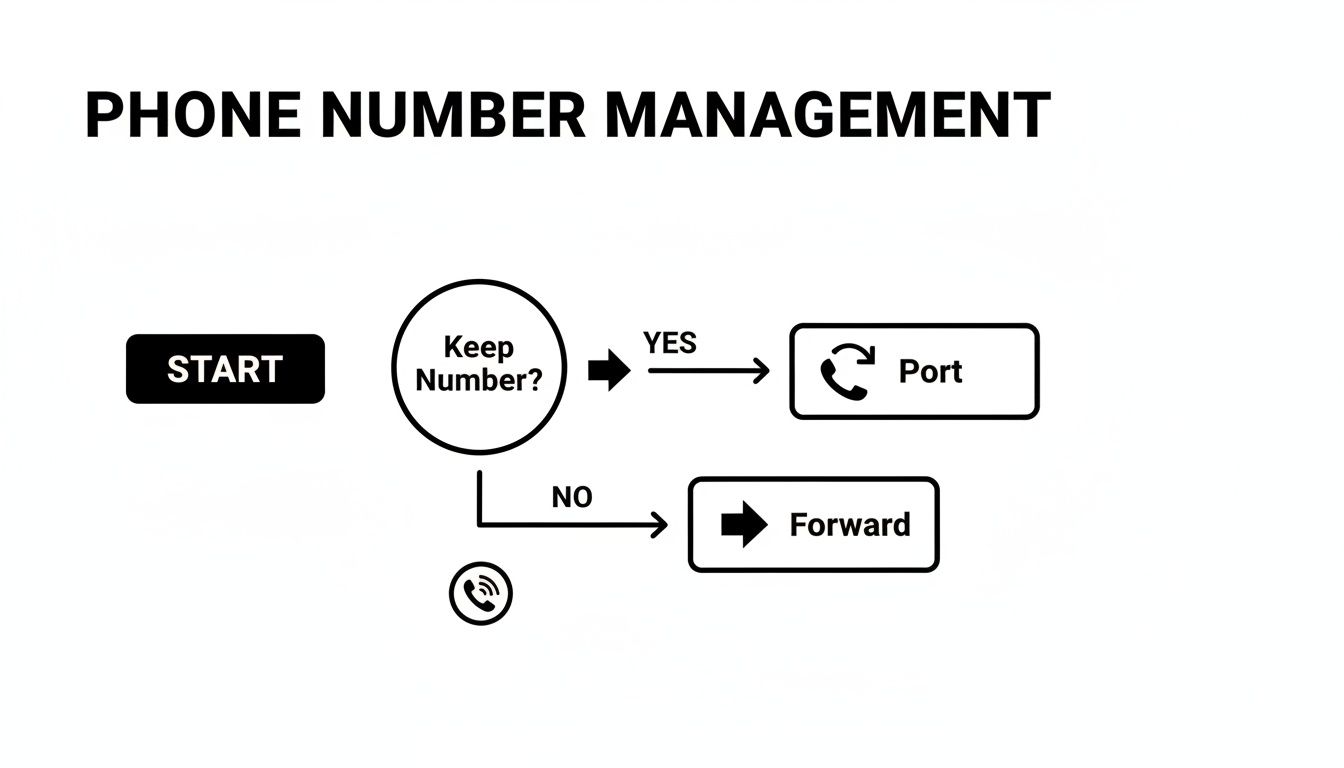
As the chart shows, if you’re keeping your current number, your choice is between porting it for full integration or forwarding it for a quicker setup.
Beyond the basics, a couple more checks will ensure you choose a phone number that works for you, not against you.
Can I Port My Number if Needed?
Always confirm that the number you pick is portable. This gives you the freedom to switch service providers down the road without losing the brand equity and customer recognition you’ve worked so hard to build. Don't get locked in.
Does It Align with My Brand Image?
What vibe does the number give off? A clean, simple set of digits can feel professional and buttoned-up. A quirky vanity number might be perfect for a creative or fun-loving brand. Make sure it feels like you.
Final Thought: Think of your business phone number as a long-term investment. Taking the time to answer these questions ensures you pick a number that doesn't just work today but grows with you for years to come.
For a deeper dive into the next steps, check out our guide on setting up your new business phone number.
As you get closer to picking your number, a few specific questions usually pop up. Let's tackle the most common ones business owners ask so you can finalize your decision with confidence.
You absolutely can. This is one of the biggest perks of modern VoIP (Voice over Internet Protocol) systems—you're no longer physically tethered to an area code.
You can pick a number with a local area code from pretty much anywhere in the country. It’s a fantastic strategy for building a local presence in a key market, even if your team is scattered all over the map. For a customer in Seattle, seeing a 206 area code instantly creates a sense of familiarity and trust.
The price tag on vanity numbers can swing wildly. It all boils down to supply, demand, and just how memorable the number is.
It helps to think of it like digital real estate. A prime address (or in this case, a prime number) costs more because it delivers more value through brand recognition and effortless customer recall.
My Two Cents: Don't get bummed out if your first-choice vanity number is already taken or way out of budget. Get creative with variations, try synonyms, or add a relevant number. You can often find a memorable and affordable alternative that still nails your brand's vibe.
For a lot of businesses, the answer is a definite "yes." Using multiple phone numbers is a brilliant and simple way to track your marketing ROI and streamline how your team operates. You just assign different numbers to different campaigns or departments.
For instance, you could slap one number on your Google Business Profile, use another for a direct mail campaign, and give a third one exclusively to your sales team. By tracking the call volume to each, you get undeniable data on which marketing channels are actually making your phone ring. This lets you double down on what’s working and cut the dead weight, getting the most out of every dollar you spend.
Ready to choose a phone number that powers your business with 24/7 intelligent communication? My AI Front Desk provides SMS-enabled local, toll-free, and vanity numbers that integrate seamlessly with our AI Receptionist. https://myaifrontdesk.com
Start your free trial for My AI Front Desk today, it takes minutes to setup!


