
AI is reshaping customer support by streamlining communication across phone, email, SMS, web chat, and social media into a single system. This approach ensures faster, consistent service, reduces costs, and enhances efficiency. Businesses are automating over 80% of customer interactions, enabling 24/7 availability, personalized experiences, and quicker resolutions.
Key takeaways:
Real-world examples include:
With customer demands rising, implementing AI for support is becoming a must for staying competitive.
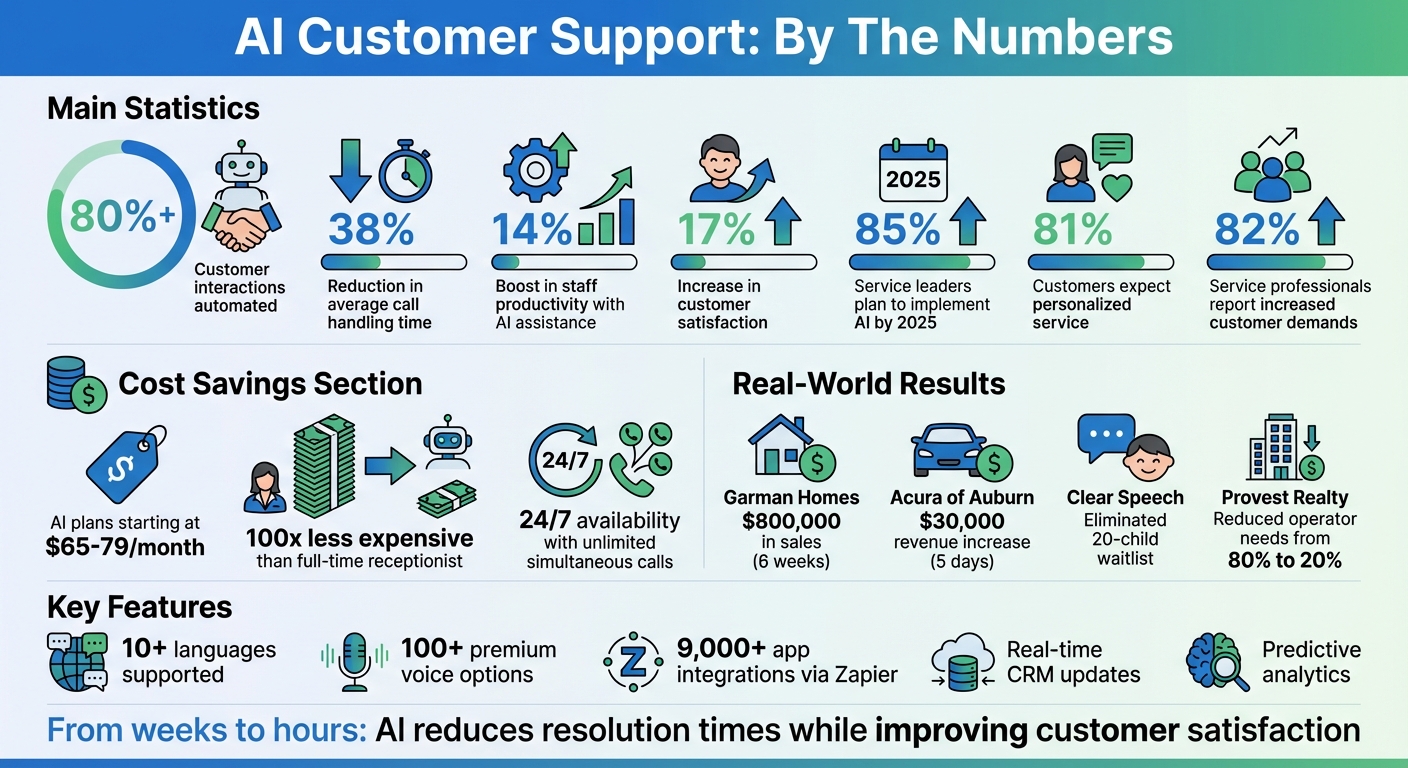
AI Customer Support Benefits: Key Statistics and ROI Data
AI works tirelessly around the clock, managing countless calls and messages simultaneously. This eliminates the frustrations of busy signals, hold music, and long wait times for customers. Today's AI-powered agents go beyond basic tasks - they can handle entire workflows like scheduling appointments, updating customer accounts, and sending personalized SMS links.
"It's like having a full-time receptionist without the time burden. The AI handles everything reliably, and I can update it in real time",
explains Dr. John Hoy from Seattle Foot & Ankle Center.
AI also breaks language barriers with multi-language support, allowing businesses to communicate with customers in their preferred language instantly - no need for additional bilingual staff.
AI tools access complete customer interaction histories, removing the need for customers to repeat themselves. This seamless experience is crucial, especially when 81% of service professionals note that customers now expect a more personalized touch than ever before. During live interactions, AI can identify specific customer needs in real time, instantly sending booking links or payment options via text.
Customization goes further with voice options - businesses can choose from over 100 premium voices to reflect their brand's identity. Advanced systems also analyze past interactions, tailoring responses to individual customers. This level of personalization not only enhances customer satisfaction but also demonstrates how AI can deliver scalable support without sacrificing quality.
AI allows businesses to handle increasing support demands without adding to their staffing costs. By automating over 80% of routine inquiries, AI frees up human agents to focus on more complex, high-value tasks. For example, My AI Front Desk offers plans starting at just $65 to $79 per month - a fraction of the cost of hiring a full-time receptionist. For many small businesses, recovering just one missed appointment or securing a single qualified lead can easily cover the monthly expense.
AI has transformed the way businesses manage customer support by seamlessly linking multiple communication channels into a cohesive system.
AI tools bring together every customer interaction - whether it’s a phone call, text, email, or web chat - into one centralized dashboard. This consolidated view eliminates the need to juggle fragmented data across different platforms. Advanced AI receptionists take this a step further by automatically logging call transcripts, text exchanges, and lead details directly into your CRM, whether you’re using HubSpot, Salesforce, or another platform.
The system operates through a three-layer structure: the Application layer manages communication channels, the AI layer interprets customer intent and executes workflows, and the Model layer uses advanced language models to understand and respond to requests. Tools like Zapier enhance this setup by connecting AI systems with thousands of apps - over 9,000, to be exact - allowing businesses to automate actions across their entire ecosystem. This level of integration ensures that your support channels work together seamlessly, creating a unified experience for both customers and staff.
AI ensures a uniform quality of service regardless of whether a customer reaches out via phone, text, or email. By relying on a centralized knowledge base containing your business FAQs, service details, and policies, AI guarantees that customers receive the same accurate information no matter how they contact you. This consistency also means customers can switch between channels - for example, starting a conversation via text and continuing it over the phone - without having to repeat their concerns.
"AI agents can interpret intent, retrieve authoritative knowledge, apply business rules, and execute actions across backend systems and support channels", explains Intercom.
Even complex tasks follow this same logic. Imagine a customer calling to book an appointment: the AI can handle everything from scheduling the appointment in Google Calendar to sending a confirmation text and updating your CRM - all during the same interaction. This approach doesn’t just answer questions; it resolves issues from start to finish, creating a smoother experience for everyone involved.
AI shines when it comes to automating routine tasks like scheduling appointments, retrieving information, and entering data. For instance, during a phone call, the system can send a personalized booking link via text based on the conversation, eliminating the need for manual follow-ups. Automated webhooks also push data to external systems instantly after calls, while workflows trigger actions in connected apps without requiring human input.
The benefits are measurable. Companies using AI for customer service report a 38% reduction in average inbound call handling time, while support staff assisted by AI see a 14% boost in productivity.
"The integration powers mean every call becomes a chance to automate, document, and improve your process. It's more than just answering phones - it's building smarter workflows for your entire business", says My AI Front Desk.
Building on a unified support framework, these AI-driven tools take customer interactions to the next level, offering seamless integration and consistent service that businesses can rely on.
AI receptionists are always on duty, managing calls, texts, and chats around the clock. They can handle an unlimited number of calls simultaneously, ensuring customers never face a busy signal - even during the busiest times. With instant responses and natural-sounding conversations, interactions feel smooth and efficient.
Businesses using these AI receptionists have seen impressive results, reporting hundreds of qualified leads and notable revenue growth within just weeks of implementation. These systems go far beyond simply answering calls - they can schedule appointments directly in Google Calendar, gather customer details through intake forms, and even send personalized booking links via text during live conversations.
"The AI handles everything reliably, and I can update it in real time. It's like having a full-time receptionist without the time burden",
says Dr. John Hoy from Seattle Foot & Ankle Center.
Thanks to integration with Zapier, businesses can connect their AI systems to over 9,000 applications, automating workflows that save time and reduce manual tasks. For example, after a call ends, the system can automatically update your CRM, send Slack notifications, trigger follow-up emails, and log voicemail transcriptions - all without human input.
This kind of automation has delivered rapid results. For instance, Acura of Auburn used an AI-powered outbound program in October 2024 to reconnect with warm leads, generating $30,000 in new revenue within just five days. Ken Bowen, CEO of Trade Recalls, called it a record-breaking month for the dealership.
During live calls, the AI can send custom booking links - like Calendly or Vagaro - via text in real time. Post-call webhooks ensure all data is instantly pushed to external platforms. According to Gartner, 85% of service leaders plan to test customer-facing generative AI by 2025, reflecting the growing importance of these tools.
Modern AI systems are equipped to handle over 10 languages, including English, Spanish, French, German, Portuguese, Japanese, Mandarin, Arabic, Russian, and Hindi. They can detect a caller’s language and respond in their preferred tongue. On top of that, voice customization options - featuring over 100 premium voices and pronunciation guides - allow businesses to align their AI with their brand identity. This ensures proper pronunciation of brand names, technical jargon, or even local landmarks.
Clear Speech, under the guidance of Operations Manager Tiffany Hurd, harnessed these features to revamp their operations in 2024. They eliminated a 20-child waitlist, captured every referral opportunity, and ensured no calls went unanswered. The result? A support experience that was both polished and approachable.
With a unified support system in place, analytics can now provide a clear picture of performance across all channels. Once implemented, use analytics dashboards to track performance in real-time. These dashboards consolidate interactions from phone, SMS, email, and web chat, allowing you to quickly identify trends as they emerge.
Modern AI dashboards bring together data from various channels, offering a single view of key metrics like call volume, conversion rates, and customer sentiment. Metrics such as engagement rates (how often the AI interacts with customers) and resolution rates (the percentage of issues resolved without human help) are particularly important. Integration with CRMs like Salesforce or HubSpot enhances ROI tracking by linking call data with lead generation insights.
Todd Dusenberry, CEO of Provest Realty, shared how AI transformed his operations. His team managed around 400 calls per week, and the dashboard revealed that AI reduced the need for human operators from 80% to just 20%, allowing his staff to focus on more complex tasks.
"The phones are quiet, the team can focus, and both offices are much calmer. Now only about 20% reach our operator."
- Todd Dusenberry, CEO, Provest Realty
Pro tip: Use your dashboard logs to export phone numbers of interested callers who didn’t book appointments. This data can fuel targeted follow-up campaigns.
These tools pave the way for predictive analytics, which can address issues before they arise.
Predictive analytics take things a step further by forecasting potential problems. By analyzing past behavior, machine learning can detect unusual account activity or service disruptions, enabling proactive intervention before customers even notice. These insights help route inquiries to the most suitable agent, cutting down on unnecessary transfers and reducing wait times. Real-time sentiment analysis, powered by natural language processing, flags signs of frustration, ensuring urgent cases get prioritized.
Companies using predictive tools report impressive results: a 38% reduction in average call handling time and a 17% increase in customer satisfaction compared to those without such tools. For instance, in 2024, a leading UK retail and commercial bank implemented an AI-driven chat system that proactively addressed natural language questions, leading to a 150% increase in satisfaction for specific support interactions.
"AI can spot when something is off - like unusual account activity or a service that's about to lapse - and step in with help customers before they realize it."
Pro tip: Enable real-time sentiment tracking in your dashboard to automatically flag frustrated interactions, allowing your team to step in and resolve issues promptly.
Predictive insights are just the beginning - continuous customer feedback ensures your AI keeps improving.
AI doesn’t just collect feedback; it categorizes responses to uncover recurring issues or documentation gaps. When the system encounters a question it can’t answer, that moment becomes an opportunity to refine the knowledge base, making future interactions smoother.
In 2024, Tiffany Hurd, Operations Manager at Clear Speech, used AI analytics to streamline referral management. By leveraging dashboard data, her team eliminated a 20-child waitlist and captured every referral opportunity, saving hours of manual work each day. Feedback loops also allow AI to test and simulate updates before deploying new responses.
Regularly reviewing call summaries and transcripts generated by AI can uncover common customer questions, helping you refine your knowledge base and improve your sales strategy. A Gartner report predicts that by 2025, 85% of service leaders will pilot customer-facing Generative AI, highlighting the growing role of data-driven refinement.
Pro tip: Review transcription logs to identify areas where your AI struggled. Update the knowledge base with clear, accurate responses to ensure your system continues to improve over time.
AI has revolutionized customer support by seamlessly combining phone, text, email, and web chat into one streamlined system. This integration eliminates the frustrating gaps that used to cost businesses both customer satisfaction and revenue. In fact, many companies now report that AI automates over 80% of customer interactions, cutting resolution times from a week to just an hour. The result? A noticeable boost in lead conversion rates and overall efficiency.
What’s important to note is that AI doesn’t replace human expertise - it works alongside it. Real-world examples show how AI-powered systems can significantly improve lead conversion and revenue, turning customer support into a key driver for business growth.
For small businesses, AI offers an affordable way to scale operations without needing a large team. With customer expectations rising - 82% of service professionals say demands have increased - AI enables round-the-clock, multi-channel support. Solutions like My AI Front Desk, starting at $79 per month, handle unlimited simultaneous calls and integrate with over 7,000 apps through Zapier. This approach can be up to 100 times less expensive than hiring a full-time receptionist.
Beyond customer interactions, businesses are using AI for tasks like appointment scheduling and billing. Real-time analytics provide insights that help refine strategies and improve performance across all channels, creating a feedback loop for continuous improvement.
As customer expectations grow and competition intensifies, adopting AI-driven support is no longer optional - it’s essential. The reality is, AI is already reshaping customer service. The real question is whether your business can adapt quickly enough to keep up. With 85% of service leaders planning to implement customer-facing AI by 2025, the opportunity to gain an early edge is shrinking. Start small, track the results, and build on what works. Your customers demand it, and your bottom line will thank you for it.
AI streamlines customer support by bringing together conversations and data from all channels - whether it's phone, text, email, or chat - into one central system. This means when a customer switches from one channel to another, the AI can pull up their interaction history, understand the context, and deliver accurate responses. The result? A seamless and unified experience for every customer.
By connecting with tools like CRMs, calendars, and workflow automation systems, AI ensures that all information stays current. This eliminates delays and prevents mixed messages. Plus, with advanced natural language models, AI can interpret customer queries consistently and apply the same business rules across all channels. This guarantees customers receive the same level of quality service, no matter how they choose to reach out.
AI-powered customer support offers small businesses a way to streamline operations and cut costs by automating everyday tasks. Whether it’s answering frequently asked questions, managing emails, or handling text messages, AI takes care of the routine so human agents can tackle more complex problems. This not only boosts efficiency but also reduces the need for extra staff and lowers training expenses.
Another advantage is how AI brings all communication channels - like phone, email, text, and web chat - into one platform. This simplifies operations and eliminates the need for multiple tools, along with their often hefty licensing fees. Plus, as your business grows, AI can easily handle increased workloads without requiring you to hire more staff. It ensures round-the-clock support that’s both reliable and cost-efficient, freeing up resources that can be invested in expanding your business.
AI transforms customer interactions by delivering a personalized touch, analyzing real-time data in an instant, and tailoring responses to each individual. Thanks to natural language processing (NLP), it can understand intent, pick out key details, and tap into systems like CRMs. This allows AI to greet customers by name, recall previous conversations, and provide information that’s relevant and timely. The result? Every interaction feels personal and up-to-date.
It doesn’t stop there. AI operates effortlessly across multiple channels - whether it’s phone, text, email, WhatsApp, or web chat. It keeps track of conversation history, so customers don’t have to repeat themselves. For instance, if someone books a reservation over the phone, AI can send a confirmation via text, ensuring a seamless experience. Plus, multi-language support adds another layer of personalization, letting businesses communicate in the language their customers prefer.
Small businesses also benefit from AI’s customizable features. Adjustments like brand voice, pronunciation guides, and workflow rules mean businesses can maintain a consistent tone and style. And with AI providing 24/7 support, companies can deliver tailored customer service without the need for constant manual effort.
Start your free trial for My AI Front Desk today, it takes minutes to setup!


