
Picking a new business number isn't just about grabbing any random set of digits. It's a real strategic move that helps shape how customers see your brand. Whether you go for a local, toll-free, or vanity number, each one sends a completely different signal. Your choice has a direct impact on customer perception and can be a surprisingly effective marketing tool.
When you choose your business number, you're really choosing a core piece of your company’s identity. It's often the very first thing a potential customer sees or hears, setting the tone for every interaction that comes after. Don't think of it as just a utility; it's a foundational part of your brand.
This number ends up everywhere—your website, your Google Business Profile, your flyers, your email signature. Its format and area code instantly tell a story about your business before the phone even rings.
The type of number you pick has a genuine psychological effect on people. A local area code, for example, makes your business feel grounded, familiar, and part of the community. This alone can encourage nearby customers to feel more comfortable calling you. Think about it: a bakery in Brooklyn with a 718 number just feels more authentic to locals than one with a generic 800-prefix.
On the flip side, a toll-free number projects a bigger, more established image. It tells people you operate on a national level and are serious about being accessible, which is a must-have for e-commerce brands or national service companies.
Your phone number is your digital handshake. It conveys professionalism, accessibility, and locality before you even say a word. Make sure it's sending the right message about your brand.
Beyond just perception, the right number can be a killer marketing tool. A catchy vanity number like 1-800-GO-SOLAR is incredibly easy for someone to remember from a radio spot or a billboard, which can drive a ton more inbound calls. It turns a simple contact detail into a brand-reinforcing slogan.
Ultimately, your phone number should be a direct reflection of your business goals. Before you decide, ask yourself a few key questions:
Nailing these answers down first ensures the number you choose is actively working for you, not just sitting on a business card.
To make things a bit clearer, here’s a quick breakdown of your main options.
This table sums up the key factors for each number type, helping you make a quick, informed decision based on your business goals.
Each type serves a different purpose, so matching the number to your strategy is the most important step.
Picking a phone number isn't just another task on your to-do list—it's a strategic move. Before you grab the first available number, take a step back and think about what you actually want it to do for your business. The right number is like a silent ambassador for your brand, shaping how people see you before they even dial.
Think about it. Are you the neighborhood contractor trying to become the go-to name in your community? If so, a phone number with a familiar, local area code is non-negotiable. It’s an instant signal that you're local, which builds a surprising amount of trust and makes potential customers feel more comfortable calling you.
The perfect number for a corner coffee shop is worlds apart from what a national e-commerce brand needs. That coffee shop thrives on its local vibe; a (718) number in Brooklyn feels right, like it belongs there. On the other hand, an online store trying to scale across the country needs to look bigger and more established. That’s where a toll-free number, like an (888) or (877), comes in. It immediately tells customers they can call from anywhere, free of charge.
The real question isn't just "What number should I get?" It's "What story do I want my number to tell?" Your answer will point you straight to the right choice, whether that’s building local credibility or establishing a nationwide brand.
Getting this right is more important than ever. The global call center market shot up to $352.4 billion in 2024 and is expected to hit $500.1 billion by 2030. That’s a massive market, and with nearly 7.5 billion mobile users out there, your phone number is a key entry point. Modern cloud phone systems let small businesses spin up new numbers in minutes, giving them the same power as the big players.
To make sure your number is pulling its weight, ask yourself a few simple but powerful questions. Your answers will create a clear roadmap.
Thinking through these points ensures you choose a number that actively works for you. For a deeper dive, check out our guide on how your Caller ID can fuel business growth. It’s all about making your number a powerful asset in your marketing toolkit right from the very beginning.
Alright, you've nailed down your business goals. Now for the fun part: picking the phone number that’s going to represent you. It's more than just a string of digits; the type of number you choose sends a powerful, instant message to your customers. Let's dig into the main options: local, toll-free, vanity, and mobile.
Each one shapes how customers see your business, from your size to your accessibility. Getting this right from the start is a huge leg up.
There's a reason local numbers work so well: they build instant trust. When someone sees an area code they recognize, their brain immediately registers the business as part of their community. It feels familiar, and that makes them much more likely to pick up the phone.
Think about it. If you’re a plumber in Dallas, a number starting with (214) or (972) just feels right. It's authentic. An 800-number, on the other hand, can feel distant and impersonal. That local connection can make a real difference in your answer rates, especially since most people are skeptical of calls from unfamiliar, non-local numbers.
Your local number is like a digital storefront sign for your community. It quietly tells customers, "We're here, we're your neighbors, and we're ready to help."
If your vision goes beyond your city limits, a toll-free number is a must-have. Prefixes like (800), (888), and (877) immediately signal a professional, established business that operates on a bigger stage.
This is non-negotiable for e-commerce brands, software companies, or any business with a national footprint. A toll-free number removes any hesitation a customer might have about calling long-distance. It’s a clear signal that you’re serious about customer service, no matter where they're located.
Vanity numbers are pure marketing magic. We're talking about custom numbers that spell out a word, like 1-800-GET-ROOF or 1-888-LAW-HELP. Their superpower? They're ridiculously easy to remember.
Picture someone hearing your ad on the radio while driving. They aren't going to jot down a random ten-digit number. But a catchy phrase? That sticks. It transforms your phone number from a simple contact detail into a genuine branding asset.
To help you weigh your options, here's a quick comparison of the three main types.
Ultimately, the best choice ties back to the goals you set earlier. Are you the trusted local expert, the nationwide provider, or the brand everyone remembers?
For the solopreneur, the consultant, or any professional who’s constantly on the move, a dedicated mobile number offers unbeatable flexibility. It puts communication right in your pocket and is ready for texting—which, let's be honest, is how a huge chunk of your customers prefer to chat.
The key here is using a dedicated mobile number for your business, not your personal one. This creates a professional boundary and keeps all your business communications in one place. We live in a mobile-first world. With projections showing that 72% of internet users will access the web only on their smartphones by 2025, having a business number that's built for both calls and texts isn't just a good idea; it's essential for growth.
If you're ready to dive in, this beginner's guide to buying a telephone number is a great place to start.
Deciding whether to keep your old phone number or start fresh is a major crossroads when you're upgrading your business phone system. It’s a bigger deal than most people think.
For any established business, your number is more than just digits; it’s an asset. It’s printed on your trucks, your business cards, and it’s already saved in your most loyal customers' contacts.
The good news? You don't have to give it up. The process is called number porting, and it lets you move your existing number from your old carrier over to a modern VoIP provider. This is how you keep the number everyone knows while unlocking powerful new tools like an AI receptionist or automated SMS workflows.
For most businesses with any history, porting is the no-brainer option. It’s all about maintaining the brand equity you've worked so hard to build. The goal is a seamless transition for your customers, eliminating the confusion or lost business that can happen when a number suddenly changes.
Picture a local pizza shop that’s used the same number for 20 years. That number is practically woven into the town's fabric. Changing it would be like changing the name of the shop itself—a massive disruption. By porting, they keep that critical line of communication open without missing a beat.
The core benefit of porting is simple: you upgrade your technology without disrupting your customer relationships. You keep your established identity while gaining the tools to serve your clients better.
The process itself is pretty straightforward, but it does require a bit of patience. You can generally expect it to take anywhere from one to four weeks. Your new provider will handle all the technical heavy lifting on the backend. Just remember the golden rule: do not cancel your old service until the port is 100% complete. If you do, you could lose your number for good.
While porting is often the default choice, getting a new number can be a surprisingly powerful strategic move. It’s not just about a fresh start; it’s about aligning your communications with a specific business goal.
Here are a few scenarios where a new number is the smarter play:
Choosing a new number isn't an admission of failure. It's a deliberate decision to use your phone number as a targeted tool for growth.
When you pick a business phone number, you're not just getting a string of digits for customers to dial. You're setting up what can be the central nervous system for all your customer communications. The real power isn't in the number itself, but in what you connect it to.
Think about it: a standalone phone number is pretty limited. It rings, you (or your voicemail) answer, and that's the end of the story. But when you plug that same number into the right software, it transforms from a simple contact point into an intelligent, automated asset for your business.
Modern platforms are built to squeeze every drop of value out of your business phone number. Instead of just being a pipeline for calls, your number becomes the brain of your customer-facing operations. This is exactly where a system like My AI Front Desk comes in, letting you hook your number into a whole suite of smart tools.
This connection unlocks powerful, automated actions that work for you around the clock. You can build workflows where an AI receptionist handles the initial screening questions from a new caller, qualifies them as a lead, and then books a follow-up call directly on your Google Calendar. This isn't just a time-saver; it’s about creating a smooth, professional experience for your customers from their very first interaction.
Your phone number shouldn't just be a line of communication; it should be a source of automation. Integrating it with your business tools allows it to actively work for you, capturing data, scheduling appointments, and ensuring no lead ever falls through the cracks.
Imagine a potential customer calling after you've closed for the day. Instead of hitting a generic voicemail box, they're greeted by a 24/7 AI receptionist. This receptionist can answer their basic questions, grab their contact info, and even text them a link to your online intake form. When you get to the office in the morning, a qualified lead is already waiting for you in your CRM, complete with all their initial details.
Connecting your number to your business tools opens up a world of possibilities. It doesn't matter if you're porting over a number you've had for years or setting up a brand new one—the goal is to create a seamless system where information flows exactly where it needs to go.
Here are a few real-world examples of what this looks like in action:
These kinds of integrations are what separate a basic phone line from a strategic business asset. If you're looking for more ideas, our guide on how to integrate your business phone with an AI receptionist dives deeper into creating these automated systems. Getting your integrations right ensures that every single call becomes an opportunity to build a stronger customer relationship and drive real growth.
Alright, you've picked the perfect phone number. Now comes the critical part: weaving it into your business so smoothly that your customers won't miss a beat. Getting this right from day one is about more than just flipping a switch; it’s a strategic rollout that protects your customer experience and ensures your new number starts paying for itself immediately.
Let's start with the behind-the-scenes tech. Before that number goes live, you'll want to dial in your call forwarding rules, get your AI receptionist's script just right, and set your official business hours. It's crucial to test everything—make sure calls route correctly and voicemail transcriptions are accurate. For a deep dive into the nuts and bolts, our comprehensive guide to business phone number setup can walk you through these initial steps.
The whole process is designed to be straightforward. You get the number, plug it into an intelligent system like an AI Front Desk, and let automation handle the routine customer conversations.
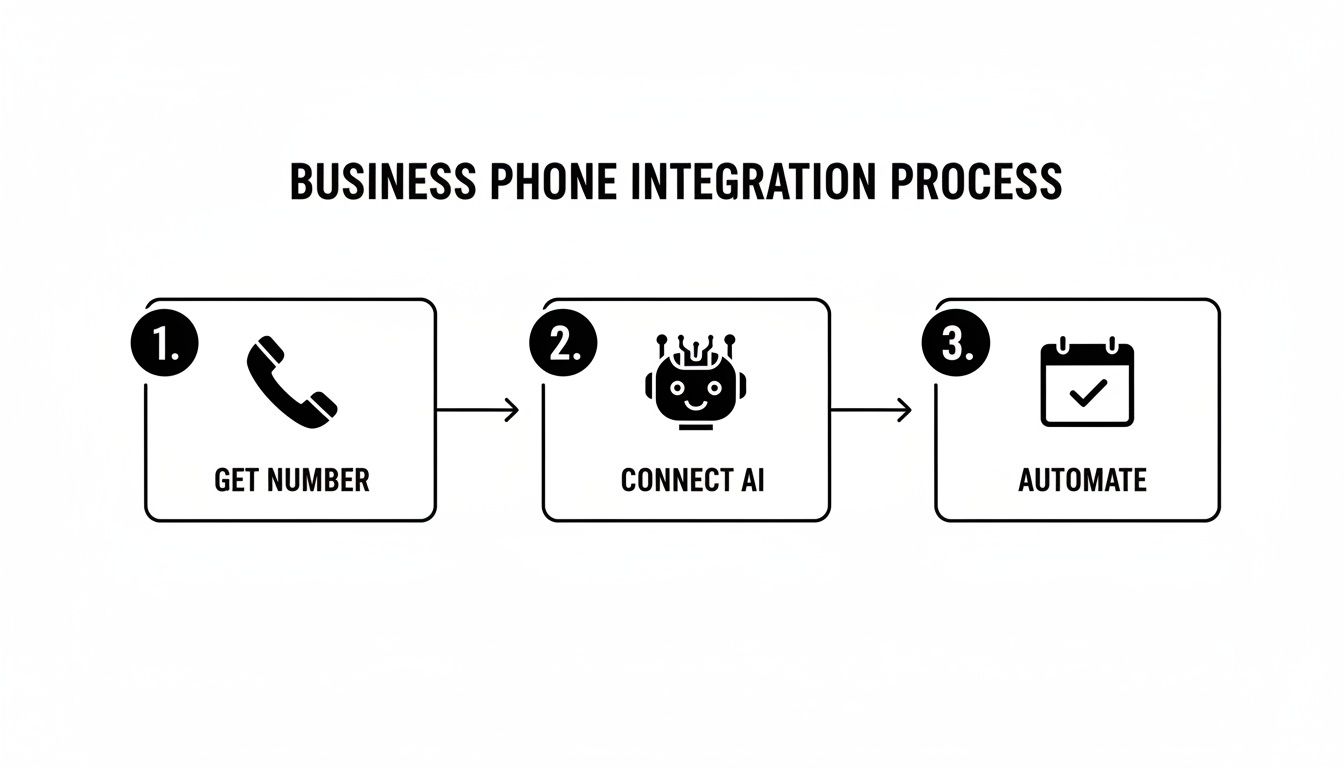
It really boils down to those three steps: acquire, connect, and automate.
With the technical side ready to go, it’s time to update your number everywhere. The last thing you want is an old, disconnected number floating around, causing confusion. I always recommend creating a simple checklist to track this.
Remember, consistency is key. A single outdated number can lead to lost leads and customer frustration. A thorough audit of your online presence is a non-negotiable step in this process.
Finally, you need to communicate the change. If you ported over your existing number, you can skip this. But for a brand-new number, a quick email or SMS blast to your current clients is a smart move. And don't forget your team! Get them trained on any new tools, like the analytics dashboard or automated SMS workflows, so they can hit the ground running.
Getting down to the final details of picking a business number usually brings up a few last-minute questions. Here are some of the most common ones we hear from small business owners, with clear, practical answers.
Absolutely. In fact, it's a fantastic strategy.
Many savvy businesses use both to speak to different audiences. A toll-free number on your website or in national ads gives your brand a polished, professional feel. At the same time, using a local number for things like your Google Business Profile or community flyers helps build local trust and makes neighborhood customers more likely to call.
It’s the best of both worlds—you get that big-company credibility and the friendly, local vibe all at once.
Moving your current number over to a new service provider—a process called porting—usually takes anywhere from one to four weeks. The exact timeline can vary depending on the carriers involved and whether it's a landline or mobile number.
The golden rule of porting is this: Do not cancel your old phone service until the transfer is 100% complete. If you cancel too early, you could lose your number for good. Your new provider will guide you through the process, which typically just involves you signing a Letter of Authorization (LOA).
It definitely can, especially if your business relies on ads people hear but don't see, like on the radio, podcasts, or billboards.
Think about it. A potential customer driving down the highway is far more likely to remember 1-800-NEW-ROOF than a random string of digits.
That instant recall can directly lead to more inbound calls and helps cement your brand in the customer's mind. It turns your phone number from a simple contact detail into a real marketing asset, often delivering a much better return on your ad spend. For brand-focused businesses, it's a smart investment.
Ready to turn your phone number into your most powerful tool for growth? My AI Front Desk equips your business with an AI receptionist that captures leads, books appointments, and provides exceptional service 24/7. Discover how My AI Front Desk can transform your business communications today.
Start your free trial for My AI Front Desk today, it takes minutes to setup!


