
Nevada’s strict all-party consent law requires that everyone on a call must agree to being recorded. Businesses that fail to comply face severe penalties, including felony charges, up to 4 years in prison, and fines of $5,000. For companies handling high call volumes, AI receptionists can simplify compliance by delivering automated consent notices, recording calls, and securely storing transcripts.
Key Points:
Tools like My AI Front Desk ($45/month) help businesses meet these legal requirements by offering features like custom greetings, area code detection, and secure dashboards for managing call data.
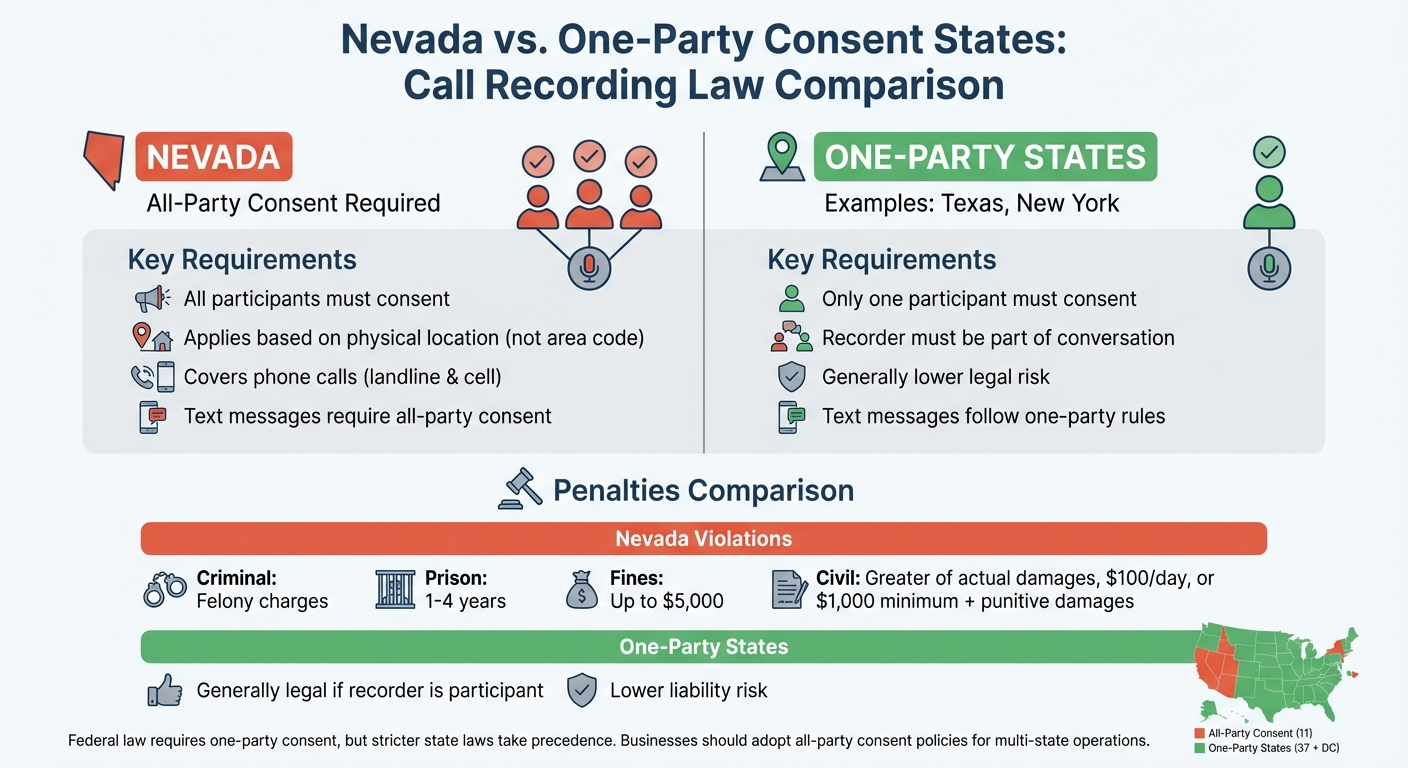
Nevada vs One-Party Consent States: Call Recording Laws Comparison
Nevada follows an all-party consent rule when it comes to recording phone calls. According to NRS 200.620, everyone participating in a call must be informed and agree to the recording. This rule applies to both landlines and cellphones, as clarified by the Nevada Supreme Court in the 2015 case Sharpe v. Nevada.
One unique aspect of Nevada's law is that it focuses on the physical location of the person being recorded, not the area code of their phone number. If someone is physically in Nevada during the call, the all-party consent rule applies - even if their phone number is from another state.
To comply, businesses often use automated messages like, “This call may be recorded for quality and training purposes.” If the caller continues the conversation after hearing this, it’s considered implied consent. However, businesses must also provide an option for callers to object.
The consequences of violating this law are steep. Recording a call without proper consent is classified as a felony and can lead to prison sentences ranging from 1 to 4 years, along with fines of up to $5,000. Civil penalties are also severe: victims can claim the greater of actual damages, $100 per day of violation, or a minimum of $1,000, plus punitive damages and attorney’s fees.
Nevada's strict requirements stand out when compared to the recording laws in other states. While 37 states and Washington, D.C. operate under one-party consent rules - where only one participant needs to be aware of the recording - Nevada is one of just 11 states requiring all-party consent as of 2025.
| Feature | Nevada (All-Party Consent) | One-Party States (e.g., Texas, New York) |
|---|---|---|
| Calls | All participants must consent | Only one participant must consent |
| In-Person Conversations | One-party consent (NRS 200.650) | One-party consent |
| Legal Risk | Felony charges; high civil liability | Generally legal if recorder is a participant |
| Text Messages | Requires all-party consent | Often follows one-party telephone rules |
This creates challenges for businesses that operate in multiple states. Under federal law, the Electronic Communications Privacy Act only requires one-party consent. However, state laws take precedence if they are stricter. For example, if you’re recording a call with someone in Nevada, you must follow Nevada’s all-party consent rule - even if the call originates from a one-party state like Texas.
To avoid legal pitfalls, businesses should consider adopting an all-party consent policy across the board. By obtaining consent for every call, regardless of location, companies can minimize the risk of violating state-specific laws. This proactive approach helps protect against criminal charges and costly civil penalties.
AI receptionists play a key role in meeting Nevada’s strict call recording laws by automatically delivering the required disclosures. For example, at the start of every call, the system might say: "This call is being recorded for quality and training purposes, and you'll be speaking with our AI assistant". This automated approach ensures that no calls slip through the cracks, even during hectic times.
The system is smart enough to detect Nevada area codes and automatically activate the all-party consent script. In states with one-party consent laws, a simpler disclosure is used. As Kixie explains:
If they keep talking, you've got the consent you need.
AI receptionists don’t just handle consent - they also simplify compliance with built-in recording and documentation tools. For instance, My AI Front Desk automatically records and transcribes every interaction, keeping proof that the required disclosure was delivered. At just $45 per month, businesses gain access to a centralized admin dashboard where they can review call transcripts, text logs, and voicemails all in one place.
The system also allows businesses to customize their greeting phrases, making it easy to update disclosures as laws change. Plus, the integrated knowledge base can be programmed to explain recording policies to callers. For businesses that handle 800 to 1,000 calls monthly - a common volume for busy operations - this level of automation is crucial for reducing compliance risks.
When legal audits come into play, having detailed records is non-negotiable. My AI Front Desk’s analytics dashboard provides a clear view of call patterns and securely stores verifiable records of every interaction. Post-call notifications and shareable links streamline the process of alerting relevant parties and distributing recordings when needed.
The dashboard also allows businesses to export caller information and interaction data, making audit preparation straightforward. Transcription tools convert audio into searchable text, making it easy to locate specific calls or confirm that proper disclosures were made. These detailed records are essential for demonstrating compliance with Nevada’s all-party consent law, NRS 200.620, especially if a legal challenge arises.
| Feature | Compliance Benefit |
|---|---|
| Custom Greeting | Ensures callers are notified of recording at the start of the call, as required by Nevada law |
| Call Transcripts | Creates a clear record of consent and caller participation |
| Admin Dashboard | Centralizes all compliance-related data for audits and reviews |
| Area Code Detection | Adjusts scripts automatically based on the caller’s location |
| Exportable Data | Enables easy downloading of records for legal audits |
These tools not only help businesses stay compliant but also set the groundwork for more efficient audit processes, which will be explored further in the next section.
From day one, it's crucial to educate your team about Nevada's all-party consent law. Every person on a call must agree to being recorded, and failing to comply is considered a felony offense. Equip your AI receptionist to deliver a clear, upfront disclosure, such as: "This call may be recorded for quality and training purposes, and you'll be speaking with our AI assistant. Do you consent to continue?". For calls that are transferred to human staff, make sure employees confirm whether consent was already obtained by the AI or, if necessary, request it again if the recording continues.
To accommodate callers who prefer not to interact with AI, configure your system to trigger an immediate transfer to a human representative. Additionally, set up your systems to identify Nevada-based callers and provide them with customized consent scripts. Once consent is secured, ensure all call data is handled with care and stored securely.
After confirming consent, the next step is safeguarding call data. Recordings often contain sensitive information, so limit access to authorized personnel only. Use a centralized dashboard with role-based access controls to manage recordings and transcripts, and establish strict data retention policies. This setup minimizes the risk of unauthorized access and ensures a clear audit trail. Holding onto recordings longer than necessary not only increases storage costs but also heightens legal risks.
Even with automated disclosures and audit trails in place, regular reviews are essential to ensure everything runs smoothly. Update your AI system and review its configurations monthly. Conduct audits of recordings and scripts to verify that consent practices and technical systems remain in compliance. Laws can change rapidly, so keeping your AI system aligned with the latest regulations is critical.
"Compliance isn't just about following rules - it's about proving you followed them. Maintain comprehensive documentation of all compliance efforts." – Hostie
Keep detailed records of all system updates, disclosure scripts, and employee training sessions. These documents can be a lifeline in the event of legal challenges or audits. If your business operates in multiple states, work closely with legal counsel to navigate the differences between one-party and all-party consent laws.
Understanding Nevada's all-party consent laws doesn't have to overwhelm your business. AI receptionists simplify compliance by automatically delivering required disclosures at the start of every call. This ensures all participants are informed they’re being recorded and speaking to an AI assistant, removing the risk of human error.
For even greater ease, My AI Front Desk offers a solution at just $45 per month. Its admin dashboard not only centralizes call transcripts but also provides a clear audit trail to confirm consent was obtained and proper procedures were followed. With features like area code detection, the platform can automatically apply Nevada-specific disclosures, ensuring alignment with local laws.
The consequences of non-compliance are severe - illegally recording a call can lead to felony charges, prison time, and fines of up to $5,000. Automated consent notifications and secure documentation help safeguard your business from these risks .
Beyond staying within the law, using an AI receptionist to consistently manage disclosures and securely store call data - complete with 24/7 monitoring - shows a commitment to professionalism and respect for privacy. Whether during business hours or after, this automated system ensures every call meets the same high standards, reinforcing trust and legal integrity for your business.
AI receptionists make sure businesses follow Nevada's all-party consent law by starting each call with a clear, audible message. This message informs everyone on the line that the conversation will be recorded. On top of that, they require the caller to give verbal agreement before continuing the call. This automated step ensures legal compliance while fostering openness and trust between businesses and their callers.
Failing to follow Nevada’s call recording laws can have serious repercussions. The state requires all parties to consent before a phone conversation is recorded. If this rule is broken, it’s classified as a felony, which could lead to prison sentences ranging from 9 months to 2 years. In less severe situations, misdemeanor charges might apply.
But the consequences don’t stop there. Businesses that record calls without proper consent could face civil lawsuits. Courts may award compensation, cover attorney’s fees, and even impose punitive damages. On top of that, unauthorized recordings could lead to regulatory actions or consumer protection claims, piling on more financial strain and potential damage to a company’s reputation.
To steer clear of these risks, businesses should always be upfront about call recordings and ensure they secure consent from everyone involved.
AI receptionists don’t automatically tweak call scripts based on where a caller is located. However, they can be programmed to use specific workflows or predefined scripts that consider regional rules or preferences, as long as this information is built into the system.
For instance, businesses can set up AI systems to align with local call recording laws or customize responses for callers in certain regions. This ensures legal requirements are met while also delivering a more personalized interaction.
Start your free trial for My AI Front Desk today, it takes minutes to setup!


