
AI call routing transforms how businesses handle customer calls. By analyzing caller intent, history, and real-time agent availability, it ensures calls are directed to the right person or system instantly. Compared to outdated menu-based systems, AI reduces wait times by up to 60%, boosts customer satisfaction by 25%, and increases agent productivity by 13.8%. It even handles 60%-80% of repetitive tasks like password resets, freeing agents for complex issues.
Key Features:
Businesses can implement strategies like round-robin, skill-based, and least-busy routing to balance workloads and improve efficiency. Integration with tools like CRMs ensures seamless workflows. Metrics like wait times, first-call resolution, and transfer rates help refine performance over time.
AI call routing isn’t just about efficiency - it’s about delivering faster, smarter, and more personalized customer service while empowering teams to focus on what matters most.
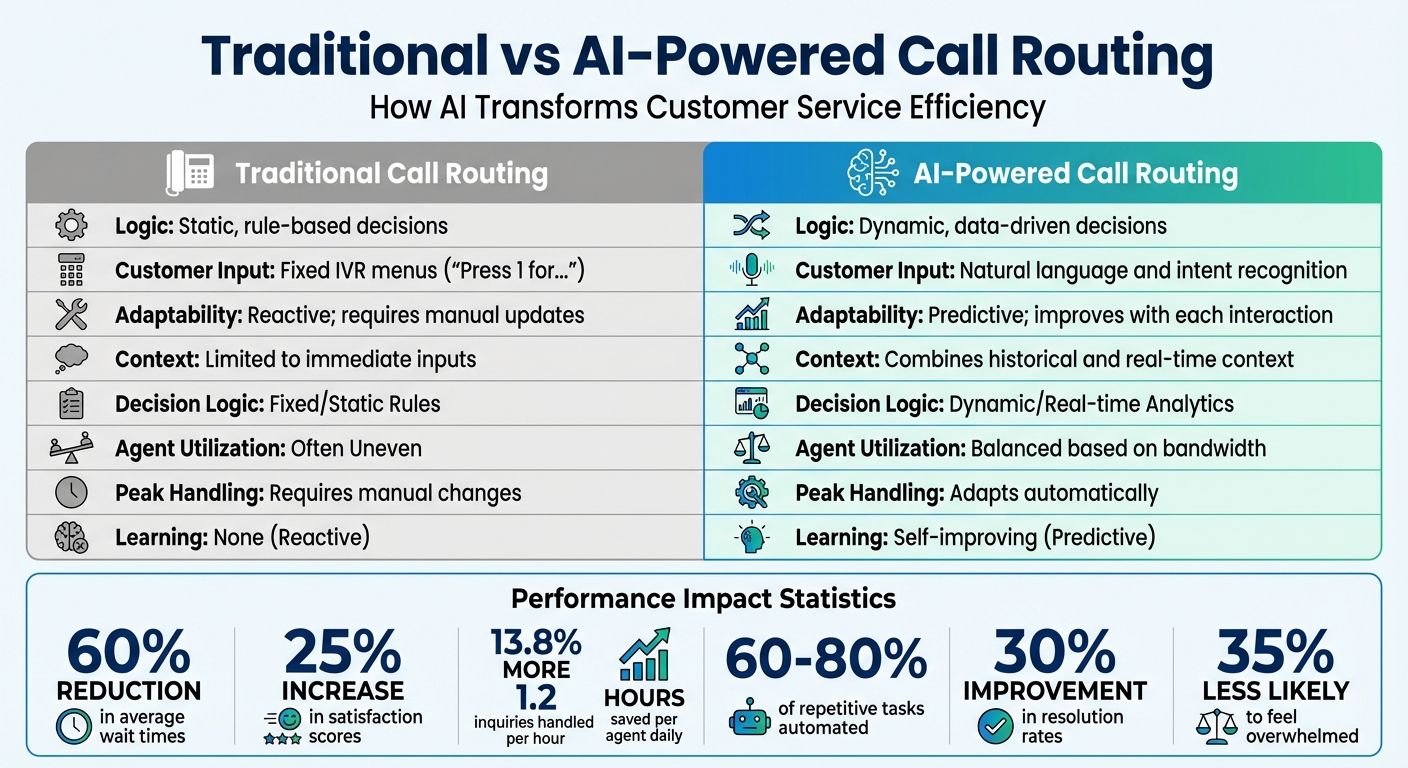
Traditional vs AI-Powered Call Routing: Key Differences and Performance Metrics
AI call routing uses advanced technology to analyze caller speech, account details, and past interactions, enabling quick, data-backed decisions about where to direct calls. By leveraging Natural Language Understanding (NLU), the system can determine the caller’s intent - whether they’re looking for billing assistance, technical support, or an update on an order - and even gauge their emotional state, such as frustration or satisfaction.
It doesn’t stop there. By combining real-time CRM data - like purchase history and previous interactions - with up-to-the-minute agent metrics, the system ensures each call is routed to the most suitable and available agent. This eliminates the frustrating delays often caused by static menu systems.
A dynamic decision engine replaces outdated static rules. Machine learning algorithms assess each call in real time, factoring in agent availability, skill sets, past performance, and current queue conditions. The system also identifies whether a request can be handled through automation (like resetting a password or tracking an order) or if it needs a human touch. In the latter case, the system ensures a smooth transfer, passing along all relevant context. These capabilities rely on three key components:
Three essential elements drive AI call routing:
However, achieving accurate AI routing depends heavily on unified data. Only 13% of companies have managed to create full data continuity across all customer touchpoints - phone, web, apps, and social media. Without this integration, the system’s predictions and decisions can fall short.
Machine learning takes call routing from merely reactive to highly predictive. It learns from every interaction, whether it results in a successful resolution or a less-than-ideal outcome. Over time, the system identifies patterns, such as which agents perform best in specific scenarios, which queries are suitable for automation, and when immediate escalation is required. This ongoing learning process continuously refines call matching and enhances overall service quality.
The results speak for themselves: support teams using AI handle 13.8% more inquiries per hour and save roughly 1.2 hours of productive time per agent each day. Beyond improving efficiency, the system also predicts future call volumes and staffing needs, helping you prepare for peak times. With 60% to 80% of incoming queries being repetitive, AI routing allows your team to focus on more complex and meaningful customer interactions.
| Feature | Traditional Call Routing | AI-Powered Call Routing |
|---|---|---|
| Logic | Static, rule-based decisions | Dynamic, data-driven decisions |
| Customer Input | Fixed IVR menus (e.g., "Press 1") | Natural language and intent recognition |
| Adaptability | Reactive; requires manual updates | Predictive; improves with each interaction |
| Context | Limited to immediate inputs | Combines historical and real-time context |
AI-powered systems employ various techniques to distribute calls across your team efficiently. Choosing the right strategy depends on factors like your team's structure, the complexity of customer inquiries, and patterns during peak call times. Below are some common approaches that demonstrate how AI can effectively manage call loads to enhance agent performance.
Round-robin routing assigns calls in a sequential order, but modern AI systems take it a step further by checking agents' real-time availability. This ensures that busy or unavailable agents are skipped without breaking the sequence.
This method is ideal for teams where agents have similar skill sets and handle straightforward inquiries, such as general customer service or basic tech support. It prevents agents from "cherry-picking" easier calls and ensures an even distribution of workload. For example, in 2025, Wyze Labs saw a 98% improvement in first-call resolution using this approach.
"AI call routing ensures that calls are evenly distributed among agents, preventing overburdening any single team member and reducing burnout." - Synthflow AI
For optimal results, round-robin logic should be applied within specific skill groups rather than across the entire team. For instance, billing-related calls can be routed to the next available agent in the billing group. This combines the fairness of sequential distribution with the precision of skill-based routing, reducing wait times and boosting overall efficiency.
Skill-based routing connects callers to agents with the expertise needed to address their specific issues. By analyzing the caller's intent - whether it's technical support, billing, or product guidance - the system ensures that customers are directed to the right person from the start. This minimizes transfers and follow-ups, significantly improving the customer experience.
The results speak for themselves: intelligent routing systems have been shown to increase first-contact resolution by 30%. In 2025, Medbelle, a healthcare provider, implemented conversational AI and skill-based routing to manage patient inquiries, achieving a 60% boost in scheduling efficiency.
"Intelligent call routing revolutionizes first contact resolution by ditching the one-size-fits-all approach." - Candace Marshall, Vice President, Product Marketing, AI and Automation, Zendesk
Modern systems go beyond basic skill matching. They evaluate agents on proficiency levels (e.g., a score from 1 to 100) and can route calls to an agent with an 80% match if they’re available, rather than making a customer wait for a 100% match who’s currently busy. To avoid long wait times for specialized agents, escalation rules can reroute calls to a capable generalist if a specialist isn’t available within 30-60 seconds. This balance ensures quicker resolutions without compromising service quality.
Least-busy routing is another effective strategy, directing calls to agents with the most bandwidth at any given moment. This approach is particularly useful during high-demand periods like Black Friday or product launches, preventing some agents from being overwhelmed while others remain underutilized.
This system automatically adapts to sudden spikes in call volume, eliminating the need for manual adjustments. Studies show that organizations using AI are 35% less likely to have agents report feeling overwhelmed, and AI-driven routing can save support teams an average of 1.2 hours of productivity per agent each day.
For this method to work seamlessly, agents must update their real-time status when handling tasks or taking breaks. Integrating the routing system with your CRM and Workforce Management platform gives the AI a complete view of agent availability. To avoid overloading the least-busy agents during extreme call spikes, you can set automated guardrails, like triggering callbacks or escalating to supervisors if wait times exceed critical thresholds.
| Feature | Traditional Routing | AI Least-Busy Routing |
|---|---|---|
| Decision Logic | Fixed/Static Rules | Dynamic/Real-time Analytics |
| Agent Utilization | Often Uneven | Balanced based on bandwidth |
| Peak Handling | Requires manual changes | Adapts automatically |
| Learning | None (Reactive) | Self-improving (Predictive) |
Each of these strategies offers unique advantages, and the choice depends on your team's needs and the complexity of customer interactions. By leveraging AI's adaptability, businesses can streamline operations, improve customer satisfaction, and ensure agents are both productive and supported.
Getting AI call routing up and running doesn’t have to be complicated. For small businesses, the key is starting with clear routing rules and gradually adding features that align with your needs. A well-configured system can operate around the clock, ensuring no customer inquiry goes unanswered.
Start by defining routes for common inquiries, such as billing, appointments, support, or product questions.
With My AI Front Desk, you can set up these routing rules through an intuitive admin dashboard - no coding required. The system’s natural language understanding allows customers to speak naturally, eliminating the need for rigid menu options like "Press 1 for Sales."
One standout feature is Max Receptionist Minutes, which lets you control AI activity by setting daily, weekly, or monthly limits. This helps manage costs while keeping the system available during peak times. If your limit is reached, you can configure overflow actions such as routing calls to voicemail or forwarding them to a human agent. This is crucial, as studies show that 85% of unanswered calls to small businesses are never returned by customers.
For skill-based routing, you can assign calls based on your team’s strengths. For example, if Sarah excels at handling technical issues, the AI can direct complex troubleshooting calls to her while managing simpler inquiries on its own. Research indicates that intelligent routing can boost first-contact resolution rates by 30%, leading to fewer follow-ups and happier customers.
Once your routing rules are in place, advanced features can take your system’s efficiency to the next level.
After establishing your basic rules, advanced features can help you handle higher call volumes and improve customer service.
Unlimited Parallel Calls allows the system to handle multiple calls at once, eliminating busy signals. Whether it’s Black Friday or another busy season, this feature automatically scales to meet demand, saving you from hiring temporary staff.
"Our AI receptionist handles multiple calls simultaneously." - My AI Front Desk
AI-Powered Voicemail is another game-changer. It recognizes when voicemail is the best option, transcribes messages into text, and sends real-time notifications to your team. This ensures urgent matters are addressed promptly without requiring someone to monitor the phone constantly. You can even configure alerts to send transcriptions directly to email or Slack.
Automated Texting Workflows further enhance efficiency by sending follow-up texts based on the content of the call. For instance, the AI can share confirmation numbers, appointment details, or resource links without disrupting the conversation. This eliminates the need for manual follow-ups and provides customers with immediate, actionable information.
To prevent overloading specific team members, set occupancy thresholds (around 75-80%). When an agent reaches this limit, the system routes calls to the next best match. Businesses using AI call routing report that their agents are 35% less likely to feel overwhelmed by high call volumes.
Once these features are in place, the next step is integrating them with your existing systems for seamless workflows.
Integration is where AI call routing truly stands out. My AI Front Desk connects with over 9,000 apps via Zapier, enabling smooth data flow between your phone system and tools like Salesforce, HubSpot, Google Calendar, or Slack.
The setup is simple: link your My AI Front Desk account to Zapier, choose the business tool you want to connect, define triggers (e.g., "Call Ended" or "New Voicemail Received"), map the data fields (like caller name, intent, or transcript), and test the connection.
This two-way data flow allows the AI to pull and use customer information during calls for a more personalized experience. For example, if a VIP customer calls, the system can instantly recognize them and reference their purchase history or previous interactions. Once the call ends, it automatically updates customer profiles or creates new leads - no manual data entry required.
"AI-driven routing and classification save teams 1.2 hours of productivity per agent, per day. That's not some marginal difference. That’s in fact a full shift regained per week." - Harshitha Raja, Verloop.io
You can also set triggers for specific call outcomes. For instance, when a voicemail is left, the system can send an automatic follow-up text. When a call concludes, it might create a calendar invite or add a task to your project management system. This level of automation ensures no detail is overlooked, even when your team is juggling multiple priorities.
For real-time accuracy in routing decisions, such as checking order status or customer tier, set up live data syncs instead of batch updates. This keeps the AI informed with up-to-the-minute information, ensuring calls are always directed to the best possible destination.
Measuring performance is the backbone of refining your call routing system. Keeping an eye on the right metrics ensures your routing decisions benefit both your customers and your team.
Start by focusing on Average Wait Time (AWT) and First-Call Resolution (FCR). These metrics are critical for gauging routing efficiency. For instance, AI-driven call routing has been shown to cut wait times by 60% and boost customer satisfaction by 25% compared to manual transfers. If you notice spikes in wait times, it might be time to revisit your staffing levels or routing rules.
Another important metric is agent occupancy. If certain agents are consistently handling more calls than others, it could signal that your routing rules need fine-tuning to ensure a more even workload.
Pay attention to misrouted call frequency and transfer rates, too. Intelligent conversational routing can slash misrouted calls by up to 95%. High transfer rates often point to issues with recognizing customer intent. Tools like the My AI Front Desk Analytics Dashboard can track these patterns in real time, helping you pinpoint where routing is falling short and which call types are causing the most transfers.
Finally, consider the Customer Effort Score (CES), which measures how easy it is for customers to get the help they need. This is crucial because nearly 98% of customers try to bypass traditional IVR systems, seeking faster and more accurate routing. By monitoring CES alongside Customer Satisfaction (CSAT) scores, you can assess whether your routing adjustments are improving the overall experience.
These metrics will give you a clear picture of your system's performance and help you measure the impact of any changes you make.
Before rolling out any changes, establish baseline metrics for key indicators like wait times, FCR, and call abandonment rates. For example, a major insurance company saw a 30% drop in call handling time after adopting AI routing. This improvement only became evident by comparing data from before and after implementation.
Regularly compare pre- and post-implementation data to evaluate the effectiveness of your changes. For instance, if you adjust routing rules to prioritize high-value customers, check if their wait times improve without negatively affecting other callers. Enhancing routing accuracy often boosts both FCR and agent satisfaction.
"AI-driven routing and classification save teams 1.2 hours of productivity per agent, per day. That's not some marginal difference. That's in fact a full shift regained per week."
– Harshitha Raja, Verloop.io
Leverage analytics to identify peak call times and adjust your AI capacity accordingly. If you notice a surge in calls during specific hours, allocate more AI resources during those periods. Reviewing call recordings and transcriptions can also provide valuable insights into where your routing system is excelling - and where it’s falling short.
AI call routing eliminates the limitations of traditional systems by enabling unlimited concurrent calls and providing round-the-clock availability. This ensures businesses can handle peak periods without missing opportunities. Companies adopting AI routing report a 60% decrease in wait times and a 25% increase in customer satisfaction.
Beyond improving customer experience, AI routing significantly enhances team productivity. Support agents using AI tools can manage 13.8% more inquiries per hour, and AI-driven classification saves each agent 1.2 hours daily. This allows human agents to focus on more complex and meaningful conversations, rather than addressing repetitive questions like operating hours or appointment scheduling.
The benefits don't stop there. Tools like My AI Front Desk make AI solutions easy to adopt, offering features like CRM and Zapier integrations (compatible with over 9,000 apps), shareable call links for training, and cost controls through receptionist minute limits. The system also ensures seamless customer interactions by handling FAQs, managing schedules, and preserving call context - an essential feature, as 56% of customers cite frustration with having to repeat themselves.
Getting started with AI call routing is straightforward. You can automate common inquiries first and expand gradually, using analytics dashboards to refine your routing rules. This approach offers a scalable solution that grows alongside your business, helping you capture more leads and provide better service without significantly increasing costs.
AI call routing isn’t just about efficiency - it’s a strategic investment in growth. By adopting this technology, you can improve customer satisfaction, enhance team productivity, and prioritize high-value interactions, all while scaling effortlessly.
AI call routing transforms how customers interact with support teams by quickly connecting them to the right person or resource. Instead of enduring long wait times, callers are matched to the appropriate support in seconds. By analyzing details like phone numbers, voice cues, and intent, these systems can cut wait times by up to 60% and boost satisfaction scores by around 25%. Unlike outdated menu-based systems, AI-driven solutions rely on natural language conversations, making the process smoother and more intuitive. Plus, with 24/7 availability and the capacity to manage unlimited simultaneous calls, customers receive immediate help without frustrating holds or dropped calls.
For support agents, AI routing takes care of repetitive tasks, freeing up their time to tackle more complex issues. This not only enhances productivity but also allows agents to handle more cases in less time. With access to personalized insights, like caller history, they can resolve problems faster, improving first-call resolution rates and minimizing the need for transfers. These advancements create a more efficient, hassle-free experience for both customers and support teams, all while helping to reduce operational expenses.
Machine learning powers the smart decision-making behind AI call routing by diving deep into data like caller ID, voice characteristics, past interactions, and the current availability of agents. By spotting patterns in caller intent, urgency, and agent expertise, it predicts the best path for every call - whether that’s directing it to an AI receptionist, a specific agent, or ensuring a smooth hand-off. What’s more, the system gets smarter over time, cutting down wait times and boosting first-call resolution rates.
On top of that, machine learning anticipates call-volume surges and evenly distributes workloads among agents. By dynamically pairing callers with the right agent - based on skills, past performance, and customer preferences - it ensures faster, more tailored support. This technology helps small businesses deliver outstanding service that feels personal and efficient.
Integrating AI call routing with your CRM doesn’t have to be complicated, and the benefits are worth it. AI systems can pull caller details - like phone numbers or account IDs - to instantly create profiles, update CRM records in real time, and log critical outcomes, such as call results or next steps. This means your team gets a complete interaction history, all without the hassle of manual data entry.
To make this even easier, many platforms offer post-call webhooks and API workflows. These tools automatically sync call logs, transcriptions, and customer details directly into your CRM. For added flexibility, tools like Zapier - which connects with over 9,000 apps - can handle tasks like creating new leads, updating contact statuses, or scheduling follow-ups. Built-in CRM integrations take it a step further by enabling personalized routing, such as ensuring high-value customers are directed to senior agents.
These integrations help businesses cut down on repetitive tasks, improve data accuracy, and deliver faster, more efficient customer service.
Start your free trial for My AI Front Desk today, it takes minutes to setup!


