
Affiliate marketing success depends heavily on choosing the right channels. Here's a quick breakdown:
Key Insight: Diversification is crucial. No single channel should account for more than 25% of your revenue. Combine email for nurturing, social media for engagement, and paid ads for quick conversions to maximize results.
Email affiliates can earn commissions ranging from 5% to 30%, but the real power lies in the ability to monetize the same subscriber multiple times. This is especially lucrative in high-ticket industries like SaaS and virtual office solutions. For instance, Alliance Virtual Offices offers affiliates up to $550 per sale, showcasing how email marketing can excel in promoting premium services.
These commission ranges provide a strong foundation for impressive performance metrics.
Email marketing consistently delivers outstanding results. With a 28.6% median conversion rate, email outperforms paid channels by nearly six times. Open rates for affiliate welcome sequences range from 30% to 50%, while standard newsletters typically see 20% to 35%. Click rates per send usually fall between 2% and 8%.
Take Michelle Schroeder Gardner from Making Sense of Cents as an example. By promoting ConvertKit to her newsletter subscribers, she earned over $10,000 in affiliate commissions in just one month. Her strategy? A detailed product review combined with a special offer tailored to her audience. Similarly, UK retailer MobileFun achieved a 49.15% open rate on their best-performing email variant by using A/B testing on subject lines and calls to action through GetResponse.
Email marketing's greatest strength is ownership. You control your list, meaning no sudden algorithm changes can jeopardize your reach. Plus, email boasts an impressive ROI of $36 to $40 for every $1 spent.
However, it’s not without challenges. Many popular email providers, like Mailchimp and HubSpot, restrict or ban affiliate-heavy content to protect their sender reputation. Deliverability depends heavily on maintaining clean lists - bounce rates should stay below 2%, and spam complaints need to be under 0.1%. Additionally, Apple’s Mail Privacy Protection has inflated open rate metrics, making clicks and conversions more reliable indicators of success.
To keep your emails landing in inboxes, focus on list hygiene. Regularly remove subscribers who haven’t engaged in six months to maintain your sender reputation and ensure strong deliverability. This proactive approach helps you stay ahead in a competitive email marketing landscape.
Social media thrives on visuals and engagement to drive affiliate success, with commission rates varying widely by industry. For instance, e-commerce products often offer affiliates between 10% and 15%, while SaaS platforms can go much higher, ranging from 20% to 70%. In finance, rates typically sit at 35% to 40%. High-ticket niches, like crypto-casinos, offer even more lucrative opportunities, with CPAs reaching $250 to $350, plus a share of net gaming revenue.
Visual products tend to dominate in this space. Take HeadshotPro, for example - it generates over $50,000 monthly, with affiliate marketing contributing 15% of its revenue by targeting content creators. Similarly, OpusClip, an AI tool for repurposing videos, pulled in more than $100,000 in total revenue within just a few months, thanks to a robust affiliate network. These examples highlight the earning potential tied to social media's visual appeal.
Social media delivers strong engagement, but its conversion rates tell a more nuanced story. Instagram Stories and Reels lead the pack, converting at 59.2% and 46.5%, respectively. TikTok livestreams also perform well, with conversion rates reaching up to 10%. However, the average conversion rate across all social platforms hovers at around 2.1%, significantly lower than email's 10.7%.
"Instagram Stories top the list as the highest-converting format (59.2%), followed closely by Reels (46.5%)."
- Danka Ha, Lead UX Researcher, Later
Micro-influencers, with follower counts between 50,000 and 100,000, significantly outperform larger accounts. Their average engagement rate is 3.86% - about three times higher than that of celebrity influencers. On TikTok, nano and micro-affiliates see engagement rates up to eight times higher than creators with over 500,000 followers. When it comes to affiliate links, the average click-through rate ranges from 0.7% to 1.2%.
Consider Constance App, a fitness platform that expanded its affiliate program from 20 to 60 partners - a 200% increase - between June and August 2024. By focusing on micro-influencers on Instagram and TikTok, the platform achieved monthly affiliate revenue exceeding $1,000.
Social media shines when it comes to showcasing products visually. Items that benefit from "before and after" transformations - like AI tools, fitness programs, or beauty products - often perform exceptionally well. The platforms also allow for rapid scaling, with some AI SaaS programs achieving 3- to 5x growth in just one quarter. Features like TikTok Shop and Instagram product tags streamline the buying process, with Instagram tags boosting add-to-cart actions by 17% compared to traditional swipe-up links.
On the flip side, social media operates as an interruption-based channel, meaning users aren't actively looking to make purchases. This dynamic results in a lower return on investment (ROI) for ads, with Meta and TikTok campaigns typically delivering a 1.5x to 4x ROI, compared to email marketing's 3x to 15x ROI. Affiliates also face challenges like algorithm changes, evolving platform policies, and privacy updates such as iOS 17, which impact attribution for 59% of brands.
"Creator-led ads crush sterile brand creative, especially in feeds where people scroll for people."
- ConvertMinded
Authenticity plays a crucial role in social media marketing. About 50% of creators only promote products that align with their personal brand. Content that integrates products naturally into a creator's lifestyle performs better, with 54.9% of users favoring this approach over direct product reviews, which sit at 38.7%. The key is blending products seamlessly into everyday content rather than relying on overt sales tactics.
Paid advertising serves as an effective complement to email and social media strategies, offering unique commission structures and performance dynamics.
Paid advertising often relies on CPA (Cost Per Acquisition) or hybrid models, which combine flat fees with a share of revenue to balance the high costs of driving traffic.
Some industries offer significantly higher payouts. For example, in the U.S. sports-betting market, CPAs reached $350 in early 2023. Similarly, crypto-casinos provide competitive rates, ranging from $250 to $350 per acquisition, along with a share of net gaming revenue. SaaS programs typically offer commissions between 20% and 70%, with leading AI tools averaging about 24.5%. Platforms like Semrush can pay up to $200 per subscription. On the other hand, sectors like e-commerce and finance tend to offer lower rates - 10% to 15% for retail products and 35% to 40% for financial services.
These varied commission structures play a significant role in shaping campaign outcomes, as we’ll explore next.
Google Search Ads deliver an ROI ranging from 1.8x to 5x, with campaigns usually breaking even within 7 to 30 days. Meta Ads (covering Facebook and Instagram) perform slightly below this, offering 1.5x to 4x ROI, but they tend to break even faster - typically within 7 to 21 days. TikTok Ads lead in conversion rates, achieving a median of 12.5% for e-commerce campaigns, compared to Google Paid Search’s average of 5.7%.
However, rising ad costs are tightening profit margins. Between 2018 and 2024, Facebook Ads CPM jumped from $5.12 to $10.45, while Google Shopping CPM increased by 45% during the same period. Despite these cost hikes, median Earnings Per Click (EPC) rose to $1.28 in 2025, up from $0.45 in 2018. This trend has prompted many brands to adopt pay-per-action models, which ensure costs are tied directly to conversions rather than impressions.
"Facing ATT signal loss, CMOs favour affiliate models that pay for conversions, not impressions." - Lucas Keller
Paid advertising offers both clear advantages and notable challenges based on its performance profile.
On the plus side, paid campaigns deliver fast, scalable results, making them ideal for testing offers quickly. Google Search Ads, in particular, excel at targeting high-intent keywords like "best [tool] for [problem]" or "[Product] vs [Competitor]", which often generate higher-quality conversions compared to broader social media campaigns. Additionally, ads featuring creators or user-generated content (UGC) tend to outperform traditional branded content, especially on social media platforms where authenticity resonates with users.
However, paid advertising has its downsides. Unlike SEO, traffic from paid ads vanishes as soon as the budget is exhausted. Privacy updates, such as those introduced in iOS 17, have made attribution more difficult for 59% of brands. Fraud is another concern, accounting for an estimated 5% to 15% of total affiliate spending. Compliance risks are also higher - platforms have tightened their rules around financial and health-related claims, increasing the likelihood of account suspensions for overly aggressive ad copy. Affiliates who adopt server-side tracking can recover 9% to 12% of "lost" sales, but implementing this solution requires a high level of technical expertise.
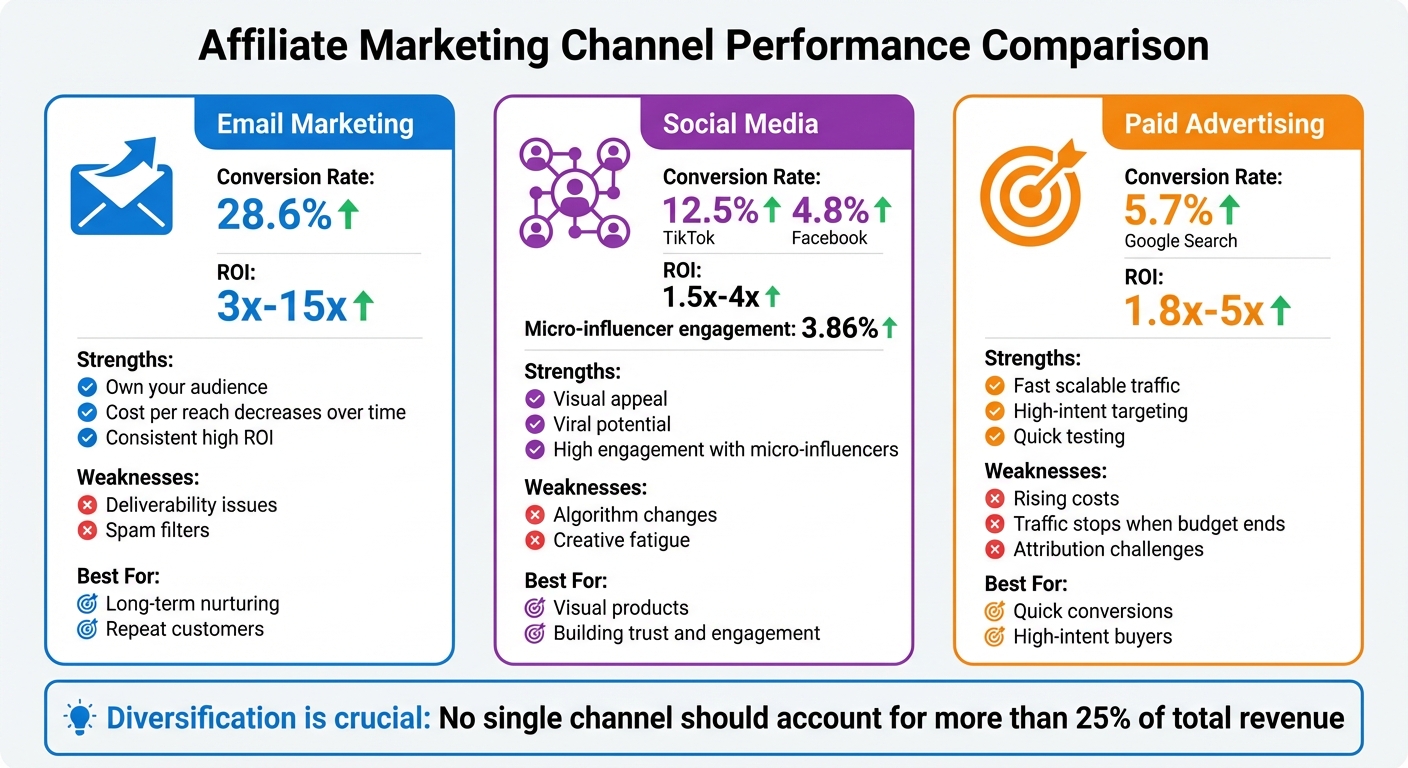
Affiliate Marketing Channel Performance Comparison: Email vs Social Media vs Paid Ads
Each marketing channel comes with its own set of strengths and challenges, influencing how affiliate revenue is generated and resources are allocated.
Email marketing stands out with a median conversion rate of 28.6% and delivers an impressive ROI of 3x–15x. One of its biggest advantages is that you own your audience, meaning your cost per reach decreases as your email list grows. It consistently delivers strong ROI and conversion rates, making it a top performer. On the flip side, issues like deliverability problems and spam filters can pose hurdles.
Social media thrives on visuals and engagement, with the added bonus of viral potential. Micro-influencers, for example, achieve engagement rates of 3.86% - three times higher than celebrity influencers. TikTok leads the pack in e-commerce, boasting a 12.5% median conversion rate, while Facebook maintains a solid 4.8%. ROI for social media typically falls between 1.5x and 4x. However, frequent algorithm changes can slash your reach, and creative fatigue can set in quickly, requiring constant updates to maintain effectiveness.
Paid advertising excels at driving quick, scalable traffic. Google Search Ads, for example, deliver an ROI of 1.8x–5x and a conversion rate of 5.7%. Paid ads are particularly effective at capturing high-intent buyers who are actively searching for solutions. The downside? Costs are steadily increasing, and traffic vanishes as soon as your ad budget runs dry.
To maximize affiliate performance, it’s essential to balance these channels and minimize their individual weaknesses. For example, My AI Front Desk uses a multi-channel approach to optimize lead conversions: email campaigns nurture prospects, social media builds trust, and paid ads target buyers who are ready to act. Diversification is crucial - no single channel should account for more than 25% of total revenue.
This comparison highlights the importance of leveraging multiple channels to achieve the best affiliate marketing results.
Email marketing continues to dominate as a top performer, boasting a median conversion rate of 28.6% and delivering an ROI anywhere from 3× to 15×. For SaaS businesses - or anyone looking to get the most out of their owned audience - email remains a powerhouse.
Each marketing channel - email, social media, and paid ads - brings its own strengths to the table. Email is perfect for building long-term relationships, social media shines with its visual appeal and viral potential, and paid ads are ideal for quickly reaching buyers who are ready to act. Together, they create a well-rounded strategy that balances engagement, scalability, and conversions.
Email stands out for its impressive ROI, social media excels at fostering trust and engagement, and paid ads deliver fast, scalable results. For AI tools like My AI Front Desk, using video demos to highlight real-world applications - like managing calls or scheduling appointments - can significantly boost engagement. This is especially important since AI SaaS platforms often contribute 15–25% of total monthly recurring revenue (MRR) for established companies.
The key to success lies in combining these channels effectively. Use email to nurture leads and encourage repeat customers, paid ads to capture high-intent buyers quickly, and social media to showcase visual proof and build credibility. Keep your messaging clear and simple - straightforward language has been shown to improve conversion rates.
For affiliates promoting My AI Front Desk, a smart strategy includes leveraging email for lead nurturing, creating video-rich social content to build trust, and running targeted paid campaigns for fast conversions. Content that highlights "before and after" results - like fewer missed appointments or improved after-hours call handling - can resonate strongly with potential users. Also, ensure your landing pages are mobile-friendly, as 50% of affiliate traffic now comes from mobile devices. Finally, aim for a balanced strategy - no single channel should account for more than 25% of your overall revenue.
Email marketing can be a game-changer for earning affiliate commissions, but it’s not without its obstacles. One of the biggest issues is low engagement rates - on average, open and click-through rates hover below 30%. This means a large chunk of emails never even make it to the eyes of potential customers. Add crowded inboxes and spam filters to the mix, and getting noticed becomes even harder.
Another hurdle is compliance and deliverability. Affiliates need to stay on top of things like cleaning up email lists, honoring unsubscribe requests, and following regulations like CAN-SPAM. Ignoring these can hurt your domain’s reputation and lead to high bounce rates. Plus, relying too heavily on email can cause audience fatigue - people get tired of seeing the same promotional content, especially when their inboxes are already overflowing with offers.
Lastly, tracking and attribution can be a headache. Problems like URL rewriting or broken redirects can mess up your reporting, leaving commissions unaccounted for - a frustrating situation for any affiliate. To tackle these challenges, strategies like segmentation, automation, and diversifying across multiple channels can help make your email campaigns more effective and impactful.
Social media algorithm updates play a big role in shaping the success of affiliate marketing. When platforms tweak how they prioritize and display content, it can directly affect the visibility of affiliate posts. This, in turn, impacts reach, engagement, and even conversions.
Take, for example, a platform that starts prioritizing video content or posts from personal connections over business pages. If your affiliate content aligns with these changes, you could see a surge in traffic. On the flip side, a misalignment might lead to a drop in visibility. The trick is to keep a close eye on performance metrics and adjust your strategy as needed to stay ahead of the game.
Using multiple channels in affiliate marketing is essential because it allows you to spread your efforts across various platforms, minimizing the risk of relying too heavily on one source. Whether it's email campaigns, social media, or paid advertising, each channel comes with its own audience behaviors and challenges - like algorithm updates or budget limitations. By diversifying, you create a safety net that helps protect your overall performance from sudden disruptions in any single channel.
This approach also opens the door to reaching new audiences and boosting conversions. Tapping into less-explored platforms can reveal fresh opportunities and enhance your return on investment (ROI). In a constantly shifting digital landscape, a multi-channel strategy keeps your affiliate program flexible and prepared to adapt.
Start your free trial for My AI Front Desk today, it takes minutes to setup!


